
Affiliate disclosure: As an Amazon Associate, TalkAboutCoffee earns from qualifying purchases. Our picks are based on editorial judgment, not commission rates.
Quick instructions (the short version)
- Coffee: 1 heaping tablespoon of coarse-ground coffee per cup of water (about 240 ml / 8 oz). Up to 2 tablespoons per cup if you like it strong.
- Grind: coarse, like sea salt or coarse breadcrumbs. Anything finer turns muddy and bitter.
- Brew time: 4 to 8 minutes once it starts perking. Start checking at 4. Stop sooner if it looks dark enough through the glass bubble.
- Heat: drop it to low the moment percolation begins. A rolling boil is not what you want.
- Most important step: remove the entire filter stem (not just the basket) the second brewing is done. This is where most percolator coffee goes wrong.
Electric or stovetop, the ratios and grind are the same. The full method is below.
Let’s start with something that might make coffee snobs cringe. Nearly any coffee expert will tell you that a percolator is about the worst possible way to make coffee. Because the water is heated to a boil in order to perk, it’s really too hot for the coffee. It gets over extracted, and you end up with the bitterness and acidity that made coffee a “grownups only” drink back in the day.
But here’s the thing the experts don’t want to admit – sometimes they’re wrong.
I used to be one of those people who turned their nose up at percolated coffee. Pour-over this, French press that, anything but that ancient contraption bubbling away on the stove. Then I spent a weekend at a friend’s cabin where the only coffee maker was his grandmother’s old stovetop percolator. I was prepared for the worst. Instead, I had some of the most satisfying coffee I’d had in months. Rich, full-bodied, and it just worked. Made me realize the problem isn’t the percolator – it’s how people use it.
That said, there are still people who prefer perked coffee to any other kind. Taste is, after all, a matter of taste. And let’s be honest – those enormous coffee urns are still the best way to make lots and lots of coffee for a crowd. Try making coffee for 40 people with your precious pour-over setup and see how that goes.
Why Percolators Get a Bad Rap (And Why It’s Not Always Fair)
The reputation problem comes from decades of people doing it wrong. Too fine a grind, too much heat, too long on the burner – and yeah, you’re going to get bitter, over-extracted swill. But that’s not the percolator’s fault any more than a burnt steak is the grill’s fault.
The science behind it is actually pretty straightforward. In a percolator, boiling water gets forced up through a hollow stem, sprays over the coffee grounds, then filters back down through the grounds and into the pot below. The cycle repeats until you turn off the heat. Done right, this creates a strong, full-bodied coffee. Done wrong, and you’re basically boiling your coffee grounds into submission.
Most people’s percolator horror stories come from leaving the thing on the stove too long, using coffee ground fine enough for espresso, or both. It’s like judging all grilled food based on hockey pucks someone left on the barbecue and forgot about.
The Parts You Need to Know
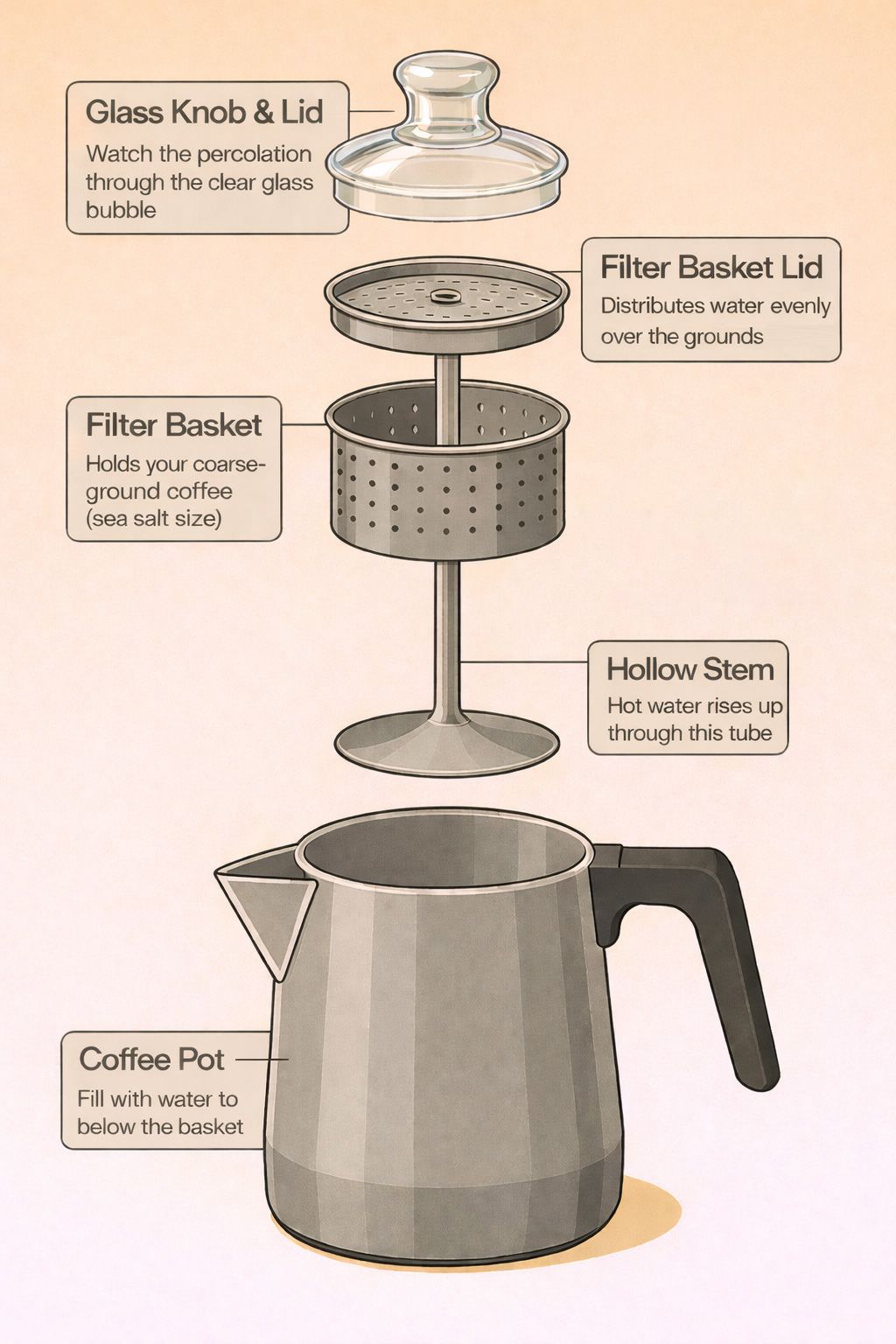
A coffee percolator has five main parts, and understanding each one helps you avoid the mistakes that give percolators their bad name.
There’s the percolator coffee pot itself, into which you put your water. There’s the stem, a hollow metal tube that fits into the bottom of the pot – in non-electric models, it has a flat round bottom that sits on the base. There’s the filter basket, which slides onto the tube and holds the ground coffee. There’s the filter basket cover, a round perforated lid that fits on top and makes sure the water showers the entire basket evenly. And finally, there’s the coffee pot lid, which often has a glass bubble in it.
That glass bubble just might be the most fun part of the entire contraption. It lets you watch the coffee splurting up from the tube and splashing inside before it spills back down onto the lid. Weirdly mesmerizing, like a little coffee fountain show happening right there on your stovetop.
Electric vs. Stovetop: Which Should You Choose?
Coffee percolators come in two distinct types – electric and stovetop. Each has its place, and honestly, both can make decent coffee despite their horrible reputation if you follow a few guidelines.
Electric percolators, including those coffee urns that can make up to forty cups at a time, are the set-it-and-forget-it option. They’re consistent, they shut off automatically, and they’re perfect for offices, church basements, and anywhere else you need to caffeinate a crowd without babysitting the process. The downside? You give up control over timing and temperature.
Stovetop percolators give you complete control, which is both a blessing and a curse. You can adjust the heat exactly how you want it, but you also have to pay attention or risk over-extraction. They’re great for camping since they don’t need electricity, and there’s something genuinely satisfying about the hands-on process. One of our readers pointed out they work differently at altitude too – at 5,300 feet, water boils at about 201 degrees, and percolators run roughly 10 degrees cooler than that, which actually makes the coffee come out better than at sea level. I thought that was fascinating.
What actually changes between the two (steps below stay the same otherwise)
- Heat: electric uses its own thermostat. Stovetop, you start at medium and drop to low the moment it perks.
- When it’s done: electric chimes or shifts indicator color. Stovetop, you watch the glass bubble and the clock.
- Pulling the basket: both still need the entire filter stem removed the second brewing finishes. Most electric models do not do this for you automatically.
- Capacity: stovetop models usually 4 to 12 cups. Electric urns scale up to 40 or 100 cups for events and offices.
For a deeper comparison and buying advice, see Electric vs Stovetop Percolators: Which Should You Buy?
How to Make Perfect Percolator Coffee
Here’s how to make percolator coffee that won’t make you question your life choices:
- Keep all parts of the percolator clean. This isn’t optional. Wash the entire thing with dishwashing liquid and hot water every single time you use it. Coffee oils go rancid faster than you’d think, and old residue will ruin even good coffee. Use a pipe cleaner for the inside of the stem. I learned this the hard way after wondering why my coffee tasted like the bottom of a week-old pot.
- Use freshly ground coffee – and make sure it’s coarse. This is where most people mess up. That pre-ground coffee from the grocery store? It’s ground for drip coffee makers and it’s too fine for percolators. You want a coarse grind, more like sea salt or coarse breadcrumbs. If you don’t have a grinder, look for coffee labeled as coarse grind, or ask your local coffee shop to grind it coarse for you. On a camping trip with no electricity? Carry your ground coffee in a vacuum container with a lid to keep the air out.
- Get your water level right. Disassemble the percolator and put the stem in place. Fill with water to below the line where the filter basket sits. Too much water and you’ll get weak coffee. Too little and it won’t perk properly.
- Don’t be stingy with the coffee. Put the filter basket on and add one heaping tablespoon of coffee for each cup of water. Some people go up to two tablespoons if they like it strong, but start with one and adjust from there. Put the basket lid in place.
- Start the heat. If you’re using an electric percolator, plug it in and turn it on – it’s on its own now. If you’re using a stovetop, put it over medium heat. Not high, not low – right in the middle.
- Watch for the magic moment. As soon as the first splurt of coffee hits that glass bubble, turn the heat down to low. This is crucial. You want just enough heat to keep percolation going, but not so much that you’re boiling your coffee. You’ll hear it change from rapid bubbling to a gentler, slower rhythm.
- Time it right. For most people, 4-8 minutes of perking is the sweet spot. Start checking at 4 minutes – the coffee coming up through the bubble should look like actual coffee, not weak tea. Don’t overthink it.
- Stop the process immediately. As soon as the pot stops perking or you decide it’s strong enough, pull it off the heat.
- Remove the filter stem – this is the step everyone skips. Carefully take off the lid and pull out the entire filter stem assembly, not just the basket. If you leave it in, steam from the coffee keeps condensing, dripping through the spent grounds, and making your coffee progressively more bitter. This is how perfectly good percolated coffee turns into undrinkable swill in about ten minutes.
- Let it rest, then enjoy. Give it about 30 seconds so any grounds that escaped can settle, then pour yourself a cup. You might be surprised by how good it actually is.
When Percolators Actually Shine
Despite what the coffee cognoscenti will tell you, there are situations where percolators are not just acceptable but actually the best choice.
Camping and outdoor adventures. Try bringing your French press on a camping trip and see how long it lasts. Percolators are practically indestructible, work on any heat source, and make coffee strong enough to get you moving after sleeping on the ground.
Large groups and events. Need coffee for 20, 30, or 50 people? A large electric percolator urn beats making pot after pot with any other method. They keep coffee warm for hours without that burnt taste you get from drip makers with hot plates.
The ritual of it. Sometimes the process matters as much as the product. There’s something deeply satisfying about the sound of a percolator bubbling away, the anticipation as you watch that glass bubble, the ritual of removing the basket at just the right moment. It connects you to decades of coffee drinkers who found comfort in exactly the same process.
Troubleshooting Common Percolator Problems
My coffee tastes bitter and terrible. Nine times out of ten, you’re using too fine a grind, perking too long, or both. Try a coarser grind and shorter brewing time. And make sure you’re removing that filter basket immediately when done.
My coffee is weak and watery. Not enough grounds, or the grind is too coarse and water’s flowing through too quickly. Try adding more coffee first, then adjust grind size if needed.
My percolator won’t start perking. Check that the stem is seated properly and the water level is right. It can take 5-10 minutes to get going, especially with electric models. Be patient.
The coffee is muddy and full of grounds. Your grind is definitely too fine. You want pieces about the size of coarse sea salt, not coffee dust.
Best Coffee Beans and Grinds for Percolators
Not all coffee works equally well in a percolator. Medium to dark roasts are your best bet because they’re less acidic and more forgiving of the longer extraction time. Brazilian, Sumatran, and other low-altitude coffees tend to be naturally lower in acid, which plays nicely with percolation.
French roast and Italian roast are particularly good choices. The roasting process has already broken down some of the compounds that turn bitter with extended brewing, and the bold flavors hold up well against the strong extraction.
For grind size – think coarse, then go a little coarser. If you’re grinding your own, a burr grinder set coarse gives you something that looks like coarse breadcrumbs or sea salt. Too fine and you get muddy, over-extracted coffee. Too coarse and the water flows through without pulling enough flavor.
The Bottom Line
I’m not going to pretend that percolated coffee is better than a well-executed pour-over or a properly pulled espresso shot. But it’s also not the coffee catastrophe that the experts make it out to be. Made properly – right grind, proper timing, remove the basket – percolator coffee is rich, full-bodied, and satisfying in ways my pour-over never quite manages.
The real problem isn’t the percolator. It’s people who don’t know how to use one. Master the technique, use good coffee ground to the right size, pay attention to timing, and you might find yourself reaching for the percolator more often than you’d ever admit in polite coffee company.
After all, our grandparents drank percolated coffee for decades. They weren’t wrong about everything.
Frequently Asked Questions About Percolator Coffee
Not if you do it right. The bad reputation comes from over-extraction – too fine a grind, perking too long, or forgetting to remove the filter basket after brewing. Follow proper technique and you might be genuinely surprised by how good it can be.
4-8 minutes depending on how strong you like it. Start checking at 4 minutes and taste-test. The coffee coming up through the glass bubble should look like actual coffee, not weak tea. Stop before it gets too dark or you’ll end up with bitter brew.
Coarse grind, like sea salt or coarse breadcrumbs. Fine grinds will give you muddy, bitter coffee that’s impossible to enjoy. If you’re buying pre-ground, look specifically for “coarse grind” or ask your coffee shop to grind it coarse for percolators.
Usually over-extraction from perking too long, grind that’s too fine, or water that’s too hot. Try shorter brew time, coarser grind, and lower heat once percolation starts. And make sure you’re removing the entire filter stem immediately when brewing is done – not just the basket.
Most store-bought ground coffee is too fine for percolators. It’s ground for drip coffee makers and will give you muddy, over-extracted results. Look for coffee specifically labeled as coarse grind, or better yet, grind your own beans.
Start with 1 heaping tablespoon per cup of water. If you like it stronger, go up to 2 tablespoons per cup – but don’t just brew longer to get more strength. That’s how you get bitterness. More grounds, not more time.
Yes, immediately. This is the step most people skip, and it makes all the difference. Remove the entire filter stem assembly, not just the basket. If you leave it in, steam keeps condensing and dripping through the spent grounds, turning your coffee bitter within minutes.
Electric is more convenient and consistent, plus it shuts off automatically. Stovetop gives you more control over heat and timing, and works great for camping. Both can make good coffee with proper technique. It really comes down to how hands-on you want to be.
Check that the stem is properly seated in the bottom of the pot and the water level is correct – it should be below where the filter basket sits. Be patient too. It can take 5-10 minutes for the water to heat up enough, especially with electric models.
Use fewer grounds rather than reducing brew time too much. If you cut brewing time too short, you’ll get weak, sour coffee instead. You can also dilute strong percolated coffee with hot water after brewing – think of it like making an Americano.
Wash all parts with hot soapy water after every use. Use a pipe cleaner or long thin brush for inside the stem – coffee oils build up in there and will make your next pot taste rancid. Once a month, run a cycle with white vinegar and water for a deep clean.
Let the water heat until it just starts to perk, then immediately drop the heat to low. You want hot enough to percolate but not a rolling boil. The percolation should be gentle and steady, not violent bubbling.
Use more coffee grounds rather than longer brew time. A darker roast also gives more intense flavor without extra bitterness. Some people swear by adding a tiny pinch of salt to cut bitter notes, though that’s definitely a personal preference thing.
Interestingly, many people with coffee-related heartburn actually find percolated coffee easier on their stomachs than drip. The longer brewing process and higher heat can break down some of the acids that cause problems. Dark roasted beans help even more with this.
Only on an electric coil or solid-hob stove. Those hold and spread heat unevenly, so a diffuser keeps the base from scorching the coffee closest to the metal. On a gas burner, skip it and set the pot directly over the flame. This is one of the most common questions in our comments, and it comes up because so many people inherit a percolator with no manual attached.
It is a genuine old-timer method, and there is real chemistry behind it. Crushed eggshell is calcium carbonate, which neutralizes some of the acid in the grounds and mellows the cup. Cleaned, dried, crushed shell gets mixed in with the grounds before brewing, and the filter or basket traps the sediment along with the coffee grounds. It works, but it is a lot of fuss for a marginal difference, and a coarser grind gets you most of the way there without cracking an egg.
Drop them in the comments below. With over 500 comments from fellow percolator users, our community has probably faced your exact issue before – and there’s always someone willing to share their hard-earned wisdom.
Discussion 582
Well syd, ya’ done it now. I happen to be of Middle Eastern descent and i remember a lot of coffee boiling for Turkish coffee. Maybe you just can’t handle the hard stuff. Besides espresso is made with steam shot thru grounds and i think steam is hotter than the boiling point of water.
Technivorm Moccamaster CDT
He said boiled…maybe he’s talking about cowboy coffee, with a sock in the pot. :-)
sydferret, what are you talking about? If you don’t like perked coffee, that’s fine. But those of us who read and post here DO like it. Perhaps you would be happy contributing to a blog about plastic drip coffee makers.
Michelle, Re your Corningware pot you might read my blog of Dec.30 about what I was advised by Corning/Pyrex. Inspection of your pot might show that it’s handle is bolted on rather than attached with just adhesive, as is the pot I obtained back then. Best to be cautious.
Linda, that “recracking grounds” is a great idea. I think most people with coffee too weak is because they buy weak grounds to start. I enjoy taste but not bitter like I used to drink on the docks in New Orleans. So, I experiment w/blending some dark with medium, etc., especially if find a sale. I now going to try recracking. Thanks!
It’s the 21st century, nobody should be boiling coffee.
http://home.howstuffworks.com/how-to-repair-small-appliances3.htm
Here’s another link for testing a percolator to see if one or both of the important brewing elements are working. There’s a heating element to get the water hot enough to push the water up the tube and extract the flavor from the beans and then the warming element to keep it, well warm. I had the problem of weak coffee when i first bought my used percolator and both of these were shot. Hope this helps.
Hey Linda, thanks for the “recracking” idea. I have a small stash of Maxwell House and I’ll give it a try. I too buy most all of my coffee on sale. I think the small cans stay fresher since it’s just the two of us and we don’t make the coffee that strong it lasts longer than usual.
I found a 70s GE electric perc at a church rummage sale for $2. Best coffee I’ve had in years. Now it’s not making strong coffee but thanks to your posts I will clean that sucker properly and get back to nice delicious coffee.
I remember my mom using an electric percolator when I was little and the aroma from it was always amazing. I found an old Corningware stovetop percolator at a flea market. Cost me $5. I tried it out and I will never go back to drip coffee. Percs make the most amazing cup of coffee although the first few attempts were pretty bad! Now I’ve perfected it and even my husband raves about the coffee. I can’t wait to try Chock Full O’Nuts Morning Roast in it!
We “recrack” pre-ground coffee (ie MJB European Roast, French Roast & Columbian)in our coffee mill for a few seconds, the grounds “open up” like freshly ground, are more aromatic and more prone to have a richer flavor. I watch for coupons for coffee brands I know to be decent and wait for the supermarket chains to have the same on sale. I just got 8 cans of MJB for 7.00 less .75 in San Francisco. Last was Folgers which was ok when in a rush for work. Try recracking and save $’s!
Hello, Kaa1260. Right now I’m using Eight O’Clock whole bean. It was on sale buy-one-get-one and it was for the big bags so i opened one and seal-a-meal sealed the whole beans in four ounce packages and use one of those in a week.
When i open one i grind the whole four ounces and put in a jar and use two thirds course ground Eight O’Clock to one third Maxwell House. Sometimes i’ve used Dunkin’ Donuts whole bean original but that’s pretty expensive. That’s another wait-for-sale item.
I’m pretty attached to the lighter roasts for drip and perk coffees and not a particular brand. For Turkish coffee and espresso i like the dark. Anyone else?
OK, I’ll bite…
I like 8 O’clock regular and Colombian or Dazbog KGBlend, all whole bean, and ground in the morning, as needed.
Lately, I have found that the Maxwell House Dark Roast makes an enjoyable cup. I like to buy it in the small cans that have the blue lids that sort of “burp” when sealed.
I look forward to hearing about others’ favorites!
Why dont we try to renew the energy of this thread by concentrating on soliciting folks favorite brand of coffee for their percolators. Maybe add nuances of whether you grind or not, on-line coffee brands, etc. I like Chock/Nuts, I like the original, and darkest roast is a little too much. I may try some of the varieties in between, since I see there are several. Hoping to get some new coffee ideas to experiment with, I certainly do not have 100% loyalty to any brand at this point….Thx for any discussion…
As for the percolator making a weak cup of coffee, I have also come to another conclusion about strength of coffee relative to how many cups of coffee you are making. I find, at least in my electric perc, that the more cups of coffee you make, the less ground coffee per cup is required. For instance, if I make a 4-cup pot of coffee for just me, if I use 1 TBSP of coffee per 6 oz – this will be a very weak cup of coffee. If, however, I make 7 cups of coffee with the same proportions of coffee–>water, I will get a normal cup of coffee that is not weak (or, at least it will be significantly stronger than the 4-cup brew). I suspect that is because more coffee stacked higher in the basket allows for more of the transfer of the oils/coffee to the water, as it seeps down through it….but would welcome ideas as to whether this happens to others and why…..Thx
James, As you see above, I had similar experiences. I have experimented, and I now know for a fact that Perc requires more coffee to make an similar strength drip brew. So you will likely need to use more than you are used to if converting to Perk from that or other brewing methods. To make 4 cups of coffee in my perk I use 5 TBSP (measured)of ground coffee. So just try using more (maybe significantly) coffee and get to a measure you like!
I have a GE electric Percolator and when I make coffee the coffee comes out looking like a weak cup of tea. I have cleaned this many, many times and follow the directions properly. I have to end up pouring the weak coffee back into the basket and then letting it soak through again. Any suggestions as to why this keeps happening?
Wow — I’ve found my tribe! I just had to post something. I love my see-through stovetop pyrex flameware percolator.
I only make coffee on the weekends and love the ritual of prepping the pot and watching the coffee perc. I have owned several different types of coffee makers over the years including several electric drip coffee brewers, a moka pot, french press, and a glass vacuum brewer, in addition to the perc. I have found that the vacuum brewer produces the BEST coffee by far, followed by the percolator as a close second.
As watching the brewing process in action is part of what makes my coffee making experience enjoyable — both methods are easily matched. However, I would have to say from a day-to-day ease of use and cleanup factor, the percolator wins hands down! I find that using a standard (1/8 cup) coffee measure for every 1-cup (5/5 – 6oz) produces the richest brew for my tastes.
Perc on!!!!
Kaa1260:
I use a Farberware Superfast every weekday morning, and enjoy the coffee. It is flavorful, and hot. I like a dark roast, and have found that for my taste, one Melitta scoop (the cone-shaped scoop) for every two cups (6 cups-3 scoops) plus one scoop “for the pot” works well.
If you grind your own beans, make sure that they are ground on the coarse side, though not as coarse as one would use for a press pot.
That being said, I have a number of percolators in my collection, and have found that while the Farberware makes a great cup of coffee, my other percs, brewing at a lower wattage, brew a tad slower, and I do notice a bit more “body” in the brew that they produce. I use these on the weekends.
I hope that you are able to find the sweet spot in your brewing, and can soon produce pot after pot of coffee that is to you liking.
On June 26, 2008 another person made a comment that I can relate to. I just bought my $25 perk on eBay, and seem to have gotten a steal. Almost brand new Farberware SUPERFAST model, made in Bronx, NY.
I have been experimenting with coffee types and measurements (making 4 – 6 cups of coffee at a time) and can not seem to make a cup that is not somewhat watered down or slightly bland. Now, I like a mellow cup – so I am enjoying it, but I am wondering what folks think may be the problem – or is this just what perk coffee is? I am wondering if my perk model sacrifices some extra brewing time to get the “speed” of the coffee-making process, and thus I am left with a quick-brewed, very light cup of coffee.
This seems to be the case if I use dark roast, or any-roast. I have not yet tried using 1.5 TBSP of coffee per 6 oz, so I guess I go there next. Any thoughts, do I need to try another model of perk?
Anyone have the same model and see the same results? Thanks for any info…..
I’m sold on perculators. I’m a mechanical engineer by proffession and I agree that the coffee is not boiled. You get a well-bodied cup of coffee at the perfect temperature with a perc. I’m throwing out the dripper!
I do not understand why some people complain about grounds. My classic GE perc basket (w/o use of paper filter) might allow some very-fine grounds into the pot but they settle to the bottom after percing done and I would see grounds in my cup only if I pour during the perc., which I not prone to do. I assemble my perc. the night before and upon rising the next morning I simply plug it in and by the time I brush teeth, comb hair, etc., my fine fresh coffee is ready, san grounds. I never remove the basket except to clean it/the pot. Those “bothersome grounds” folks must be among them that remove the leaves from the spring/creek before they drink. That’s a joke, son.!
There is nothing better than a perked coffee. The aroma fills the house..Its part of the coffee experience. If you perk it on a medium heat for a long time and remove the grounds immediately, it leave behind the most flavorful coffee which can sit and be reheated all day. I make a big pot in the morning and live off it all day. It never tastes burned and it beats those drips and french presses any day!!!
I live in northwest Ohio and found them at Kroger’s and Meijer’s stores. Some are called wrap-around and some are just a disk that fits on the bottom. If you can’t find any like that just use the basket style or check out Amazon they have quite a bit of grocery stuff.
Sandra M. Thanks for the info. I thought there should be a filter for the percolater basket but haven’t seen any for years. Where did you find the wrap-a-round one you mentioned in your message to me? Thanks a bunch.
Your home grinder or even grinding in the grocery store is good enough, well at least for me it is. I use the paper wrap-around filters in the baskets. They seem to be the best at keeping out the grounds. There are round paper disk filters that only cover the bottoms of the basket-they let in a few grounds but that’s not a deal breaker for me. Last but not least you can also use regular basket style filter for drip pots by gently pushing it over the stem. I will wet the filter after putting it on in order to get the grounds in there easier (it will then stick to the sides when it’s wet.)
I have had a lot of trouble getting a good cup of coffee. I can’t find a grind that is course enough to keep this from happening. I have tried grinding it myself with an electric grinder but is still gets through the strainer. Does anyone make a coffee specifically for a percolater and if so where do I find it?
I don’t think the difference in aroma is strictly the drip vs percolator. If you use an aluminum manual drip pot then an electric one the difference is pretty noticeable there as well. It’s because of the plastic in the electric ones.
It alters the taste too.I still use my electric drip when i don’t have the patience to grind some coffee or in the summer since the coffee isn’t as hot.I don’t grind coffee every day, once a week is good enough for me. Btw, I use 3 quarters ground coffee and one quarter “coffee can” coffee. Maxwell House seems to work the best for this recipe, but not too tasty for the only coffee in a percolator.
My guess is it’s too fine a grind.
I just had to add my two cents worth to this drip/perc debate. I bought some fancy flavored coffee the other day trying to save some money on my Starbucks habit. I made it all week in the drip maker and wondered why it had no “fancy” coffee flavor. Just thought it was the coffee. Well, today I made a pot in my Farberware stove top perc. The first thing that I noticed was the AMAZING aroma. It will take me some trial and error to get the coffee just right–I made it a bit too weak–but even still, it tastes much better than the drip.
Metallic taste, probably the reactive nature of the copper. aluminum will probably react to the acids in the coffee too. I would think a stainless steel or glass percolator would be best.
You really should use a glass coffee pot so you can watch as the water turns darker the kids really love it!
I just found a vintage copper Ferrara percolator – I love it but there is a slight metallic taste to the coffee. Is there any way to get rid of that?
I love coffee of all types, and I drink it black when it’s hot, cream and Splenda when it’s iced. I have a Mr. Coffee espresso machine, a moka pot, a Vietnamese cup-top gadget and an Arcosteel stainless stove-top percolator. My percolator gets the most use for both hot and iced coffee. My wife won’t drink coffee any way but perked. Glad to see it’s not a dying art!
Oh forgot to say I started collecting OTHER coffee percs along the way such as Revere Ware (single & double pot), Corning “Spice of Life” (my pattern) & Blue Corn Flower (other family members pattern) stove tops & electrics, french presses by various makers, and we even have a LaPavoni Expresso/Steamer machine in brass & copper (makes great “White Nuns” used by steaming milk into the best creamiest silky substance). We even have a minature Revere Ware coffee maker as part of a child’s set of Revere Ware pots & pans! Cute!
I broke my 9 cup Pyrex Perc stem & couldn’t find a replacement at stores. I found scads at garage & estate sales, & at 2nd hand stores. So I started collecting all size pots and innards in case I happen to break anything.
I had that 9 cupper for 20 years before I broke the stem, and haven’t broken any other pieces since. BUT I sure do have a whole lot of pots & innards! We love coffee & percing IS the best way.
My husband gets acid tunny probs with it so we switched over to a BODUM coffee perc. It’s electric and was rated the best perc followed by the Black & Decker perc in the same design. The design of the old SILEX maker with a bottom pot, a top with a long stem that goes into the bottom pot and a place for the filter in the top pot.
The water starts to heat up and goes up the stem, percs the coffee without boiling the coffee, and when the heat is turned off, the brew gushes back into the bottom pot! The new models are electric and are timed to do all the magic. The big PROBLEM with them seems to be their stupid switches that lose time or end up trying to brew twice instead of keeping the coffee hot!
I’ve had several BODUMS over 7 years and they worked GREAT until the switches (or gaskets) gave up the ghost. Glad to see more going back to the simple ways of a happier life…. get involved in simple things and life is a happier less stressful place. Have a great perced cup o coffee often!
Amazing! Thanks for that website!!! (Instructables) I prefer to try and fix things myself before giving up and tossing them!!! Thanks again!!
For those who are adventurous here is a link to the “instructables” website about repairing an electric percolator.
http://www.instructables.com/id/Repairing-a-Cordless-Electric-Percolator-similar-/
Okay, folks. I created a group page on facebook called Percolator Love, and its open to all. Please feel free to contribute pics, advice, criticism, whatever.
We need a site for people to post pictures of their percs. Anyone up to starting a facebook group?
Daisy, thanks for the tip. I didn’t like the smell in the pot and washing with soap and water did not help.
Sandra is certainly right in the benefits of repairing an older perc. And this is certainly the preferred way to go when viable. However, when doing this, it is best to make sure a qualified professional make the repair.
Eric, i wouldn’t ditch the electric percolator that fast. My thrift store Farberware 12 cup percolator worked 2 times then the heating element and warming element went out. The Mr.
Appliance store here replace both for $30. A new 12 cup percolator costs around $80 and they don’t say “Brooklyn, N.Y”, but “China” underneath now. The Mr.
Appliance store is a national franchise and Toledo is not a huge town so try to find one of those or even a place online that would carry small appliance parts.Even better if they have a telephone number to ask for advise. Read Amazon’s reviews for new electric perks. Most seem okay, and then every 8th or 10th one you get the machine that works for 6 months to a year then konks out.
They are all made in China now. If it says “made in U.S.A.” then it’s a collector’s item.
I was cleaning out some old stuff from my mom’s house this past weekend (she passed away in December) and I ran across her old electric percolator. As a lark I tossed it in the car and I fired it up tonight. All I can say is wow….just wow….it had been a long time since I had perked coffee. I’m no coffee snob…I even like bad coffee, LOL but something about this is just great. Maybe it’s a nostalgia thing, the sound of the perking, the smell that permeates the house, but whatever it is I’ll keep doing it. My high priced Cuisinart drip maker may be yard sale material, LOL.
By the way, Russ offered the perfect (and often overlooked) solution to percolators with plastic globes on the lid. Some of the later GE Immersibles, the newer Cuisinarts, and the now discontinued Melitta Java Perk use a plastic globe. The Java Perk is exceptionally well noted as having problems with this piece breaking, and so Russ’ idea is probably a pretty good step to take even before this happens so as to prevent a mess on your kitchen counter.
Golly, glad to see how many people have started using pecolators again! I would like to address a couple items I noticed in some of these posts. First of all, if your coffee is coming out weak, then you are either using too coarse a grind, or your percolator is stepping down (from perc to warm) too soon, indicating a bad heating element.
Try using a grind that is only a little coarser than you would use for auto drip. And if you suspect that the heating element is bad, you are probably best off just getting a new perc, unless you feel confident in your ability to replace the element. Few appliance stores these days do that kind of work.
Vicky, I measured my 9 cup Pyrex perc and the bell diameter is exactly the same for both (I have them both)the stem hight is 1 inch longer for the 9 Cup thus the 6-cup innards should work just fine.
Question here!.. I found my mothers Pyrex 9-cup perc, and its missing it’s “innards”(basket & stem). A friend of mine found the “innards” from a 6-cup Pyrex perc and gave it to me. Can this shorter set up be used in my 9-cup? Does the bubble on the lid play an important role? Thanks!
Response to Ellen & Daisy; As for non-heating, I no expert but do well enough to repair my own machines. I examined my 30 plus yrs old GE perc before using it first time and noted the type to be one with heating elements controlled by metal strips that expand/contract to control electricity for perc and then hold heat. Similar to contacts of an automobile distributor points the metal strips contact points can corrode and not allow elect. to flow.
Thus, no heat/perc..Might be a simple matter of cleaning the contacts. Or, the strips might have loosened from dropping or banging the pot. I recently bought a new elect. grill but it not heat.
Exam of the internal control elements revealed that during assembly someone had neglected to tighten the contact strips into place. So, simple stuff happens. Have one with knowledge check your perc.
As for knobs, take the damaged one and/or lid to local owned/operated hardware store. Not Lowes, etc. plus look for cheap pots in Salvation Army/GoodWill, consignment shops for percs w/lid knobs that fit yours. Use the parts you need and chuck the rest.
I would also look at Big Lots. Key is keep it simple because it usually is. Very simple control system which can be fixed by anyone with basic knowledge.
However, more modern percs might utilize an electronic control system which might be more difficult to fix but relief might be found at a local fix-it shop or hardware store. Cleaning pots no big deal. No need to scrub.
Mild kitchen soap as you would a tea glass and rinse well. I only rinse my perc out and clean w/soap every-other use. I suggest you read my previous blogs as of last Sept. to learn my thinking/experince re coffee.
Some people make it more complicated than necessary. I never found the need to remove the stem and basket after perc-ing and I drink good coffee. Yours a little bitter, add a pinch or 2 of salt to basket then next shopping day buy a better grade of coffee but not before reading my blogs.
Here is where I suspect some of the confusion on how percs brew coffee and how prone they supposedly are to over-extraction stems from: I have a 20-something-year-old Faberware perc that was given to me to sell at a yard sale and I read the wattage on the bottom and it was 1,000+ watts. By contrast, the Presto Percolator I bought two years ago — which is still on the market — is 800 watts. The higher wattage in an automatic drip coffeemaker doesn’t always translate to hotter coffee because water cools as it is pumped through the tubes. On a perc, however, wattage is a better indicator. My impression is that the older percs may have been prone to outright boiling because their heating elements were overkill for the pot. As Eric astutely points out at the top of the comments here, however, that is NOT my experience with a newer perc. It isn’t boiling the grounds. I am the first one to hate scorched, acrid coffee and if I can enjoy perc, anyone can.
The *best* reviewed perc on the market is the Presto version. It is a more elegant looking perc than average, but its functionality is more than skin deep. It features a black knob on the lid instead of the clear plastic top (and no, none of the ones I know of on the market now use real glass, and that plastic WILL eventually discolor, fog over and crack).
The number one complaint against automatic drip coffeemakers (ADCs) is that they brew too low/cool. The second complaint pertains to annoying condensation/leaks/overflows. The perc solves these oft-reported problems. The aforementioned Presto will yield coffee at ~195F in the pot, immediately after the brew cycle completes. The key with the electric type is to perc until the ready light illuminates, and then unplug it immediately and take the basket and the spent grounds out using an oven mitt. This will eliminate bitterness caused *not by the brew process itself*, but by using the electric perc to keep the coffee hot (BIG NO-NO). If you use the correct grind — noticeably more coarse than drip — you can obtain a full-bodied cup of coffee without an over-extracted taste. The next best tip I can pass along for keeping the coffee hot, whether by perc or by ADC, is to use a glass-insulated serving decanter instead of the type with a polycarb (plastic) or stainless steel interior. A glass-lined server or airpot is easier to clean and will keep your coffee hotter for many more hours than a glass or thermal ADC carafe will. With these steps you will enjoy hotter coffee than you ever had out of an ADC and it will taste fresher for longer, too.
Contrast the piping hot coffee from a perc to the following: The highest temp I’ve seen an ADC hit brewing a full pot to a stainless steel double-walled carafe is 186F (Cuisinart DTC-975). However, most drips crest at about 170-180F. The low end of that temperature spectrum, when measured using a digital thermometer inside a full decanter brewed through a clean machine is Mr. Coffee/Proctor-Silex/Hamilton Beach/Black & Decker/Sunbeam vs. Krups/Cuisinart/Capresso/Technivorm on the high end of that spectrum. Unfortunately, the longevity of an ADC is frequently only as good as one’s ability to clean the machine properly, and for all one’s best efforts there are places in your average ADC that are impossible to reach. A perc solves that problem by exposing only one material (stainless steel) to your coffee (and perhaps a plastic knob, depending on model). There are comparatively few crevices — mostly just the spout, which a pipe cleaner will get to. Moreover, the quality of the stainless steel interior on a perc pot is more stain-resistant and thus easier to clean than the cheaply manufactured stainless carafes I’ve seen paired to the ADCs, whose interiors are generally poorly manufactured and therefore highly susceptible to coffee stains, rancid residues and stale odors that normal cleaning methods fail to remove. By contrast, the stainless steel used in perc construction is of a higher grade inside and out, in my experience. This means that there are no toxic plastic, silicone, rubber and/or rusting parts contacting your coffee as is the case with your average ADC. As such, the electric perc is not only the hottest *electrical* method of brewing coffee, but the healthiest method to brew coffee (short of a completely manual method, such as the press pot).
CONCLUSION
Those who are saying bad things of the perc haven’t tried one recently. The perc falls under the category: “Until you try it, don’t knock it.” As someone else pointed out, YOUR NOSE WILL NOT LIE. If the grinds smell burnt (boiled) you will know, and a thermometer will confirm it for you. If, on the other hand, the coffee smells better than any other electric drip coffeemaker you’ve tried, that is because it IS better. The human nose is way under-rated. The experts are going off of assumption that the boiling continues indefinitely to keep your coffee heated. That may be true if you also use your perc to keep the coffee warm. But if you immediately remove the grinds and pour it off to a server, the coffee is going to be hotter and last longer with no harsh over-extracted flavor to speak of. (Use fresh, burr-ground beans for best results. Account for the fact that the pre-ground coffee sold in grocery stores is optimized for ADCs, not percs.)
The perc is the best solution for those who prefer cold milk or cream in their coffee because it is actually *too hot* to drink black otherwise. If perc isn’t the way you wish to go, it is necessary to make peace with the reality that with most ADCs on the market, adding more than a teaspoon or two of cold milk or cream to an unheated mug and stirring with a large, cold spoon is going to yield lukewarm results in short order. For those who like the programming features on many ADCs, the best workaround for tepid coffee is to pour directly to an insulated mug and immediately put a lid on it (imitating way coffee to-go is served). Your second alternative is to preheat your coffee cup with the creamer/milk in the microwave for a couple seconds before you pour that first cup of java. Yes, it is possible to obtain a decent cup of joe out of a quality ADC, but it will never be as hot as perc, and often won’t smell or sound as nice brewing, either. Those are just the inescapable facts of coffee brewing life as I see it.
Best of luck!