
Affiliate disclosure: As an Amazon Associate, TalkAboutCoffee earns from qualifying purchases. Our picks are based on editorial judgment, not commission rates.
Quick instructions (the short version)
- Coffee: 1 heaping tablespoon of coarse-ground coffee per cup of water (about 240 ml / 8 oz). Up to 2 tablespoons per cup if you like it strong.
- Grind: coarse, like sea salt or coarse breadcrumbs. Anything finer turns muddy and bitter.
- Brew time: 4 to 8 minutes once it starts perking. Start checking at 4. Stop sooner if it looks dark enough through the glass bubble.
- Heat: drop it to low the moment percolation begins. A rolling boil is not what you want.
- Most important step: remove the entire filter stem (not just the basket) the second brewing is done. This is where most percolator coffee goes wrong.
Electric or stovetop, the ratios and grind are the same. The full method is below.
Let’s start with something that might make coffee snobs cringe. Nearly any coffee expert will tell you that a percolator is about the worst possible way to make coffee. Because the water is heated to a boil in order to perk, it’s really too hot for the coffee. It gets over extracted, and you end up with the bitterness and acidity that made coffee a “grownups only” drink back in the day.
But here’s the thing the experts don’t want to admit – sometimes they’re wrong.
I used to be one of those people who turned their nose up at percolated coffee. Pour-over this, French press that, anything but that ancient contraption bubbling away on the stove. Then I spent a weekend at a friend’s cabin where the only coffee maker was his grandmother’s old stovetop percolator. I was prepared for the worst. Instead, I had some of the most satisfying coffee I’d had in months. Rich, full-bodied, and it just worked. Made me realize the problem isn’t the percolator – it’s how people use it.
That said, there are still people who prefer perked coffee to any other kind. Taste is, after all, a matter of taste. And let’s be honest – those enormous coffee urns are still the best way to make lots and lots of coffee for a crowd. Try making coffee for 40 people with your precious pour-over setup and see how that goes.
Why Percolators Get a Bad Rap (And Why It’s Not Always Fair)
The reputation problem comes from decades of people doing it wrong. Too fine a grind, too much heat, too long on the burner – and yeah, you’re going to get bitter, over-extracted swill. But that’s not the percolator’s fault any more than a burnt steak is the grill’s fault.
The science behind it is actually pretty straightforward. In a percolator, boiling water gets forced up through a hollow stem, sprays over the coffee grounds, then filters back down through the grounds and into the pot below. The cycle repeats until you turn off the heat. Done right, this creates a strong, full-bodied coffee. Done wrong, and you’re basically boiling your coffee grounds into submission.
Most people’s percolator horror stories come from leaving the thing on the stove too long, using coffee ground fine enough for espresso, or both. It’s like judging all grilled food based on hockey pucks someone left on the barbecue and forgot about.
The Parts You Need to Know
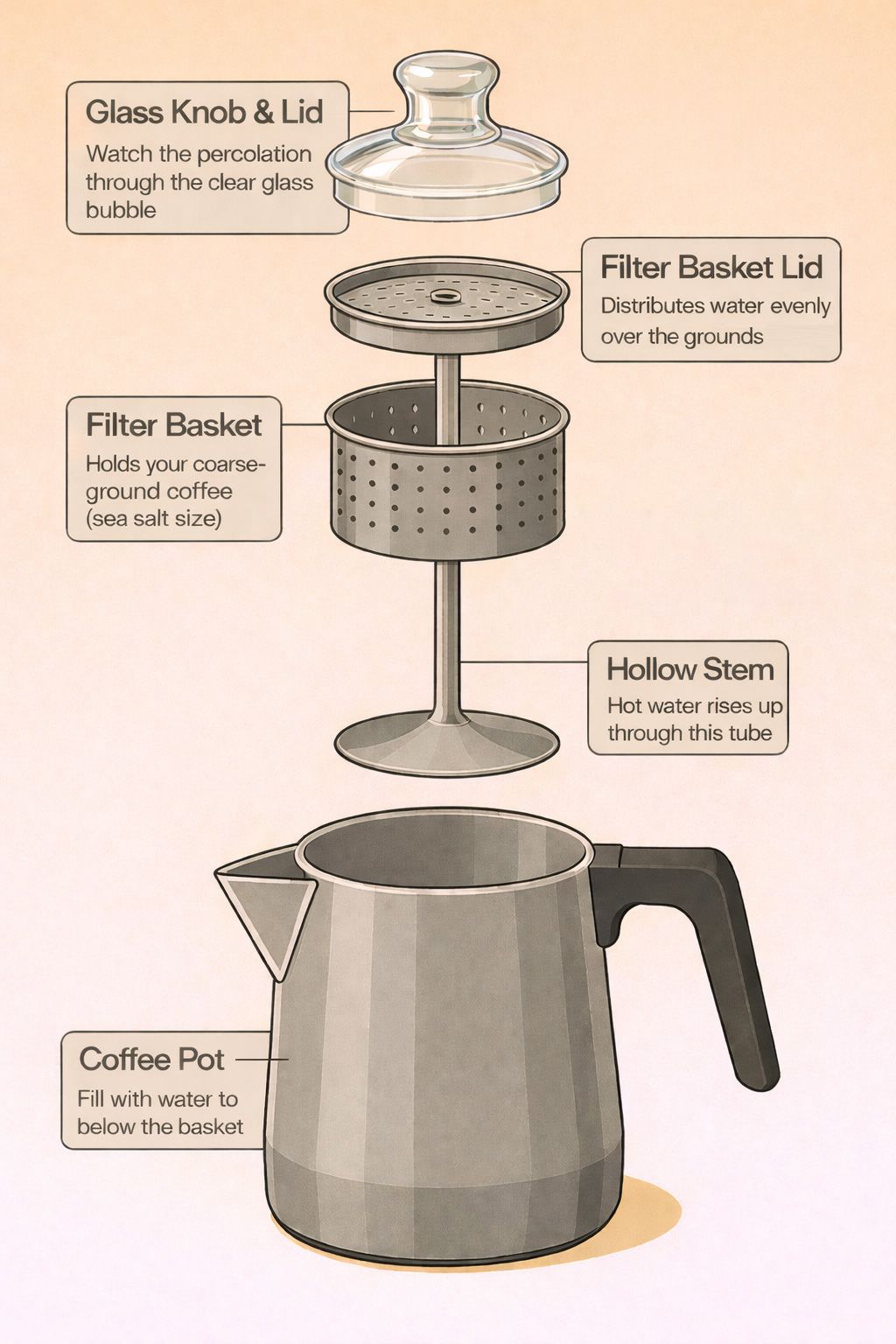
A coffee percolator has five main parts, and understanding each one helps you avoid the mistakes that give percolators their bad name.
There’s the percolator coffee pot itself, into which you put your water. There’s the stem, a hollow metal tube that fits into the bottom of the pot – in non-electric models, it has a flat round bottom that sits on the base. There’s the filter basket, which slides onto the tube and holds the ground coffee. There’s the filter basket cover, a round perforated lid that fits on top and makes sure the water showers the entire basket evenly. And finally, there’s the coffee pot lid, which often has a glass bubble in it.
That glass bubble just might be the most fun part of the entire contraption. It lets you watch the coffee splurting up from the tube and splashing inside before it spills back down onto the lid. Weirdly mesmerizing, like a little coffee fountain show happening right there on your stovetop.
Electric vs. Stovetop: Which Should You Choose?
Coffee percolators come in two distinct types – electric and stovetop. Each has its place, and honestly, both can make decent coffee despite their horrible reputation if you follow a few guidelines.
Electric percolators, including those coffee urns that can make up to forty cups at a time, are the set-it-and-forget-it option. They’re consistent, they shut off automatically, and they’re perfect for offices, church basements, and anywhere else you need to caffeinate a crowd without babysitting the process. The downside? You give up control over timing and temperature.
Stovetop percolators give you complete control, which is both a blessing and a curse. You can adjust the heat exactly how you want it, but you also have to pay attention or risk over-extraction. They’re great for camping since they don’t need electricity, and there’s something genuinely satisfying about the hands-on process. One of our readers pointed out they work differently at altitude too – at 5,300 feet, water boils at about 201 degrees, and percolators run roughly 10 degrees cooler than that, which actually makes the coffee come out better than at sea level. I thought that was fascinating.
What actually changes between the two (steps below stay the same otherwise)
- Heat: electric uses its own thermostat. Stovetop, you start at medium and drop to low the moment it perks.
- When it’s done: electric chimes or shifts indicator color. Stovetop, you watch the glass bubble and the clock.
- Pulling the basket: both still need the entire filter stem removed the second brewing finishes. Most electric models do not do this for you automatically.
- Capacity: stovetop models usually 4 to 12 cups. Electric urns scale up to 40 or 100 cups for events and offices.
For a deeper comparison and buying advice, see Electric vs Stovetop Percolators: Which Should You Buy?
How to Make Perfect Percolator Coffee
Here’s how to make percolator coffee that won’t make you question your life choices:
- Keep all parts of the percolator clean. This isn’t optional. Wash the entire thing with dishwashing liquid and hot water every single time you use it. Coffee oils go rancid faster than you’d think, and old residue will ruin even good coffee. Use a pipe cleaner for the inside of the stem. I learned this the hard way after wondering why my coffee tasted like the bottom of a week-old pot.
- Use freshly ground coffee – and make sure it’s coarse. This is where most people mess up. That pre-ground coffee from the grocery store? It’s ground for drip coffee makers and it’s too fine for percolators. You want a coarse grind, more like sea salt or coarse breadcrumbs. If you don’t have a grinder, look for coffee labeled as coarse grind, or ask your local coffee shop to grind it coarse for you. On a camping trip with no electricity? Carry your ground coffee in a vacuum container with a lid to keep the air out.
- Get your water level right. Disassemble the percolator and put the stem in place. Fill with water to below the line where the filter basket sits. Too much water and you’ll get weak coffee. Too little and it won’t perk properly.
- Don’t be stingy with the coffee. Put the filter basket on and add one heaping tablespoon of coffee for each cup of water. Some people go up to two tablespoons if they like it strong, but start with one and adjust from there. Put the basket lid in place.
- Start the heat. If you’re using an electric percolator, plug it in and turn it on – it’s on its own now. If you’re using a stovetop, put it over medium heat. Not high, not low – right in the middle.
- Watch for the magic moment. As soon as the first splurt of coffee hits that glass bubble, turn the heat down to low. This is crucial. You want just enough heat to keep percolation going, but not so much that you’re boiling your coffee. You’ll hear it change from rapid bubbling to a gentler, slower rhythm.
- Time it right. For most people, 4-8 minutes of perking is the sweet spot. Start checking at 4 minutes – the coffee coming up through the bubble should look like actual coffee, not weak tea. Don’t overthink it.
- Stop the process immediately. As soon as the pot stops perking or you decide it’s strong enough, pull it off the heat.
- Remove the filter stem – this is the step everyone skips. Carefully take off the lid and pull out the entire filter stem assembly, not just the basket. If you leave it in, steam from the coffee keeps condensing, dripping through the spent grounds, and making your coffee progressively more bitter. This is how perfectly good percolated coffee turns into undrinkable swill in about ten minutes.
- Let it rest, then enjoy. Give it about 30 seconds so any grounds that escaped can settle, then pour yourself a cup. You might be surprised by how good it actually is.
When Percolators Actually Shine
Despite what the coffee cognoscenti will tell you, there are situations where percolators are not just acceptable but actually the best choice.
Camping and outdoor adventures. Try bringing your French press on a camping trip and see how long it lasts. Percolators are practically indestructible, work on any heat source, and make coffee strong enough to get you moving after sleeping on the ground.
Large groups and events. Need coffee for 20, 30, or 50 people? A large electric percolator urn beats making pot after pot with any other method. They keep coffee warm for hours without that burnt taste you get from drip makers with hot plates.
The ritual of it. Sometimes the process matters as much as the product. There’s something deeply satisfying about the sound of a percolator bubbling away, the anticipation as you watch that glass bubble, the ritual of removing the basket at just the right moment. It connects you to decades of coffee drinkers who found comfort in exactly the same process.
Troubleshooting Common Percolator Problems
My coffee tastes bitter and terrible. Nine times out of ten, you’re using too fine a grind, perking too long, or both. Try a coarser grind and shorter brewing time. And make sure you’re removing that filter basket immediately when done.
My coffee is weak and watery. Not enough grounds, or the grind is too coarse and water’s flowing through too quickly. Try adding more coffee first, then adjust grind size if needed.
My percolator won’t start perking. Check that the stem is seated properly and the water level is right. It can take 5-10 minutes to get going, especially with electric models. Be patient.
The coffee is muddy and full of grounds. Your grind is definitely too fine. You want pieces about the size of coarse sea salt, not coffee dust.
Best Coffee Beans and Grinds for Percolators
Not all coffee works equally well in a percolator. Medium to dark roasts are your best bet because they’re less acidic and more forgiving of the longer extraction time. Brazilian, Sumatran, and other low-altitude coffees tend to be naturally lower in acid, which plays nicely with percolation.
French roast and Italian roast are particularly good choices. The roasting process has already broken down some of the compounds that turn bitter with extended brewing, and the bold flavors hold up well against the strong extraction.
For grind size – think coarse, then go a little coarser. If you’re grinding your own, a burr grinder set coarse gives you something that looks like coarse breadcrumbs or sea salt. Too fine and you get muddy, over-extracted coffee. Too coarse and the water flows through without pulling enough flavor.
The Bottom Line
I’m not going to pretend that percolated coffee is better than a well-executed pour-over or a properly pulled espresso shot. But it’s also not the coffee catastrophe that the experts make it out to be. Made properly – right grind, proper timing, remove the basket – percolator coffee is rich, full-bodied, and satisfying in ways my pour-over never quite manages.
The real problem isn’t the percolator. It’s people who don’t know how to use one. Master the technique, use good coffee ground to the right size, pay attention to timing, and you might find yourself reaching for the percolator more often than you’d ever admit in polite coffee company.
After all, our grandparents drank percolated coffee for decades. They weren’t wrong about everything.
Frequently Asked Questions About Percolator Coffee
Not if you do it right. The bad reputation comes from over-extraction – too fine a grind, perking too long, or forgetting to remove the filter basket after brewing. Follow proper technique and you might be genuinely surprised by how good it can be.
4-8 minutes depending on how strong you like it. Start checking at 4 minutes and taste-test. The coffee coming up through the glass bubble should look like actual coffee, not weak tea. Stop before it gets too dark or you’ll end up with bitter brew.
Coarse grind, like sea salt or coarse breadcrumbs. Fine grinds will give you muddy, bitter coffee that’s impossible to enjoy. If you’re buying pre-ground, look specifically for “coarse grind” or ask your coffee shop to grind it coarse for percolators.
Usually over-extraction from perking too long, grind that’s too fine, or water that’s too hot. Try shorter brew time, coarser grind, and lower heat once percolation starts. And make sure you’re removing the entire filter stem immediately when brewing is done – not just the basket.
Most store-bought ground coffee is too fine for percolators. It’s ground for drip coffee makers and will give you muddy, over-extracted results. Look for coffee specifically labeled as coarse grind, or better yet, grind your own beans.
Start with 1 heaping tablespoon per cup of water. If you like it stronger, go up to 2 tablespoons per cup – but don’t just brew longer to get more strength. That’s how you get bitterness. More grounds, not more time.
Yes, immediately. This is the step most people skip, and it makes all the difference. Remove the entire filter stem assembly, not just the basket. If you leave it in, steam keeps condensing and dripping through the spent grounds, turning your coffee bitter within minutes.
Electric is more convenient and consistent, plus it shuts off automatically. Stovetop gives you more control over heat and timing, and works great for camping. Both can make good coffee with proper technique. It really comes down to how hands-on you want to be.
Check that the stem is properly seated in the bottom of the pot and the water level is correct – it should be below where the filter basket sits. Be patient too. It can take 5-10 minutes for the water to heat up enough, especially with electric models.
Use fewer grounds rather than reducing brew time too much. If you cut brewing time too short, you’ll get weak, sour coffee instead. You can also dilute strong percolated coffee with hot water after brewing – think of it like making an Americano.
Wash all parts with hot soapy water after every use. Use a pipe cleaner or long thin brush for inside the stem – coffee oils build up in there and will make your next pot taste rancid. Once a month, run a cycle with white vinegar and water for a deep clean.
Let the water heat until it just starts to perk, then immediately drop the heat to low. You want hot enough to percolate but not a rolling boil. The percolation should be gentle and steady, not violent bubbling.
Use more coffee grounds rather than longer brew time. A darker roast also gives more intense flavor without extra bitterness. Some people swear by adding a tiny pinch of salt to cut bitter notes, though that’s definitely a personal preference thing.
Interestingly, many people with coffee-related heartburn actually find percolated coffee easier on their stomachs than drip. The longer brewing process and higher heat can break down some of the acids that cause problems. Dark roasted beans help even more with this.
Only on an electric coil or solid-hob stove. Those hold and spread heat unevenly, so a diffuser keeps the base from scorching the coffee closest to the metal. On a gas burner, skip it and set the pot directly over the flame. This is one of the most common questions in our comments, and it comes up because so many people inherit a percolator with no manual attached.
It is a genuine old-timer method, and there is real chemistry behind it. Crushed eggshell is calcium carbonate, which neutralizes some of the acid in the grounds and mellows the cup. Cleaned, dried, crushed shell gets mixed in with the grounds before brewing, and the filter or basket traps the sediment along with the coffee grounds. It works, but it is a lot of fuss for a marginal difference, and a coarser grind gets you most of the way there without cracking an egg.
Drop them in the comments below. With over 500 comments from fellow percolator users, our community has probably faced your exact issue before – and there’s always someone willing to share their hard-earned wisdom.
Discussion 582
Thanks everyone. I was about to give up on my new Farberware stove top percolator because the coffee was bitter but you have all inspired me! I look forward to a better cup of coffee tomorrow. Thank you for ALL of your GREAT suggestions!
Suzanne, I’ve always used a mild white vinegar/water solution for cleaning my electric percolators (just perc it through and rinse). It does the trick! What a lovely thing to have one of your children revive something that’s been such a part of your family life.
What a wonderful site! Little did I know how many other people appreciate perked coffee (stove top &/or electric). My parents perked w/stove top, I prefer electric and have had vintage as well as new. In some haste, I purchased a Cuisinart 12 cup online this past December. By January, the plastic bubble top is broken :( .. Cuisinart is glad to sell me a (back-ordered) full top for $10. I only need the bubble top. I did read Russ’ ingenious instructions for making a new bubble top and will run it by my genius husband who can do anything! :) But, in case he’s too busy, anyone know of a ‘universal bubble top’ for electric percolators? Thanks in advance.
PS .. I’ll be interested in reading responses to Ellen’s Q. since that’s what happened to my last pot.
why did my electric percolator stop perking? It is heating and the stem is in place but the water is not shooting up into the basket. Why?
i have a GE coffee pot (40 years old). Is it okay to use white vinegar to clean the inside. It wasn’t used for quite a long while but is now having a new life since one of my children has decided to use it.
I leave my beans in the freezer now, and just grind what I neeed, returning bag of beans to freezer.
just picked up an 8 cup Presto coffee perc at an auction ($1.00) looks to be made in the 50s or 60s … made in USA … WOW what a great cup of coffee!
I remember my grandmother would rinse her stove top perc after each use and scrub it with a brush but would not let anyone near it with dish soap.
She would also use egg shells to smooth out the taste … her coffee was to die for and the neighborhood ladies came over each morning (like a coffee club) (gossip gossip)
This is a great site
Donna Smith; Allow me to suggest reading my frequent blogs since I discovered this last Sept. after re-discovering percs and I a big fan re good coffee,having lived in metro New Orleans many yrs and familiar w/Louisianne brand which, depending on degree of roast, can be heavy but good with equal amount/less of hot milk in cup.
I sugg. leaving the hot basket in perc due to no effect on brew, per my experiences, which include that grinding and storing in sealed container a cup or two of beans at a time, not noticable affect on quality and saves time/effort. I do not understand why some persons blog w/complaints about time to brew when all needs done is, before to bed simply load perc, i.e., water plus grounds, and upon awakened next morning turn on perc and it finished by time in bathroom and teeth brushed preparing mouth for the first cup of fresh Joe. Or, set a timer so perc done by time u awake, if wanting fresh cup immediately. Some persons seem inclined to make life more a trial when simple planning can make it a Hoot!
Works for me!
I just bought a Farberware 2-4 cup perculator after determining that it was my best option for a coffee maker that makes 2 mugs of coffee. There aren’t many drip makers of any quality that make only 2-4 cups and although the larger ones can be set to brew only 4 cups, what a waste of space. So I went retro and got a perculator. I have only had it for 2 days, but haven’t yet brewed a good cup of coffee, so I turned to Google and found this year-long discussion. I am amused that I’ve gotten the best information available about perculators from the discussion folowing an article which began, “Let’s start with a caveat. Nearly any coffee expert will tell you that a percolator is about the worst possible way to make coffee…”
After reading through quite a lot of the discussion, I am dedicated to making a good cup of coffee with my new perculator. I have the 1/4-inch Port-a-Filter brush awaiting purchase in my amazon.com shopping cart, plans to make use of egg shells which use to just go down the disposal, and a commitment to allow enough time each morning to grind coffee beans to the right consistency of coarse but not too coarse and not too fine either. I think my major problem to date has been using coffee that is too finely ground. Now that I think about it, I have an unopened bag of Louisianne coffee that is probably perfect for perculating! Now there’s real coffee!
I don’t much like handling all the hot parts to remove the basket after brewing, but I guess I will get better with practice.
Thanks for all the tips and I hope to come back soon and exclaim over the best cup of coffee I’ve ever made!
Urgent/Important caution to all bloggers using or might obtain CorningWare perc pots: I recently acquired a classic 6 cup Corning pot w/o basket/stem so contacted the Corning/Pyrex company about parts and received response from World Kitchen Consumer Care Center advising me that the percolators had been discontinued 30 yrs ago (ans. my other question as to why none new on the market) Stating that in 1979 Corning had issued a nation-wide Warning program (first I heard of it) That expoxy sealant holding the metal band/handle can become brittle and cause handle to separate from the pot w/o warning!!, thereby, possibly result in burns, etc..even if used only for holding liquids, as I have been using mine for hot cocoa but discovered it too much a trial to clean the cocoa/milk residue from the rim assembly. They suggest that one not give or sell the pots to other folks. I would be remiss in not passing-on that warning to you fellow perc users/lovers. I suggest that removing the handle might create a unique vase.
Bob Ray; Hope my suggestions help. After 27 yrs in New Orleans area I relocated back to home country 11yrs ago, Paris,TN, where my Scot ancestors settled in early 1800’s plus some now in the San Francisco area but none north of the Mason-Dixon. This area is rural/small towns w/o large stores/shopping centers, i.e., hvy traffic, too many people, etc., so I improvise by keeping a “wish list” which I fill when travel to large metro areas.
Your Local fix-it shops and/or hardware store personnel can likely provide more suggestions. Good time to shop Salvation Army, etc., and consignment shops now, following Christmas when people rid selves of items replaced/up-graded by gifts. Works for me.!
Thank you for the information David Greer. I use to live in Mentor Ohio when I was between the ages of 1 and 10 and I know a Richard Greer that has a sister Trula. Do you know if your related ? I am 52 years old and they are a few years older. Mary and I will shop at the Salvation Army in Jackson Mississippi soon.
Bob Ray, All any us lacking parts have to do is use our imaginaton/think-out-of-the-box. First, have a mind picture of what one needs, take measurements then, shop the Salvation Army, Good Will, etc., shops/Big Lots for pyrex glass/alum pot covers of proper size. Also, easy to fabricate a filter cover via alum or plastic lids/paint can covers, etc., simply punch 10 penny nail holes in it (downward)for perc water to distribute over grounds.
Simple stuff. You mentioned tea; We in W. Tenn. (me at least)drink iced tea year round and I have re-discovered what I think the best results (remembering how my Grandmother & Mother did) which is to purchase loose tea or, as I now do because it cheaper, buy family size bags and open/empty (measured) into boiling water which is then removed from heat.
Let steep to cool-down then screen to use. Better extraction/quality than bags themselves. Try it.
I have found a GE 42 cup serial B0960BW, model 106840R but the filter basket cover and the coffee pot lid was not with the GE 42 coffee pot. I use the GE pot to heat water and submerge tea bags into the hot water. If anyone has a filter basket cover and a coffee pot lid, please contact me. Thank you.
Howdy, great site. Just a couple of thoughts. I could never get a HOT cup of coffee from any drip machine. It drove me to ask questions and was directed to the old reliable perk type makers,I’ve not been disappointed and boy howdy always a HOT cup of coffee. Fresh coffee is a must,whole beans freshly ground is best.Like others have said, as soon as coffee starts to perk turn heat down to low try your darnedest not to boil the coffee.Lastly is the cup, not that it improves the taste, but it chore makes that piping HOT coffee easier to enjoy. I like those old restaurant heavy thick white ceramic single finger coffee cups. Ya’all can put piping HOT coffee in it,slurp or sip and never blister your lip, like what happens with dem thin walled coffee mugs ya get today. And if’in ya’all get a hanker’in ta smash up your fresh grounds with the butt of your pistol remember to unload it fist,this ensures ya’all GET ta enjoy dat HOT cup of perked coffee.Hey ya’all enjoy dat HOT cup of coffee and keep on a perk’en dat good coffee. Oh anyone look’en fer a good all stainless steel percolator( non electric)
Lehman’s sells em, http://www.lehmans.com will get ya one,and if’in dee’s thoughts are worth 2cents then ya’all got something. thanks
To Margy and Pat; Allow me to suggest a cleaning product that we all have. Baking soda and a damp sponge/cloth is perfect for cleaning the exterior and interior where it also neturalizes the acid residue/sweetens the interior plus it not scratch. Then, place the remaining/extra soda powder in the sink drain pipes and pour microwave heated cup of vinegar into drain to purge and sanitize them. Let it work a few minutes then flush.
Thanks Margy! I have tried different types of coffee but have not tried the products you mentioned. Just had an ice storm here so will have to wait until the roads are good for traveling. Can’t wait to try this.
A clean pot will help, but maybe it is the brand of coffee? To get the inside of the pot clean, try to find “Dip It” for percolators. It’s a powder. Don’t get the liquid. DipIt will get rid of lots of staining inside (even the ceramic sleeve). I have had good luck getting a shine inside with Cameo Aluminum & Stainless Steel Cleaner. Just don’t use it on the shiny OUTSIDE of the pot. It is an abrasive and will cloud the finish. Suds the inside first and then immediately suds again after and rinse-rinse-rinse.
Just discovered this site. I’ve got an old Farberware electric 2-4 cup perculator. It has the ceramic covered stem. Whenever I make coffee, it has a bitter taste. I tried to clean it by perking it with some white vinegar and water but the taste is still there when I brew it. Any ideas on how to get rid of this taste?
Steve; First, I wouldn’t be concerned about aluminum parts (food grade alum is safe)unless it a Chinese product I not trust. People who deliberately put anti-freeze glycol in toothpaste and dog food cannot be trusted re any product. Even aluminum. I use a 1975 GE made in USA model/catalog #75P31 which I bought at the Salvation Army store months ago for $5. It’s stainless but basket & stem alum.
I have been using the GE 9 cup electric perc 40 years old and it makes the greatest coffee. I also had all the high end machines, and they all all junk. I am also concerned about the aluminum in my old perc. I may get another vintage electric perc with all stainless steel interior as well as the basket and stem. Does anyone know of a older make/ model that is all stainless? thanks
Rebekka, I feel that very good cup of perc coffee could change your mind. Allow me to suggest to start with half a cup of strong very hot coffee in which you fill the cup with very hot milk and a spoon of sugar. You end up with cafe au lait I love drinking at the Cafe Du Monde in New Orleans. Over time you will/might decrease the amount of milk. If anyone interested I have a recipe for New Orleans hot beignets which are a treat w/coffee and cocoa. I wouldn’t worry abut the amount of aluminum you might ingest. If much were leached from the alum pots they would not last long and not the case. Be more concerned about the content of your antacids, etc..
wow–I knew that brewing a good pot of coffee was an art, but I never imagined it would mean so much to so many people!
Personally, I can’t stand coffee, but my hubby and daughter are addicted–
We have gone through two or three Mr. Coffees–handed down from parents, and now have a too-complicated and very disappointing Bunn.
As a kid, I can remember the glass Pyrex percolator Mom and Dad used every single day–I have thought about investing in one, if I could find it, but now have a stainless Martha Stewart I bought at an auction (I paid $1 for a big box of stuff and it was inside) so I think I am going to give it a try.
I have had electric percs in the past, but don’t have a good feeling about anything aluminum and avoid using said aluminum as much as possible.
I haven’t sat down to read all the posts, but it was great fun reading what I did–I’ll be back to catch up on the science and art of percolator coffee!
Tim, ur correct. Common spice grinder or even blender can be used. Simply flush the spice residue from the device,(it not explode/short-out if you not submerge the motor base in water) then dry and grind coffee in batches using a flour seive to extract the fine grind wanted and continue until the amount of grounds wanted.
Simple kitchen science. Takes a little extra time/effort but results are worth it. Most stores that sell whole beans provide a grinder and I’ve not experienced any real loss of quality if a pound or more of ground coffee is stored in an air-tight container, but, like anything, time stored is the key.
However, some people are too picky. Like a touch of added flavor(?) add a pinch or 2 of cinnamon, ground cloves or apple pie spice to the brew basket and a splash (or more)of bourbon or dark rum to the cup is a treat. Same as spiced hard cider we used to enjoy before a roaring fireplace when the snow gets deep and no need to drive anywhere.
Life can be a “hoot” if one uses noodle and the effort.
If you grind your coffee like I do, bear in mind, how long you grind it for, fast grind is coarse so longer perking. I tend to grind it a little bit finer, but not so fine.
Common sense, after the first perc, turn the gas down to low, so it percs nice and slow, and about 10 min is enough for the color and flavor to develop…..
I use an old percolator, so old it has no automatic shutoff. the longer it percolates the stronger the coffee, but I only let it go 10 minutes once it is fully percolating. That coffee is so strong and thick it is very good coffee.
I’m not impressed with the new percs I’ve seen in stores,i.e., Macys and WM. Half attempt effort Chinese knock-off crap w/o ability to choose strenth of brew while apparently figuring that people too stupid/lazy/dumb to select. Persons looking for quality old percs might find them in charity, consignment and even pawn shops. Also, large commercial size might be found in restaurant supply stores. Use imaginations. Worth the effort. I’m even into mixing good quality blends/roasts I find on sale, i.e., med w/french dark, etc., ending up w/interesting inexpensive good stuff.
I just bought my first percolator today, it makes the best coffee I have ever had. I don’t believe what you hear about people thinking percolators don’t make good coffee. Fast, Hot and amazing flavor.
The serial number for the cord is e155176. I have the 42 cup urn that I am in search of a basket cover and lid.
This site/page has been down a couple of days? Tim, I would think that being in the UK one could have all the French roast wanted. The S.F. coffee I remember is from driving thru a cloud of smoke on the elevated roadway in the mornings when Hills Brothers Coffee Co. would roast.
Almost make one high.! Mike, I bet another stem can be obtained via the pyrex Corning Glass site or ebay. Plenty of parts around, just a matter of locating.
Everyone enjoying coffee should try Turkish/Greek coffee (demitasse?) which is pulverized dark roast beans (the original instant?)in boiling water. Very sweet and hot enough to sear ones tongue. A little goes a long way.
The entire bean is consumed, and people here complain about a few grounds in the pot.!?
just broke the glass stem in my pyrex pot, very depressing:(
That should be Moka pot.LOL
I found my old espresso pot, trying it now.
Oh yes, I grind mine as well, love it freshly ground, and French roast is good.
I have two percolaters, one stove top, and an old electric type that looks like a Russioan tea urn. I never liked the drip machine type. The best way is to let it heat gently and bubble for 4 to 5 min,( You can see the color develop, so who ever says remove from heat after one bubble splurt is wrong, thats my honest opinion) this avoids the bitterness. Recently in San Francisco I had a delicious cup in a restaurant, they said it was a French roast, Peres”I have fond memories of my father perking his coff on a Saturday morning in Ireland, the aroma drifted to the top of the house, that was enough to get us out of bed ! PERCS FOR EVER…
Now if I can get some San Francisco blend here in the UK, would be great.
Tim
Chris, You might read my comments of Sept., Oct., and Nov. where I mention my professional experience w/coffees and suggest using a med.price and med-dark roast brand. No light roast crap. If you make coffee, make real coffee. Margy is right about the A&P, med-dark roast and grind it your self and I aways nibbled on several beans but we not have A&P here so I do the next best w/Folgers med/dark roast (Columbian beans are best)French roast too heavy, for me, and rounded tablespoon per 6-8 oz cup and set perc at maximum then adjust future measures/settings to taste.
Nabob’s Full City Roast is good.
Chris…I am in the Albany NY area and a friend put me on to “Uncommon Grounds” house brand, whole beans. I don’t know if this is a national chain, but the coffee is wonderful. It is kinda expensive, at ten dollars a pound, but I save mine for really comfort-needed moments, or company. Daily, I use Eight O’Clock classic, the old A&P beans you used to smell grinding when you went shopping with mom in the stores that had actual oiled wooden floors!
THANK YOU ALL! The opinions are truly helpful regarding all hints.
I am off to purchase a pecolator now -wish me luck…
David, I’m not quite sure what ever became of the coffee pot. My Mom & Dad had moved a couple of times after they retired, so I don’t know if one of my brothers or sisters had grabbed it. I sure hope one of them did.
As for your experience drinking coffee made with seawater.. all I can say is YUCK! I’ll bet your eyeballs just about jumped out of their sockets. Sounds like #1, either that guy was a jokester or #2, he didn’t have an ounce of sense in his head.
I think I’d probably go with #1 though. My Dad was a welder, he worked for Bethlehem Steel in East Boston servicing Naval Ships. Every night we sat at the supper table and listened to his stories that always had us laughing.
As for your reply to Shelley, I agree. I did a search and found one pot that appeared to have an octagonal shape, I’m wondering if that may happen to be the pot she has.
I have just replaced my drip coffee maker with a perculator type and I know that the coffee I was using (folgers) doesn’t even come close to the taste of the drip. Most of the time it is bitter and just plain blah! I have tasted really good coffee in a perculator but not sure what was used.
What is the best store bought coffee you can get? Anyone recommend a brand?
Shelly, You not provide enough details, i.e., gas/elect. stove, what pan support? Sounds like mis-matched parts. That thing is too artsy fartsy for me so suggest you go to bialettiusa.com or send email inquiry via info @ bialettiusa..
Dear all coffee lovers, help needed. Is there a device that will sit on the stove to make our Bialetti more stable. It has twice fallen off the stove as the base is too small for the pan support.
Annie, you still have/use that pot? My memory takes me back to some of best coffee ever when I in the USN in the ’60s, served in the heavy crusier USS Los Angeles-CA 135, in CIC (Combat information center) where we were the eyes and ears of the fleet, long hours which required strong coffee and too much smoking. We had a two gal. perc pot that people took turns cleaning and refilling with fresh water for the next watch.
One very late night/early morning I stumbled into CIC and grabbed a fresh cup to jolt me awake and had half of it down before realizing that some knuckle-head had made that batch by drawing water from the sea-water tap. I became VERY WIDE awake.! I don’t recommend it.
David, my Mom had a Sunbeam stainless steel (electric) pot that had the type of perc method you described with the 2 bowls. It sat on a high shelf in the pantry for years. Back in the 70’s I had taken it down and bought some ground coffee to try it out. What a great cup of coffee it made! Of course at that time, we were used to drinking instant coffee… ugh! When I made the perked it started a whole new outlook. My Dad somehow found a new gasket for it .. not sure how he found it because I believe that pot was probably from the 40’s or 50’s, so at that time it was already 20 or 30 yrs old… Brings back very fond memories, indeed!
My thanks to Vicki Lea; I had not thought to check ebay but best not or I’ll end up with more “stuff” than I need. I’m a gadget freak. My science knowledge is refreshing it self and I think that that type pot worked by the heated water/air pressure of the lower globe forced the water up the tube and when bottom empty the heat had to be reduced at which time the coffee liquor was allowed to flow thru the grounds filter to the lower globe. Interesting process but required too much attention. I now recall seeing what I think were large stainless steel versions in resturants. Many years ago. Funny how memory works.
To David; I’ve seen what you described on eBay a time or two. I haven’t looked in a while, but there’s usually quite a few of the really old-time glass percolators for sale. That’s where I purchased my Flameware all-glass percolator. But I can’t comment on how it works.
In the late ’40s I recall my Mother making coffee using a large all glass hour-glass shaped maker. A large globe base w/water and a large glass globe atop w/grounds and a tube connecting the two. I remember watching in amazement as the water flowed up the tube and filled the upper globe then drained thru the grounds and when finished she removed the top globe. Anyone know about what I describe and the science involved.?
To Tina; Why remove the basket until finished with the coffee? Simply turn down heat to stop the percing and the grounds in basket not increase strength of brew. At end of pot simply lower pot into sink and dump basket, etc., w/o danger of burns. If you feel you simply must remove the basket, use butter knife or other thin blade to raise the basket lid,wet fingers with cold water and lift lid then use pot-holder or kitchen towel to grasp top of perc tube, careful of steam! Simple kitchen skills! Coffee grounds/tea leaves make good mulch but no harm to flush down drain.