
Affiliate disclosure: As an Amazon Associate, TalkAboutCoffee earns from qualifying purchases. Our picks are based on editorial judgment, not commission rates.
Quick verdict
The Keurig K-Elite is the K-Cup machine to buy if you want strong brew, iced coffee, hot water on demand, and a large enough reservoir to stop refilling it every two cups. At $150 to $180, it’s not the cheapest Keurig, but it’s the one that doesn’t make you feel like you bought a cheap Keurig. If you used to own a Breville BKC700XL (now discontinued), this is the closest modern equivalent for what that machine actually did well.
- Brew sizes: 4, 6, 8, 10, and 12 oz
- Water reservoir: 75 oz (about 8 cups between refills)
- Temperature control: 187 to 192 F (adjustable in 1 F steps)
- Strong brew button: yes (slows the pour for richer extraction)
- Iced coffee mode: yes (compensates for ice dilution)
- Hot water on demand: yes (for tea, oatmeal, instant noodles)
- Programmable on/off: yes (clock + auto-start)
- High altitude setting: yes
- Dimensions: 13.1″ H x 9.9″ D x 12.7″ W
- Price band: typically $150 to $180
I’ll start with the part everyone asks first: yes, K-Cup coffee is fine. Not great, not bad, fine. The reason to own a single-serve K-Cup machine is not because it makes better coffee than a French press or a pour-over. It’s because at 6:30 a.m. on a Tuesday, you do not want to grind beans, weigh anything, time anything, or clean anything. You want to press a button, wait 60 seconds, and walk away with a cup. The Keurig K-Elite is the version of that machine that doesn’t feel like a compromise.
I’ve owned three different Keurigs over the past decade plus the now-discontinued Breville BKC700XL (which is what brought me to the K-Elite when Breville stopped making single-serve K-Cup brewers entirely). The K-Elite is meaningfully better than the cheap Keurigs and not far off from the premium ones at half the price. It’s the sensible buy in the middle of the line.
What you actually get
The K-Elite is a single-serve K-Cup brewer with the features that matter and almost none of the features that don’t. The 75 oz removable water reservoir is the single biggest quality-of-life difference between this and the entry-level Keurigs. Eight cups between refills means you fill it twice a week instead of every other day.
The five brew sizes (4, 6, 8, 10, 12 oz) cover the realistic range. The 12 oz is the maximum which is plenty for a normal mug but won’t fill a giant travel mug. The “strong brew” button slows the pour, gives the water more contact time with the grounds, and produces a noticeably bolder cup. I use it for every cup. The “iced” mode brews stronger and hotter so when you pour over ice you don’t end up with sour weak coffee.
The temperature control is the feature most people don’t know they need. You can set the brew temperature anywhere between 187 and 192 F. The default is around 192. Drop to 188 if you like a smoother, less acidic cup. The difference is real and changes which coffees taste good.
Hot water on demand is the underrated feature. Press the hot water button, no pod, and you get a 4 to 12 oz pour of plain hot water. I use it for tea every afternoon and for oatmeal most mornings. The programmable clock means you can set the machine to power on at 6:15 a.m. so it’s ready when you walk into the kitchen.
What’s actually good about it
- The reservoir is large enough. 75 oz is the difference between “I need to refill this thing again” and “the water is just always there.” Cheaper Keurigs (K-Mini, K-Compact, K-Classic) make you fill before every brew or every other brew. This one you fill twice a week.
- Strong brew actually works. Most “strong” buttons on cheap brewers just delay the pour by 5 seconds. The K-Elite’s is closer to a 20 percent contact-time increase and produces a measurably bolder cup. If you find regular K-Cups weak, this fixes most of the problem.
- Iced mode is genuinely useful. Brewing a 6 oz hot pour over a glass of ice ends up tasting like weak coffee water. The K-Elite’s iced mode compensates so the cup actually holds up.
- It’s quiet. The pump is meaningfully quieter than the cheaper Keurigs. If you brew before your partner is awake, this matters.
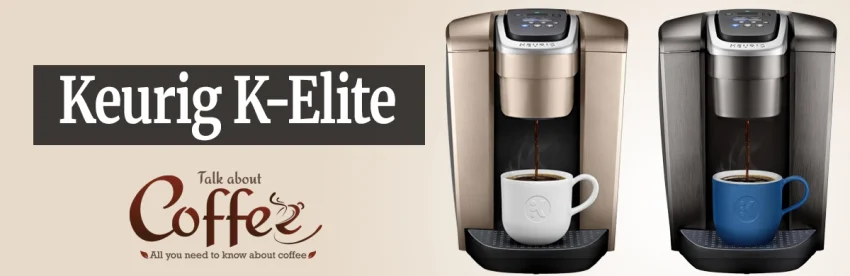
- Brushed silver finish hides fingerprints. The cheaper plastic-bodied Keurigs look beat up after a year. The K-Elite still looks new after three.
- K-Cup ecosystem. The huge variety of pods (700+ flavors from 75+ brands) is the real reason to own a Keurig at all. Specialty coffee, decaf, tea, hot chocolate, mocha, cider, all from the same machine.
What’s not great
- Cost-per-cup with K-Cups. A K-Cup costs roughly 50 to 80 cents per cup depending on brand. That’s three to five times the cost of brewing from whole beans. If you drink three cups a day, that’s $50 to $90 per month just on pods.
- Coffee is fine, not great. Even with strong brew and good pods, the cup quality caps below what a $200 espresso machine or a $40 French press will produce. K-Cup brewing is fast and convenient. It is not specialty coffee.
- Plastic body. The chassis is plastic with a brushed-silver overlay. Not the durable all-metal feel of higher-end Breville or De’Longhi equipment. It works for 3 to 5 years of daily use, then the pump or heating element typically goes.
- No milk frothing. Single-serve K-Cup machines don’t froth milk. If you want a cappuccino or latte, you need a separate milk frother (see our milk frother roundup) or a different machine entirely.
- Environmental impact. Plastic pods. Reusable K-Cup adapters exist (Keurig sells one for $15) and let you use your own ground coffee, which solves both the cost and the waste issue but defeats much of the convenience.
- The 12 oz max can be limiting. If you drink from a 16 to 20 oz travel mug, you’ll need to run two cycles back-to-back, which doubles the pod cost per drink.
The reusable pod option (important)
If the per-cup cost is bothering you, get the official Keurig “My K-Cup Universal Reusable Coffee Filter” for $15 and use your own ground coffee. Bring-your-own-beans drops the per-cup cost from 60 cents to about 15 cents and gives you full control over what’s actually being brewed. The convenience hit is small: scoop coffee, snap the lid, brew, dump grounds, rinse. About 30 seconds added to the workflow.
This is what I do most weekday mornings. I keep a tub of Cafe Bustelo or whatever’s on sale and only use real K-Cup pods for guests or for specific flavors I can’t get in whole bean (peppermint mocha, holiday blends, etc.).
Keurig K-Elite vs alternatives
- Keurig K-Classic ($90 to $110). Same brewing engine, smaller reservoir (48 oz), no strong brew button, no iced mode, no temperature control. Buy this if budget is tight. Skip if you’ll be annoyed when you can’t get a stronger cup.
- Keurig K-Supreme Plus ($170 to $200). Same features as K-Elite plus MultiStream Technology (multiple needles for more even saturation). The brewing difference is subtle. Worth the extra $20 to $30 only if you’re a careful coffee drinker who tastes the difference. Most people won’t.
- Cuisinart SS-10 ($170 to $220). Larger 72 oz reservoir, slightly bigger brew sizes (up to 12 oz with a separate “extra cup” mode), reusable pod included. Comparable to K-Elite but uses Keurig’s pods plus its own ground-coffee pod. The premium alternative if you want a non-Keurig brand with the same feature set.
- Discontinued Breville BKC700XL. The machine that was best-in-class for single-serve K-Cup brewing for years. No direct Breville replacement exists. If you’re searching for one, see our original BKC700XL review for context.
Who this machine is for
- You drink 1 to 4 cups of coffee a day and want each one fresh and individual.
- Your household includes more than one coffee drinker and you all like different things.
- You travel often and want a low-maintenance machine when you are home.
- You used to own a Breville single-serve and need a replacement now that Breville exited this market.
- You drink tea or hot chocolate occasionally and want hot water on demand.
- You don’t have the bench space or the time for an espresso machine.
Skip this machine if you make less than one cup a day (the running cost doesn’t make sense), if you make more than five cups a day (the pod cost gets painful fast), or if you actually want specialty-coffee-quality drinks (you’ll be disappointed).
Frequently asked questions
Is the Keurig K-Elite worth the price over a basic Keurig?
Yes if you’ll use the strong brew, iced mode, or temperature control. The larger reservoir alone justifies it for most households. If you only ever brew one default cup, save $50 and get a K-Classic or K-Compact.
How long does a Keurig K-Elite last?
Three to five years of daily use is typical. The pump is usually what fails first. Descaling monthly (with the Keurig descaling solution or 1:1 white vinegar and water) extends life significantly. Most failures I’ve seen were on machines that had never been descaled.
Can I use ground coffee instead of K-Cup pods?
Yes. Buy the official Keurig “My K-Cup Universal Reusable Coffee Filter” for about $15. Scoop in your ground coffee, snap closed, brew normally. Drops per-cup cost from 60 cents to about 15 cents. Works with any coffee ground for drip.
Why was the Breville BKC700XL discontinued?
Breville stopped making single-serve K-Cup brewers around 2013-2014 to focus on their espresso line (Barista Express, Oracle, Bambino). No direct Breville replacement exists. The Keurig K-Elite is the closest modern equivalent for what the BKC700XL actually did.
Does the K-Elite work with off-brand pods?
Yes. Any K-Cup labeled “for Keurig 2.0” or “Keurig-compatible” works. The cheaper third-party pods (Victor Allen, Solimo, Maud’s) are roughly half the price of Starbucks or Green Mountain pods and the quality is acceptable if not amazing.
How loud is the K-Elite?
Around 60 dB during brewing, similar to a quiet dishwasher. Quieter than cheaper Keurigs (K-Mini, K-Compact) which run around 70 dB. Our full Keurig buyer’s guide covers how the whole current K-Cup lineup stacks up if the K-Elite turns out to be more machine than you need.
Is the reservoir really removable for easy filling?
Yes. Lift it out, take it to the sink, fill, put it back. No spilling water near the machine. This is a real convenience improvement over the side-fill design on cheaper Keurigs.
For the broader context on single-serve brewers and where they fit in a home coffee setup, see our best single-serve coffee makers overview.
Discussion