

Affiliate disclosure: As an Amazon Associate, TalkAboutCoffee earns from qualifying purchases. Our picks are based on editorial judgment, not commission rates.
Quick answer
- Coffee: 2 cups of medium-coarse ground coffee per 25 cups of water. Add another 1/3 cup of grounds for every additional 5 cups of water.
- Brew time: roughly 40 seconds per cup. A 30-cup urn takes about 20 minutes. A 100-cup urn takes about an hour.
- Minimum batch: most urns require a minimum number of cups to brew correctly. Check the manufacturer’s instructions or look for the “min” line inside the urn.
- Filters: a paper filter is optional but recommended. The basket alone will work, but a paper liner means cleaner coffee and easier cleanup.
- Sizing for a crowd: plan for 1 to 1 1/2 cups of coffee per attendee. If you’re serving 40 people, a 40-cup urn covers it.
Back when young families routinely entertained dinner parties of twenty to thirty people, a coffee urn was practically standard equipment. Nearly every suburban kitchen had one, often a West Bend or Hamilton Beach in Avocado, Harvest Gold, or Burnt Orange to match the rest of the appliances. You don’t see them in homes much anymore, but they’re still a requirement for caterers, churches, community centers, and anyone hosting an event where more than fifteen people might want coffee.
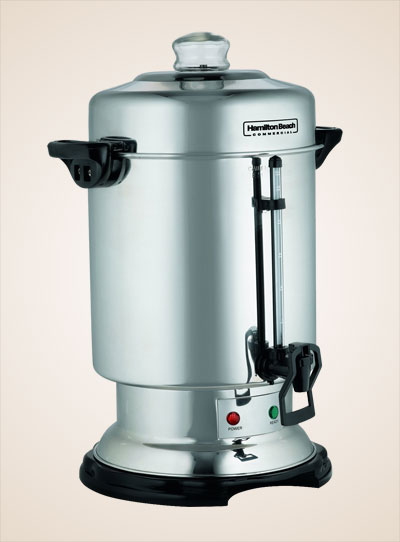
A coffee urn is essentially a very large electric percolator. Water is held in the main chamber, a hollow tube carries it up through ground coffee in a basket, and the brewed coffee drips back into the chamber where it’s kept warm. The technology is closer to a 1950s home percolator than a modern drip brewer, which is part of why urns are so reliable. There’s almost nothing to break.
Coffee urns are also available for rent at party rental centers. Since few people today have regular use for one, renting an urn for a single event is usually more economical than buying one. We’ve included a list of solid models to buy further down if you do need one of your own.
How a coffee urn is different from a percolator or drip brewer
A standard home percolator brews 4 to 12 cups. A coffee urn starts at around 25 cups and goes up to 100 or more. The brewing physics are the same, but the scale changes a few things. Urns are designed to keep coffee hot for hours after brewing, so they have a warming element built in. They also have a spigot at the front for serving, which most percolators do not. And they usually have an indicator light or chime to tell you when brewing is done, since 40 minutes is too long to stand and watch a glass bubble.
If you’re trying to decide between an urn and a regular brewer for a smaller gathering, a good rule of thumb is the 20-cup line. Below that, a couple of large drip brewers or a large percolator works fine. Above that, you want an urn. For more on the home version, see our guide to making percolator coffee.
How to make coffee in a coffee urn
The best instructions are always the ones that came with your specific urn. But rental units and shared community urns often arrive without a manual, so here is the method that works for almost every model on the market.
- Open the urn and lift out the filter basket and center stem. You may have to twist the stem to unlock it from the base.
- Fill the chamber with cold water to the line for your batch size. Most urns have water-level markings on the inside corresponding to cup counts. Use filtered or spring water for the best taste.
- Replace the center stem. Twist it to lock if needed.
- Fit a paper filter into the basket (optional but recommended). Slide the basket onto the stem.
- Measure your ground coffee. Use a coarse to medium-coarse grind, the same one you’d use for a percolator. For 25 cups, use 2 cups of grounds. Add 1/3 cup more for every additional 5 cups (see the chart below).
- Cover the basket with the basket lid if there is one. This spreads water evenly over the grounds.
- Close and lock the urn lid.
- Plug in and wait. Brewing takes about 40 seconds per cup. Most urns have an indicator light that turns on when brewing is finished.
- Remove the basket and stem after brewing is done. Wait about 30 minutes after the brew cycle so the assembly cools enough to handle safely. Leaving spent grounds in contact with the brewed coffee makes it taste burnt over time.
- Serve from the spigot. Most urns hold coffee at serving temperature for several hours.
Coffee urn measurement chart
This chart assumes a medium-coarse grind and a standard 5 to 6 ounce “cup” (urn manufacturers all use this smaller cup size, not a 12 oz mug). Adjust slightly stronger or weaker to taste.
| Urn size | Ground coffee | Approx. brew time | Serves |
|---|---|---|---|
| 25 cups | 2 cups | 17 minutes | 15-20 people |
| 30 cups | 2 1/3 cups | 20 minutes | 20-25 people |
| 40 cups | 3 cups | 27 minutes | 25-35 people |
| 50 cups | 3 2/3 cups | 33 minutes | 35-45 people |
| 60 cups | 4 1/3 cups | 40 minutes | 40-55 people |
| 100 cups | 7 cups | about 1 hour | 65-90 people |
How many cups for how many people
A good planning rule is 1 to 1 1/2 cups of coffee per attendee. About a third of any adult crowd will drink coffee. Of those, half will have a second cup. So for 50 people, expect to pour 50 to 75 cups. A 60-cup urn covers it. For an early-morning event or a coffee-heavy crowd (church coffee hour, post-funeral reception), bump up to 2 cups per attendee and size accordingly.
For groups over 40, the safer move is to rent two smaller urns rather than one giant one. Two 40-cup urns are easier to manage, fit on a normal serving table, and give you a backup if one fails. They also let you do regular in one and decaf or hot water for tea in the other.
Best coffee urns to buy
If you’re hosting events more than once or twice a year, owning your own urn pays for itself fast. These are the models that hold up best across years of catering and community use.
- Hamilton Beach 40540 (45 cups). The workhorse. Stainless body, two-way faucet, brew indicator light, around $80 to $100. The most common urn at small church events and family parties. See our detailed Hamilton Beach 40540 review.
- West Bend 58030 (12 to 30 cups). Smaller, all-stainless, well-built. Brews and warms reliably. Good for groups under 30. Around $50 to $70.
- Hamilton Beach 45100 (100 cups). The standard “big event” urn. Stainless, drip-free spigot, ready light. About $150 to $200. Heavier than smaller models, so factor in storage and lifting.
- Mr. Coffee CBTU45 (45 cups). Plastic-bodied budget option. Lighter and easier to store than the all-stainless models, around $50 to $70. Fine for occasional use but the stainless models last longer.
Best coffee for a coffee urn
Any coffee that works in a percolator works in an urn. The grind needs to be medium-coarse, not the fine grind sold for drip machines. Most major brands sell their standard ground coffee at a grind that works in both drip and percolation, so a tub of Folgers, Maxwell House, or Yuban ground coffee will brew fine in an urn. For better results, ask your local coffee shop to grind whole beans to “percolator coarse.”
Avoid expensive single-origin specialty beans for urn brewing. The long brew time, the high temperature, and the warming element all blunt the more delicate flavors you’re paying for. Save the good stuff for pour-over and pull a reliable medium roast for the urn. A 100-cup urn full of $20-a-pound beans is a waste.
Frequently asked questions
Do coffee urns need filters?
Most urns have a metal filter basket that works without paper, but a paper filter liner gives cleaner coffee and makes cleanup much faster. Use a flat-bottom round filter sized for your urn (8 to 12 inch diameter depending on capacity). If you skip the paper, expect some sediment in the bottom of the urn.
Can you put milk in a coffee urn?
No. Urns are designed for water and coffee only. Milk burns onto the heating element and is extremely difficult to clean. It can also cause the urn to short out. If you want hot milk for the event, heat it separately in a smaller server.
How long can coffee stay in the urn?
Most urns will hold coffee at serving temperature for 4 to 6 hours. After the first hour, remove the filter basket and grounds so the spent grounds stop steeping in the finished coffee. For events longer than 6 hours, brew a fresh batch midway through.
How do you clean a coffee urn?
After use, discard the grounds, rinse the basket and stem in hot soapy water, and wipe down the inside of the urn. Once a month for regular users, run a cycle with white vinegar and water (1 part vinegar to 4 parts water), then rinse and run two cycles of plain water to clear any vinegar taste. Mineral buildup is the most common urn failure cause.
What size urn do I need for 50 people?
A 50-cup urn covers a group of 35 to 45 people. For 50 people, go with a 60-cup urn or rent two 30-cup units. Always size up rather than down for events. Running out of coffee is much worse than having extra.
Why does my coffee taste bitter from the urn?
Three usual causes: the grind is too fine, the grounds have been left in too long, or the urn itself needs descaling. Try a coarser grind first, remove the basket the moment brewing finishes, and run a vinegar cycle if the urn has been used heavily without cleaning.
Can I make hot water in a coffee urn?
Yes, just leave the filter basket empty. An urn full of hot water is ideal for tea, hot chocolate, or instant coffee at events where you want to offer options. Many caterers run two urns side by side, one with coffee and one with hot water.
If you end up with a lot of leftover grounds after a big event, see our articles on ways to use coffee around your home and coffee grounds and composting.
Discussion 1
I just recently purchased a West Bend Model 3638E coffee urn. I purchased it at a thrift store and as such, there are no instructions to using it. Can you point me in the right direction to finding instructions for using one of these? Thanks.