
Affiliate disclosure: As an Amazon Associate, TalkAboutCoffee earns from qualifying purchases. Our picks are based on editorial judgment, not commission rates.
Update (May 2026): The Hamilton Beach 40540 has been discontinued. New units are increasingly hard to find. For current alternatives by capacity and use case, see our 2026 coffee urn buying guide. The closest direct Hamilton Beach replacement is the 40514. This review remains useful if you own a 40540 already or find a used one in good condition.
Quick verdict
The Hamilton Beach 40540 is the urn most people should buy if they need to make coffee for 25 to 40 people without spending more than $100. It’s not exciting. It’s reliable, easy to clean, and built to a price point that punishes anything with a moving part. After years of seeing this exact model on church coffee tables, conference room counters, and family-reunion buffet lines, it earns the recommendation.
- Capacity: 12 to 45 cups (5 oz cups)
- Brew time: about 1 minute per cup, so ~45 minutes for a full batch
- Coffee needed for a full 40-cup batch: roughly 3 cups of medium-coarse grounds
- Power: 1090 watts
- Materials: stainless steel body, cool-touch handles
- Dispense: two-way faucet, push cup against lever or press the spigot for self-serve
- Price band: typically $80 to $110
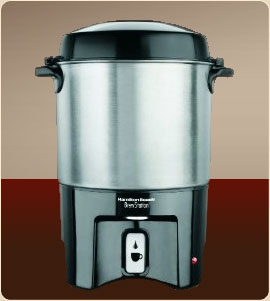
If you’ve been to a church coffee hour, a community center potluck, or any office big enough to have an actual lobby, you’ve probably stood in front of a Hamilton Beach 40540. It’s the urn people buy when they need to make a lot of coffee, don’t want to think about it, and don’t want to spend the budget on a commercial Bunn machine. The 40540 has been around long enough that the design has been refined to where there’s almost nothing to break and almost nothing to fuss with.
That doesn’t make it a great coffee maker. Urns are not great coffee makers. They were never meant to be. What it does is make 30 to 45 cups of perfectly drinkable coffee, keep that coffee warm for several hours, dispense without making a mess, and clean up in a few minutes. For about $90, that’s a very fair trade.
What you actually get
The 40540 brews between 12 and 45 cups in a single batch, where a “cup” is the urn-industry standard 5 ounces (not a 12 oz mug). It draws 1090 watts, which is enough to brew about a cup per minute. A full 40-cup batch takes around 45 minutes start to finish.
The body is stainless steel with black plastic on the handles, base, and lid. Cool-touch handles mean you can actually move the urn after brewing without an oven mitt, which sounds minor until you’ve tried to carry a hot urn full of coffee to a different table. There’s an internal heating element, an indicator light that turns green when brewing is complete, and a removable cord.
The two-way faucet is the design feature Hamilton Beach calls “BrewStation.” You can either press a cup against the lever for a hands-free pour or use it like a normal spigot. For self-serve setups, the press-to-pour version is much better at controlling drip and waste than a traditional twist-style spigot.
The filter basket is removable and dishwasher safe. So is the brew tube. The body wipes clean with a damp cloth.
How much coffee for a full batch
The most common question on this urn is how much ground coffee to use. The honest answer is that a 40-cup batch needs roughly 3 cups of medium-coarse ground coffee. For smaller batches, scale down using this rule: 2 cups of grounds for 25 cups of water, plus 1/3 cup of grounds for every additional 5 cups.
- 12 cups: about 3/4 cup of grounds (the minimum batch this urn supports)
- 20 cups: about 1 1/3 cups of grounds
- 30 cups: about 2 1/3 cups of grounds
- 40 cups: about 3 cups of grounds
- 45 cups (max): about 3 1/3 cups of grounds
Grind matters. Use coffee ground for percolators (medium-coarse, like coarse sea salt). The same grind sold for drip machines is too fine. It will give you muddy coffee with sediment in the spigot. If you’re buying a tub of pre-ground Folgers, Maxwell House, or Yuban, you’re fine. If you’re using whole beans, set your grinder to “percolator” or one step coarser than drip. For more on this, see our guide to making coffee in a coffee urn, which has a full measurement chart by capacity.
What’s actually good about it
- It’s hard to break. No fragile parts, no electronics beyond a heating element and an indicator light. Nothing for the temperature sensor to lose calibration on. Nothing for a circuit board to fry. The most common failure mode on a 10-year-old 40540 is the cord, which you can replace for $10.
- The press-to-pour faucet works. It dispenses cleanly, doesn’t drip after release, and gives self-serve guests a way to fill a cup without spilling everywhere. The lever’s spring is firm enough to require an intentional push, which keeps it from running by accident if someone bumps the urn.
- Cleanup is fast. Pop out the basket, dump grounds, rinse, wipe interior. Five minutes. Most failures on coffee urns trace back to people skipping the periodic vinegar descaling. The 40540 doesn’t change that, but at least the smooth stainless interior makes it easy to actually do.
- It scales down well. A lot of urns this size insist on a high minimum batch (25 or 30 cups). The 40540 will brew as little as 12 cups, which makes it usable for smaller coffee hours where you don’t actually need 40 cups.
What’s not great
- The coffee is fine, not memorable. Urn coffee is urn coffee. It’s brewed by percolation at near-boiling temperature and held warm for hours. You’re not going to mistake it for pour-over. If you’re hosting coffee snobs, brew a smaller batch in something else and use the urn for the rest.
- Brew time is long. Forty-five minutes for a full batch is normal for the category, but it means you have to plan the morning around it. Plug it in before you set up the rest of the room, not when guests start arriving.
- No insulation. The “warming” function is an active heating element, not a thermos design. If you leave coffee in the urn for 3+ hours, it starts to taste cooked. For very long events, brew a fresh batch midway through rather than relying on the warmer.
- Plastic parts. The lid handle, the base, and the lever assembly are plastic. They’ll last ten years of normal use but they’re not what you’d buy if you wanted something to outlive you. For all-stainless construction, look at the heavier (and more expensive) commercial urns from West Bend or Bunn.
Hamilton Beach 40540 vs similar urns
- West Bend 58030 (30 cups, $50 to $70). Smaller capacity but all-stainless construction. Better build quality, fewer cups. Pick this if you mostly host groups under 25 and care about how the urn looks on a buffet line.
- Hamilton Beach 45100 (100 cups, $150 to $200). Same general design at almost three times the capacity. Pick this if your events regularly run 60 to 90 people. Heavier and harder to store, so don’t go bigger than you need.
- Mr. Coffee CBTU45 (45 cups, $50 to $70). Plastic-bodied budget alternative. Same capacity, lower price, less durable. Fine for occasional use. The 40540 is worth the extra $30 if you’ll use it more than a few times a year.
Who this urn is for
The Hamilton Beach 40540 is the right call if you fit any of these:
- You run coffee hour at a small to mid-size church or community group (20 to 40 people regularly)
- Your office has 25 to 40 people and you want one urn that handles everyone
- You host family events, work picnics, or post-funeral receptions a few times a year
- You need an urn that newcomers can operate without an instruction sheet
- You want stainless rather than plastic but don’t want to spend $200
It’s not the right call if you regularly serve more than 50 people (size up to the 45100), if you only need coffee for 15 or fewer (a large drip brewer is easier), or if you want commercial-grade construction that will run daily for ten years (look at Bunn).
Frequently asked questions
How much coffee for the Hamilton Beach 40 cup coffee maker?
About 3 cups of medium-coarse ground coffee for a full 40-cup batch. Scale at 2 cups of grounds per 25 cups of water, adding 1/3 cup of grounds for every additional 5 cups of water.
How long does it take to brew a full pot?
About 45 minutes for a full 40-cup batch. Smaller batches scale roughly linearly at about 1 minute per cup.
What’s the minimum batch size?
12 cups (5 oz cups). Brewing fewer cups than that will not give you proper percolation and the coffee will be weak or under-extracted.
Can you put milk in the Hamilton Beach 40540?
No. Like all coffee urns, the 40540 is designed for water and coffee only. Milk burns onto the heating element and is extremely difficult to clean. Heat milk separately in a regular pot or in a smaller server.
How do I clean the Hamilton Beach 40540?
After each use: empty grounds, rinse basket and brew tube in hot soapy water, wipe interior with a damp cloth. Once a month or after every 10 uses: run a brew cycle with 1 part white vinegar to 4 parts water, then two cycles of plain water to clear any vinegar taste. Mineral buildup is the most common cause of slow brewing or weak coffee in urns.
Why is my Hamilton Beach 40540 brewing slowly?
The two usual causes are mineral buildup in the brew tube (run a vinegar descaling cycle) or trying to brew below the minimum batch size. Less commonly, the heating element is failing, in which case the urn won’t reach proper brewing temperature.
How long does coffee stay hot in the 40540?
The internal warming element will keep coffee at serving temperature for about 4 to 6 hours. Quality drops after the first hour as the spent grounds keep contributing bitterness. For events running longer than 2 to 3 hours, remove the basket after the first hour or brew a fresh batch midway through.
Is the Hamilton Beach 40540 dishwasher safe?
The filter basket and brew tube are dishwasher safe. The main urn body is not. Wipe it with a damp cloth and avoid submerging it.
For the full guide to urn brewing, see our article on how to make coffee in a coffee urn. For the smaller-batch home equivalent, see how to make percolator coffee.
Discussion