
Affiliate disclosure: As an Amazon Associate, TalkAboutCoffee earns from qualifying purchases. Our picks are based on editorial judgment, not commission rates.
Quick decision matrix
- Buy electric if: you want set-and-forget operation, you brew daily, you’re serving 8+ people regularly, or you need a unit for the office.
- Buy stovetop if: you camp, you want control over the brew, you don’t have counter space for another appliance, or you only make coffee occasionally.
- Best size for most homes: 8-cup, either type. Anything smaller and you’ll outgrow it; anything larger and you’ll never fill the minimum batch line.
- For 40+ people events: skip the percolator question entirely and get a coffee urn. See our coffee urn buying guide.
- Price ballpark: Stovetop: $20-50 (Farberware, GSI Outdoors). Electric: $35-90 (Presto, Hamilton Beach, Cuisinart).
If you’re trying to fix bad percolator coffee instead of buying a new one, see troubleshooting percolator problems. For brewing technique, see our percolator brewing guide.
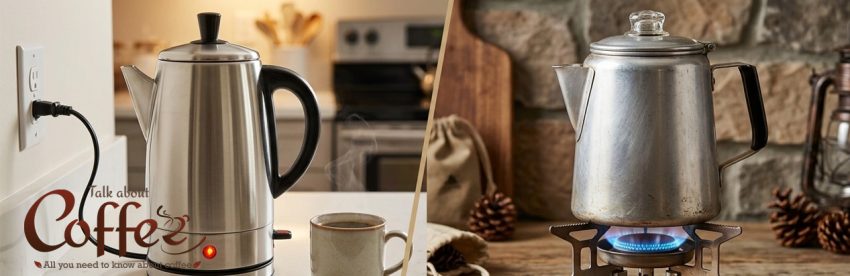
So you’ve decided to join the ranks of people who aren’t ashamed to admit they like percolated coffee. Good for you. Now comes the next big decision: electric or stovetop? It’s like choosing between automatic and manual transmission. Both will get you where you’re going, but the experience is completely different.
I’ve used both types extensively, and honestly, the “which is better” question is the wrong one to ask. The real question is which one fits your life, your kitchen, and your coffee-drinking habits better. Because trust me, there’s nothing worse than buying the wrong type and then convincing yourself you like it when you really don’t.
The Case for Electric Percolators
Let’s start with electric percolators, because they’re probably what most people think of when they hear “coffee percolator.” These are the plug-in models that do all the work for you, from those cute little 4-cup units to those massive 100-cup urns you see at church gatherings.
The biggest advantage? They’re basically foolproof. Once you figure out your preferred coffee-to-water ratio and timing, you literally just add water, add coffee, plug it in, and walk away. No babysitting, no adjusting heat levels, no watching through that little glass bubble wondering if you’re doing it right. The percolator handles the temperature control, shuts off when it’s done, and keeps your coffee warm without burning it.
This makes electric percolators perfect for offices, kitchens where you’re multitasking, or anyone who wants good coffee without the hands-on process. I know people who set up their electric percolator the night before, plug it into a timer, and wake up to fresh coffee. Try doing that with a stovetop model.
Electric percolators also tend to be more consistent. They’re designed to heat water to the optimal temperature for percolation and maintain it there. You’re not dealing with gas burners that run hot or electric stovetops that take forever to adjust temperature. The built-in heating element knows exactly what it’s supposed to do.
The downside? You give up control. If your electric percolator tends to run hot or perks too vigorously, you can’t just turn down the heat. You’re stuck with whatever the manufacturer decided was the right temperature and timing. Some electric models also have a tendency to keep coffee too warm for too long, which can make it taste burnt even if it started out perfect.
The Case for Stovetop Percolators
Stovetop percolators are the old-school choice, and there’s something deeply satisfying about the hands-on process. These are the ones your grandmother probably used, the ones that work on gas ranges, electric stovetops, campfires, and basically any heat source you can think of.
The biggest advantage is complete control. You decide how much heat to use, when to turn it down after that first perk, how long to let it brew, and exactly when to stop the process. You can adjust on the fly if your coffee is perking too vigorously or not quite strong enough. It’s like the difference between driving a car with manual transmission versus automatic. More work, but also more control over the experience.
Stovetop percolators are also incredibly versatile. They work on any heat source, which makes them perfect for camping, power outages, or kitchens with funky electrical setups. They’re usually more durable too, since they don’t have electrical components that can break. A good stovetop percolator can last literally decades with proper care.
The ritual aspect is real. There’s something meditative about the process of heating the water, listening for that first perk, turning down the heat, and watching the coffee bubble up through the glass dome. It forces you to slow down and pay attention, which some people find relaxing rather than annoying.
The downside? You actually have to pay attention. Walk away from a stovetop percolator and you might come back to bitter, over-extracted coffee or a burnt pot. They require more skill to use consistently, and there’s definitely a learning curve while you figure out your stove’s quirks and your preferred timing.
Capacity Considerations
This is where the differences really show up. Electric percolators come in a huge range of sizes, from tiny 4-cup models perfect for one or two people, all the way up to massive 100-cup urns that can caffeinate an entire office or event. The large electric urns are basically unbeatable for making coffee for crowds. Try making coffee for 50 people with a stovetop percolator and let me know how that goes.
Stovetop percolators tend to max out around 12-16 cups, with most falling in the 6-10 cup range. They’re designed for family-sized batches, not feeding an army. If you regularly need to make coffee for large groups, electric is pretty much your only practical option.
Portability and Flexibility
Want to take your percolator camping? Stovetop wins hands down. They work on camp stoves, over fires, and basically anywhere you can generate heat. Electric percolators need, well, electricity, which limits your options significantly.
But if you’re moving your percolator around the kitchen or office, electric models are often easier to relocate. Just unplug and move, versus having to deal with hot stovetops and potential spills.
Cost Considerations
Generally speaking, stovetop percolators are less expensive initially. You can get a decent stovetop model for $30-60, while electric percolators typically start around $50 and go up significantly for larger capacities. Those big electric urns can cost several hundred dollars.
However, stovetop percolators use your stove’s energy, while electric models use their own heating element. The energy cost difference is pretty minimal for normal home use, but it’s worth considering if you’re making large quantities regularly.
Maintenance and Durability
Stovetop percolators are simpler machines with fewer things that can break. No heating elements to burn out, no electrical components to fail, no automatic shut-off mechanisms to malfunction. They’re basically stainless steel or aluminum pots with some additional parts.
Electric percolators have more complex internals, which means more potential failure points. The heating element can burn out, the thermostat can fail, and electrical cords can wear out. On the flip side, they often come with warranties and are easier to replace when they do break.
For cleaning, both types require the same basic maintenance. Wash all the parts thoroughly after each use, clean the stem with a pipe cleaner, and descale periodically. Neither is particularly high-maintenance in this regard.
The Coffee Quality Question
Here’s where it gets interesting, because the coffee quality difference between electric and stovetop percolators has more to do with technique than equipment type. Both can make excellent coffee, and both can make terrible coffee if you don’t know what you’re doing.
Stovetop percolators give you more control over the brewing process, which means you can fine-tune to get exactly the flavor profile you want. You can adjust heat levels, extend or shorten brewing time, and stop the process at exactly the right moment.
Electric percolators prioritize consistency over customization. They’re designed to hit a sweet spot that works for most people most of the time, but you can’t tweak the process as much if you want something specific.
So Which Should You Buy?
Choose electric if:
- You want set-it-and-forget-it convenience
- You need to make coffee for large groups regularly
- You multitask in the kitchen and don’t want to babysit your coffee
- Consistency is more important to you than control
- You’re setting up coffee service for an office or event space
Choose stovetop if:
- You enjoy the hands-on brewing process
- You want complete control over your coffee
- You need something portable for camping or travel
- You prefer simpler machines with fewer failure points
- You like the ritual and tradition of manual coffee making
- Your kitchen has limited counter space or electrical outlets
Consider getting both if:
- You’re a serious coffee enthusiast who wants options
- You need different capacities for different situations
- You want electric for daily convenience and stovetop for weekends/camping
- You’ve got the budget and storage space
The Bottom Line
There’s no universally “better” choice between electric and stovetop percolators. It really comes down to matching the tool to your lifestyle and preferences. Electric percolators excel at convenience and consistency, while stovetop models give you control and versatility.
The good news is that both types can make genuinely good coffee when used properly. The bad reputation of percolated coffee comes from poor technique and cheap equipment, not from choosing the wrong type of percolator. Focus on getting a quality model of whichever type suits your needs, learn proper technique, and use good coffee ground to the right size.
Your taste buds won’t know the difference between coffee made in a good electric percolator versus a good stovetop percolator. But your daily routine definitely will.
Frequently Asked Questions
Only if you have access to electricity, like at an RV site or a cabin with power. Electric percolators need a standard outlet to operate, so they won’t work at a primitive campsite. For backcountry or tent camping, a stovetop percolator is the way to go. It works on camp stoves, over open fires, and basically any heat source you can find.
Not necessarily. Electric percolators make more consistent coffee because they control the temperature automatically, but “consistent” doesn’t always mean “better.” A skilled user with a stovetop percolator can fine-tune heat and timing to produce a cup that’s exactly how they like it. The quality comes down to technique and good coffee, not which type of percolator you use.
A quality electric percolator usually lasts 5-10 years with regular use and proper care. The heating element and thermostat are the most common failure points. Stovetop percolators tend to outlast their electric counterparts significantly. Some last decades because they have no electrical components to wear out. Regular descaling and thorough cleaning after each use will extend the life of either type.
Only if the percolator is made from a magnetic material like stainless steel. Aluminum percolators won’t work on induction cooktops because induction requires a ferromagnetic surface to generate heat. Check your percolator with a magnet. If it sticks to the bottom, you’re good to go. Many modern stainless steel percolators are induction-compatible, but always verify before buying.
Stovetop percolators are generally easier to clean because you can fully submerge them in water and even put most of them in the dishwasher. Electric percolators have electrical components in the base that can’t get wet, so you need to be more careful when washing them. Both types need the same basic cleaning routine. Wash all removable parts after each use, scrub the stem with a pipe cleaner, and descale with vinegar periodically.
It can be, but it doesn’t have to be. With a stovetop percolator, you control the heat and brewing time, so you can push extraction further for a stronger cup if you want. Electric percolators are designed to stop at a predetermined point, which usually produces a medium-strength brew. That said, coffee strength also depends on how much ground coffee you use and the grind size, not just the percolator type.
Discussion