
Affiliate disclosure: As an Amazon Associate, TalkAboutCoffee earns from qualifying purchases. Our picks are based on editorial judgment, not commission rates.
Quick instructions (the short version)
- Coffee: 1 heaping tablespoon of coarse-ground coffee per cup of water (about 240 ml / 8 oz). Up to 2 tablespoons per cup if you like it strong.
- Grind: coarse, like sea salt or coarse breadcrumbs. Anything finer turns muddy and bitter.
- Brew time: 4 to 8 minutes once it starts perking. Start checking at 4. Stop sooner if it looks dark enough through the glass bubble.
- Heat: drop it to low the moment percolation begins. A rolling boil is not what you want.
- Most important step: remove the entire filter stem (not just the basket) the second brewing is done. This is where most percolator coffee goes wrong.
Electric or stovetop, the ratios and grind are the same. The full method is below.
Let’s start with something that might make coffee snobs cringe. Nearly any coffee expert will tell you that a percolator is about the worst possible way to make coffee. Because the water is heated to a boil in order to perk, it’s really too hot for the coffee. It gets over extracted, and you end up with the bitterness and acidity that made coffee a “grownups only” drink back in the day.
But here’s the thing the experts don’t want to admit – sometimes they’re wrong.
I used to be one of those people who turned their nose up at percolated coffee. Pour-over this, French press that, anything but that ancient contraption bubbling away on the stove. Then I spent a weekend at a friend’s cabin where the only coffee maker was his grandmother’s old stovetop percolator. I was prepared for the worst. Instead, I had some of the most satisfying coffee I’d had in months. Rich, full-bodied, and it just worked. Made me realize the problem isn’t the percolator – it’s how people use it.
That said, there are still people who prefer perked coffee to any other kind. Taste is, after all, a matter of taste. And let’s be honest – those enormous coffee urns are still the best way to make lots and lots of coffee for a crowd. Try making coffee for 40 people with your precious pour-over setup and see how that goes.
Why Percolators Get a Bad Rap (And Why It’s Not Always Fair)
The reputation problem comes from decades of people doing it wrong. Too fine a grind, too much heat, too long on the burner – and yeah, you’re going to get bitter, over-extracted swill. But that’s not the percolator’s fault any more than a burnt steak is the grill’s fault.
The science behind it is actually pretty straightforward. In a percolator, boiling water gets forced up through a hollow stem, sprays over the coffee grounds, then filters back down through the grounds and into the pot below. The cycle repeats until you turn off the heat. Done right, this creates a strong, full-bodied coffee. Done wrong, and you’re basically boiling your coffee grounds into submission.
Most people’s percolator horror stories come from leaving the thing on the stove too long, using coffee ground fine enough for espresso, or both. It’s like judging all grilled food based on hockey pucks someone left on the barbecue and forgot about.
The Parts You Need to Know
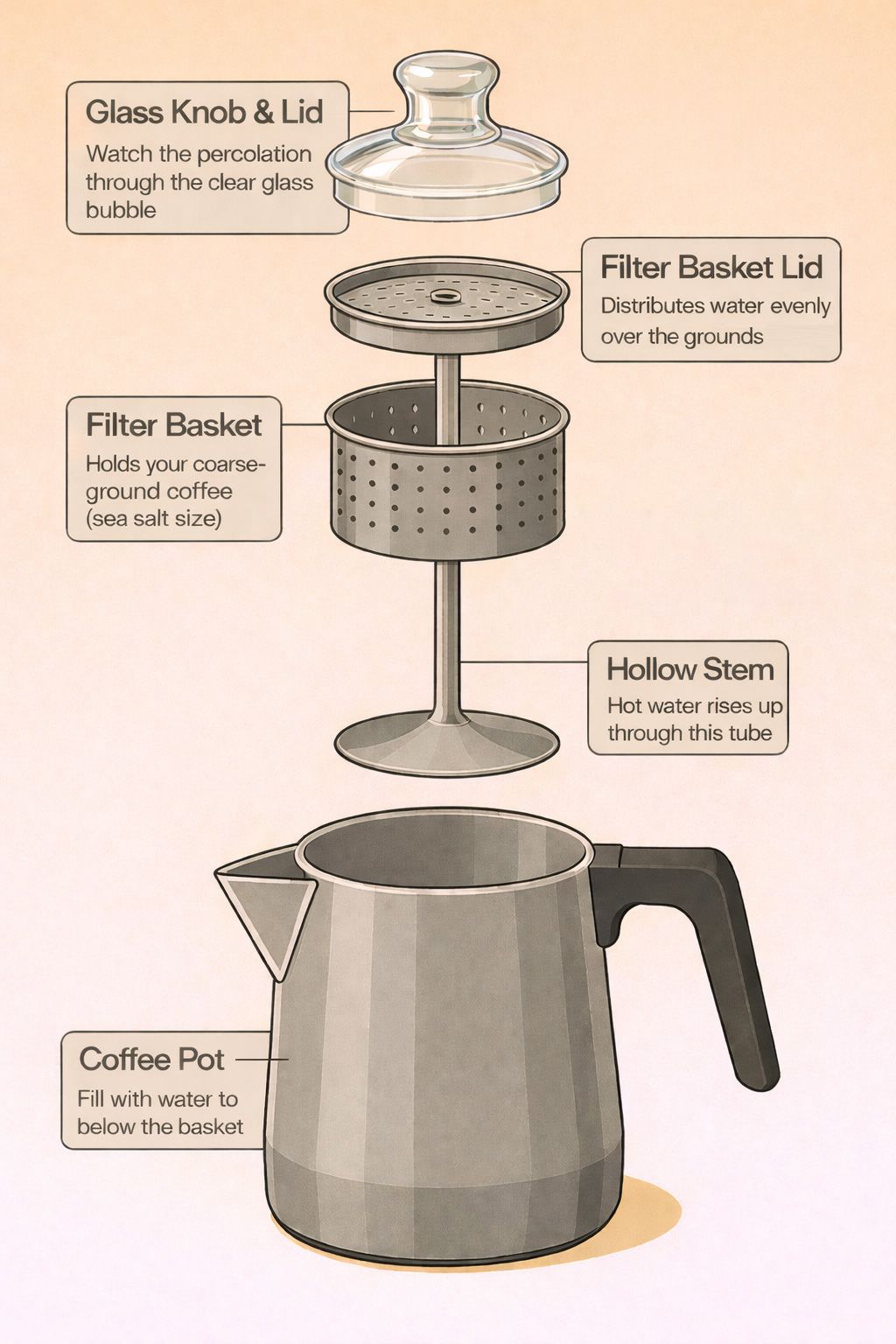
A coffee percolator has five main parts, and understanding each one helps you avoid the mistakes that give percolators their bad name.
There’s the percolator coffee pot itself, into which you put your water. There’s the stem, a hollow metal tube that fits into the bottom of the pot – in non-electric models, it has a flat round bottom that sits on the base. There’s the filter basket, which slides onto the tube and holds the ground coffee. There’s the filter basket cover, a round perforated lid that fits on top and makes sure the water showers the entire basket evenly. And finally, there’s the coffee pot lid, which often has a glass bubble in it.
That glass bubble just might be the most fun part of the entire contraption. It lets you watch the coffee splurting up from the tube and splashing inside before it spills back down onto the lid. Weirdly mesmerizing, like a little coffee fountain show happening right there on your stovetop.
Electric vs. Stovetop: Which Should You Choose?
Coffee percolators come in two distinct types – electric and stovetop. Each has its place, and honestly, both can make decent coffee despite their horrible reputation if you follow a few guidelines.
Electric percolators, including those coffee urns that can make up to forty cups at a time, are the set-it-and-forget-it option. They’re consistent, they shut off automatically, and they’re perfect for offices, church basements, and anywhere else you need to caffeinate a crowd without babysitting the process. The downside? You give up control over timing and temperature.
Stovetop percolators give you complete control, which is both a blessing and a curse. You can adjust the heat exactly how you want it, but you also have to pay attention or risk over-extraction. They’re great for camping since they don’t need electricity, and there’s something genuinely satisfying about the hands-on process. One of our readers pointed out they work differently at altitude too – at 5,300 feet, water boils at about 201 degrees, and percolators run roughly 10 degrees cooler than that, which actually makes the coffee come out better than at sea level. I thought that was fascinating.
What actually changes between the two (steps below stay the same otherwise)
- Heat: electric uses its own thermostat. Stovetop, you start at medium and drop to low the moment it perks.
- When it’s done: electric chimes or shifts indicator color. Stovetop, you watch the glass bubble and the clock.
- Pulling the basket: both still need the entire filter stem removed the second brewing finishes. Most electric models do not do this for you automatically.
- Capacity: stovetop models usually 4 to 12 cups. Electric urns scale up to 40 or 100 cups for events and offices.
For a deeper comparison and buying advice, see Electric vs Stovetop Percolators: Which Should You Buy?
How to Make Perfect Percolator Coffee
Here’s how to make percolator coffee that won’t make you question your life choices:
- Keep all parts of the percolator clean. This isn’t optional. Wash the entire thing with dishwashing liquid and hot water every single time you use it. Coffee oils go rancid faster than you’d think, and old residue will ruin even good coffee. Use a pipe cleaner for the inside of the stem. I learned this the hard way after wondering why my coffee tasted like the bottom of a week-old pot.
- Use freshly ground coffee – and make sure it’s coarse. This is where most people mess up. That pre-ground coffee from the grocery store? It’s ground for drip coffee makers and it’s too fine for percolators. You want a coarse grind, more like sea salt or coarse breadcrumbs. If you don’t have a grinder, look for coffee labeled as coarse grind, or ask your local coffee shop to grind it coarse for you. On a camping trip with no electricity? Carry your ground coffee in a vacuum container with a lid to keep the air out.
- Get your water level right. Disassemble the percolator and put the stem in place. Fill with water to below the line where the filter basket sits. Too much water and you’ll get weak coffee. Too little and it won’t perk properly.
- Don’t be stingy with the coffee. Put the filter basket on and add one heaping tablespoon of coffee for each cup of water. Some people go up to two tablespoons if they like it strong, but start with one and adjust from there. Put the basket lid in place.
- Start the heat. If you’re using an electric percolator, plug it in and turn it on – it’s on its own now. If you’re using a stovetop, put it over medium heat. Not high, not low – right in the middle.
- Watch for the magic moment. As soon as the first splurt of coffee hits that glass bubble, turn the heat down to low. This is crucial. You want just enough heat to keep percolation going, but not so much that you’re boiling your coffee. You’ll hear it change from rapid bubbling to a gentler, slower rhythm.
- Time it right. For most people, 4-8 minutes of perking is the sweet spot. Start checking at 4 minutes – the coffee coming up through the bubble should look like actual coffee, not weak tea. Don’t overthink it.
- Stop the process immediately. As soon as the pot stops perking or you decide it’s strong enough, pull it off the heat.
- Remove the filter stem – this is the step everyone skips. Carefully take off the lid and pull out the entire filter stem assembly, not just the basket. If you leave it in, steam from the coffee keeps condensing, dripping through the spent grounds, and making your coffee progressively more bitter. This is how perfectly good percolated coffee turns into undrinkable swill in about ten minutes.
- Let it rest, then enjoy. Give it about 30 seconds so any grounds that escaped can settle, then pour yourself a cup. You might be surprised by how good it actually is.
When Percolators Actually Shine
Despite what the coffee cognoscenti will tell you, there are situations where percolators are not just acceptable but actually the best choice.
Camping and outdoor adventures. Try bringing your French press on a camping trip and see how long it lasts. Percolators are practically indestructible, work on any heat source, and make coffee strong enough to get you moving after sleeping on the ground.
Large groups and events. Need coffee for 20, 30, or 50 people? A large electric percolator urn beats making pot after pot with any other method. They keep coffee warm for hours without that burnt taste you get from drip makers with hot plates.
The ritual of it. Sometimes the process matters as much as the product. There’s something deeply satisfying about the sound of a percolator bubbling away, the anticipation as you watch that glass bubble, the ritual of removing the basket at just the right moment. It connects you to decades of coffee drinkers who found comfort in exactly the same process.
Troubleshooting Common Percolator Problems
My coffee tastes bitter and terrible. Nine times out of ten, you’re using too fine a grind, perking too long, or both. Try a coarser grind and shorter brewing time. And make sure you’re removing that filter basket immediately when done.
My coffee is weak and watery. Not enough grounds, or the grind is too coarse and water’s flowing through too quickly. Try adding more coffee first, then adjust grind size if needed.
My percolator won’t start perking. Check that the stem is seated properly and the water level is right. It can take 5-10 minutes to get going, especially with electric models. Be patient.
The coffee is muddy and full of grounds. Your grind is definitely too fine. You want pieces about the size of coarse sea salt, not coffee dust.
Best Coffee Beans and Grinds for Percolators
Not all coffee works equally well in a percolator. Medium to dark roasts are your best bet because they’re less acidic and more forgiving of the longer extraction time. Brazilian, Sumatran, and other low-altitude coffees tend to be naturally lower in acid, which plays nicely with percolation.
French roast and Italian roast are particularly good choices. The roasting process has already broken down some of the compounds that turn bitter with extended brewing, and the bold flavors hold up well against the strong extraction.
For grind size – think coarse, then go a little coarser. If you’re grinding your own, a burr grinder set coarse gives you something that looks like coarse breadcrumbs or sea salt. Too fine and you get muddy, over-extracted coffee. Too coarse and the water flows through without pulling enough flavor.
The Bottom Line
I’m not going to pretend that percolated coffee is better than a well-executed pour-over or a properly pulled espresso shot. But it’s also not the coffee catastrophe that the experts make it out to be. Made properly – right grind, proper timing, remove the basket – percolator coffee is rich, full-bodied, and satisfying in ways my pour-over never quite manages.
The real problem isn’t the percolator. It’s people who don’t know how to use one. Master the technique, use good coffee ground to the right size, pay attention to timing, and you might find yourself reaching for the percolator more often than you’d ever admit in polite coffee company.
After all, our grandparents drank percolated coffee for decades. They weren’t wrong about everything.
Frequently Asked Questions About Percolator Coffee
Not if you do it right. The bad reputation comes from over-extraction – too fine a grind, perking too long, or forgetting to remove the filter basket after brewing. Follow proper technique and you might be genuinely surprised by how good it can be.
4-8 minutes depending on how strong you like it. Start checking at 4 minutes and taste-test. The coffee coming up through the glass bubble should look like actual coffee, not weak tea. Stop before it gets too dark or you’ll end up with bitter brew.
Coarse grind, like sea salt or coarse breadcrumbs. Fine grinds will give you muddy, bitter coffee that’s impossible to enjoy. If you’re buying pre-ground, look specifically for “coarse grind” or ask your coffee shop to grind it coarse for percolators.
Usually over-extraction from perking too long, grind that’s too fine, or water that’s too hot. Try shorter brew time, coarser grind, and lower heat once percolation starts. And make sure you’re removing the entire filter stem immediately when brewing is done – not just the basket.
Most store-bought ground coffee is too fine for percolators. It’s ground for drip coffee makers and will give you muddy, over-extracted results. Look for coffee specifically labeled as coarse grind, or better yet, grind your own beans.
Start with 1 heaping tablespoon per cup of water. If you like it stronger, go up to 2 tablespoons per cup – but don’t just brew longer to get more strength. That’s how you get bitterness. More grounds, not more time.
Yes, immediately. This is the step most people skip, and it makes all the difference. Remove the entire filter stem assembly, not just the basket. If you leave it in, steam keeps condensing and dripping through the spent grounds, turning your coffee bitter within minutes.
Electric is more convenient and consistent, plus it shuts off automatically. Stovetop gives you more control over heat and timing, and works great for camping. Both can make good coffee with proper technique. It really comes down to how hands-on you want to be.
Check that the stem is properly seated in the bottom of the pot and the water level is correct – it should be below where the filter basket sits. Be patient too. It can take 5-10 minutes for the water to heat up enough, especially with electric models.
Use fewer grounds rather than reducing brew time too much. If you cut brewing time too short, you’ll get weak, sour coffee instead. You can also dilute strong percolated coffee with hot water after brewing – think of it like making an Americano.
Wash all parts with hot soapy water after every use. Use a pipe cleaner or long thin brush for inside the stem – coffee oils build up in there and will make your next pot taste rancid. Once a month, run a cycle with white vinegar and water for a deep clean.
Let the water heat until it just starts to perk, then immediately drop the heat to low. You want hot enough to percolate but not a rolling boil. The percolation should be gentle and steady, not violent bubbling.
Use more coffee grounds rather than longer brew time. A darker roast also gives more intense flavor without extra bitterness. Some people swear by adding a tiny pinch of salt to cut bitter notes, though that’s definitely a personal preference thing.
Interestingly, many people with coffee-related heartburn actually find percolated coffee easier on their stomachs than drip. The longer brewing process and higher heat can break down some of the acids that cause problems. Dark roasted beans help even more with this.
Only on an electric coil or solid-hob stove. Those hold and spread heat unevenly, so a diffuser keeps the base from scorching the coffee closest to the metal. On a gas burner, skip it and set the pot directly over the flame. This is one of the most common questions in our comments, and it comes up because so many people inherit a percolator with no manual attached.
It is a genuine old-timer method, and there is real chemistry behind it. Crushed eggshell is calcium carbonate, which neutralizes some of the acid in the grounds and mellows the cup. Cleaned, dried, crushed shell gets mixed in with the grounds before brewing, and the filter or basket traps the sediment along with the coffee grounds. It works, but it is a lot of fuss for a marginal difference, and a coarser grind gets you most of the way there without cracking an egg.
Drop them in the comments below. With over 500 comments from fellow percolator users, our community has probably faced your exact issue before – and there’s always someone willing to share their hard-earned wisdom.
Discussion 582
Jessie, look around ebay and occasionally you will find old coffee pots that will strike your fancy. I know i quit looking because i was too successful.
Tina, most of the time i just let the basket stay if the coffee will get served quick enough, but when i take out the grounds and basket i usually use a well wrung out dish rag and/or a pot holder. I’ve found that the Better Homes and Garden brand from Walmart have silicone ribbing on one side and that keeps a good grip on pots, coffee pots, etc. The last time I took out the basket I used the silicone grippy pot holder and a pair of pliers to lift the tube and basket out. No problems. Good luck and good coffee.
Is there a way to avoid burning my fingers and making a big mess when I remove the grounds from my 8 cup century stove top pot? I’m brand new to perking. I started after a visit to older relatives who perk great coffee.
I’ve been using a percolator for years. My electric percolator has recently died on me so I comadeered my grandma’s stove top percolator and I was amazed at the taste! I like my coffee stronger than the electric one makes it so now I can make it to my own taste. Anyone know where I can get an good old fashioned one since I am a lover of antiques?? 30’s or 40’s? No great thrift shops around here.
I bought an electric Sunbeam Deluxe coffee percolator at a second hand store for $10. I remember the smell of good coffee from years ago and I’m tickled pink this machine was a great purchase! Yay hot coffee!
I just was given a little 7 cupper stove top percolater. I remember my grandmother making it, but am at a loss to how to make it myself. Love all of the repsonses on your site, helpfu, but still not sure of amount/time/and if a filter is needed let me know. Thanks.Pam
Hi Mark. I vote you just use the perk to keep the water hot and then have packets of instant hot chocolate available for folks to make their own. You can be the ultimate party host and offer other “instant” hot drinks at the same time like a variety of teas (herbal, flavored, plain, chai) and cider. Put all of your packets in a nice bowl and offer cream, sugar, honey, lemon, etc on the side for a sort of hot drink bar. It might be a little to fru fru for a cowboy party, but hey – nothing wrong with a little luxury with your bonfire! Anyway, you will make it your own and I’m sure it will be FABULOUS and your guests will be impressed!!!
Can you use a 12-42cup automatic(westbend party perk)to make or just keep hot chocolate hot? any rules will it get and stay too hot or should I just use this to heat and keep water hot and give out pkts of H.C. thanks
I guess you can find anything on the web. I am having some folks over tomorrow night for a “cowboy” cookout and am going to make some good old “cowboy” coffee over a fire. I usually don’t mind a few grounds in my coffee and sometimes I think it’s actually better the longer it goes. I’ve even put the left overs back on the fire the next morning. I know it goes against all coffee experts preach, but sometimes we just need to go back to the old ways and enjoy things the way our grandfathers did when life was much simpler and care free. Thanks for all of your comments!
Kelly, what she did was likely check the color as a gage for quality/strength when using a stove perc whereas an electric perc does the job via the setting..I set my perc at strong and adjust according to the roast(I prefer medium which provides enough flavor w/o the bitterness/oil of dark/french roast) plus, as I get half way/near the bottom I pour a cup of hot water over the grounds basket to extend my pleasure drink, if desired. I no longer buy the expensive Columbian dark roast needed when I utilized a drip machine because my perc circulates the heated water enough times to properly “cook” not “boil” the grounds. By the way, left-over coffee makes an excellent rich base for roast beef, etc., gravy/sauce, w/o coffee taste. Something else I learned living in New Orleans.
I have a question about an odd “coffee” behavior I noticed in an old (1930s) film. Norma Shearer was making coffee with a stove top percolator. Once it finished brewing she took off the top of the percolator, poured a little coffee into a cup and then immediately pour that coffee back into the filter basket. She put the top back on and then served the coffee! What did she do that for? Thanks!
Enjoyed this blog, I’m only down to about the 90th message and am running out of time. Will be back.
A couple of comments:
We had a nice Cuisinart electric percolator. Eventually the clear plastic knob on the lid came loose because the tabs holding it down wore out. Cuisinart was very kind – they send a replacement for the knob for free. That was a few years ago. Eventually the plastic base warped, though, and we ended up shopping for another. Couldn’t find another Cuisinart, but we now use a Betty Crocker. Excellent machine. It keeps the coffee very hot all day with no loss of flavour.
This past week or two the coffee quality went down, and I think it’s because we used a finer grind than usual and the basket holes became clogged. I’ve cleared them now, and am looking forward to the next pot.
Nabob’s Full City Metropolis coffee is a dark roast that I find nice and strong.
It used to be common to add salt to coffee made in restaurants around 35 – 40 years ago to reduce bitterness, but there wasn’t the variety of coffee available that we have now. I don’t know if they still do that.
Cowboy coffee sounds much like Swedish kokkaffe (cooked coffee). You put coursely ground coffee grinds into a saucepan or kettle, and boil it a while. The caffeine content is high, and you drink it with a sugar lozenge between your front teeth (Swedish sugar lozenges don’t melt as quickly as North American cubes do).
For so long, I was stuck with instant coffee on camping trips (solo). I bought one of those blue “denim” enameled percolators, thinking I might use it reasonably well. I bought disc filters to put in the basket before adding ground coffee; I was disappointed at how much of the grounds/sediments it allowed to pass. I was back to instant, but not willingly…or for long. I discovered “wrap around” filters! These have the usual center hole that slides over the stem. You add your coffee and then fold the corners over; the corners have holes, too, so they go over the stem and completely enclose the grounds. Now that coffee was good!
Coffee perc it is! I was all set to buy a Faberware electric perc at Bed and Bath yesterday, but stopped myself. After many years of drinking electrically made coffee, I had enough. I kept remembering the ’60’s, when I had a lovely Corningware stove pot and made this wonderful coffee. I thought those days were gone until I went on the web and found one, just like the one I used to have. It isn’t here yet, but the comments of everyone boosts my patience; I can hardly wait for that special cup. I might add, everyone loved my coffee. I used to make 2 or 3 pots a day. It was always wonderful.
Reply to Bill Cooper: I suggest the Internet with all its links plus take broken parts to old neighborhood appliance and hardware stores to possibly match with similar shape/size of metal/glass. Use imagination/improvise. As I mentioned before, check Salvation Army and other discount shops.
Bill, See the exchange between Myself (Margy) and Russ of March 10 and 12 of this year.
Russ has such good information for all of us!
I’ve unearthed a 35-year old Farberware percolator and would agree with anyone who proclaims that the percolator produces coffee that is as rich and mellow as any drip coffeemaker and maybe even French press. But the little clay insulator that goes at the base of the stem has shattered and our local stores in Virginia say they haven’t seen clay insulators for years. Anyone know where such can be found?
So glad I stumbled on this site. I am a backpacker who has turned to car camping with a toddler and bought an enamelware set that came with a perc. I plan to make my first batch this weekend and all of the info was very useful. If it’s good, I may have to perc at home and dump the drip. Thanks again.
Additional comments to my previous yesterday. I feel that everyone should drink what they enjoy. I find artsy fartsy coffees w/steam/camels milk, etc.,stirred by finger of a virgin to be a special treat but day-in-day-out coffee should be simple, enjoyable and non-expensive. During my years as a marine surveyor in the Port of New Orleans I examined many thousands of tons of all types green coffee from all parts of world and developed a taste for “the right coffee”. I discoverd that most coffee importers/roasters purchase good beans but some small label high profit operations buy “trash coffee” from certain parts of Africa, etc.. No matter the quality of green beans (not trash)the roasting process determines the product one drinks. I suggest that one stick with what one knows or what parents/friends drink or at least select a label that has been proved over time. Black/dark/oily French roast is for espresso, etc., but too heavy for casual drink, to my taste. Select a medium roast which brings out the real coffee taste and can be adjusted via amounts. Light roast is a waste of coffee/money. Drink tea.! Use a drip machine(?) borrow or obtain an old perc from family attic and experiment. One level tablespoon of grounds per 8 oz cup and try medium and strong settings..Apinch or 2 of salt to neutralize acid.
New Orleans type coffee with chicory (ground roasted root) is an acquired taste and best when drank there. Water is as important as the coffee. All tap water has been treated with chlorine gas which rapidly dissipates when exposed to the atmosphere but if it smells of such, simply fill a sauce pot full and let set for 15-30 minutes or bring to boil on stove, or run through a filter that removes chlorine. Don’t waste money on bottled water most which came from plants tap and distilled is tasteless due to minerals removed. Keep it simple. Old perc not have timer to allow fresh coffee when one awakens, simply add a timer device to wall socket. Duh? or Duh! Life is a “hoot” when stating the day with a pleasant coffee so, enjoy!
I too had a hard time figuring out how to make coffee in a large urn, until a friend who is a minister’s wife told me how she made it at church. For a 50 cup pot, she used a plain white paper towel as a filter in the bottom of the basket, making a small hole in the center for the stem. She put 2 1/2 cups of good coffee over the towel and folded the outer edges of the paper towel in, then locked the cover in place. It takes about an hour to perk 50 cups. When the light comes on, carefully unlock the lid, remove the basket/stem and replace the lid. It’s ready!
I recently re-discovered “good coffee” when I paid $3 for a vintage GE perc I could not pass up at the Salvation Army Store, cleaned it and checked the electricals then, next morning drank the best cups of coffee I’ve made in years. You can find good deals at those stores, i.e., replacement cords, pots/pans, bread machines, etc., at fantastic prices, which are brought in/donated daily. Its a good trade.
They obtain funds and we obtain bargains/items no longer made and/or made in the USA. That plastic Chinese crap in stores these days does not cut it plus, I’m big on recycling/using a well made item until non-repairable. Special note: A pinch or two of salt (alkaline/base) in the basket will do the same as egg shells to neutralize the coffee acidity.
I just purchased 2 vintage electric percolators, 1 is a Universal with a red glass dome and bakelite feet and the other is Manning-Bowman Co. I started them both with a vinegar mixture to clean them out and they perked along happily forever! I want to use them. Do I assume they are too old to have the “Stop Perking” cycle? They start bubbling quite quickly and then go into full perking mode in about 8 minutes. Would that be when I unplug them? I am anxious to enjoy the aroma!
Hi – had the same question earlier this year and Russ found out for me that it is there to hold up the spring, which, on some models is not “attached” to the stem. Without the ceramic sleeve to hold up the spring, the basket would fall to the bottom. Also, DipIt cleans that ceramic to almost white. Great stuff for the whole pot, but get the powder box.
I have a question. I just bought an electric percolator at a garage sale. On the stem, there is another tube – it’s dark grey and has a rough texture, it fits loosely so you can slide it off, and it’s about 1/8″ thick. What is this, and what’s it’s purpose. It seems like some kind of stone”
Thank you. I will try and hopefully will be successful.
Hey Rebecca, welcome to the world or “percs.” The top of this article pretty much says it all about stove top percolators except that i use a filter either regular drip filter and just push it over the pump tube or the wrap around type especially for percolators. Since I generally forget about stuff on the stove I set a timer once the first perc hits the glass top. I set it for 7 minutes for a little stronger brew, some folks may like 5.
After that I lower the flame then put a heat diffuser under the pot to keep it warm and not perc. I don’t usually remove the basket. Just too lazy and the coffee doesn’t last that long anyway.
Hope this helps and percolate in good health.
I just found an unused Revere Ware copper clad bottom 8 cup coffee percolator in our basement. All the tags were still inside but there were no usage instructions included. I called Revere Ware and they told me they will try to find instructions and mail them to me. Please help me try to use this vintage percolator to make a great tasting cup of coffee. THANK YOU to anyone/everyone who can give me much appreciated advice and directions.
I have been a stove top user for 40 years, I have tried so many different machines none of which make great coffee at home, If I have guests I bring out a espresso machine machine and make cappuccino for them. For myself I use my stove top, I drink it black with no sugar thats the only way you can taste the pure coffee taste.
personally I dont think it makes a lot of difference using spring or filtered water , Good coffee doesnt need to be flavoured with nuts or anything else, I keep my coffee dry in a cupboard. at the end of the day its all a matter of personal taste, my wife cant drink my coffee she thinks its way to strong.
Just curious…as much as I am a coffee fanatic, I simply *love* the deco-retro styles of some percolators. Is this a draw to others as well? I also figure if I can find a vintage perc that still functions, it ought to just about go forever, rather than the plastic $100 wishy-washy coffee makers I have been buying!
Well, I found a guy locally who looked at the Jet O Matic (by Duncan Hines no less! LOL), and he said the pump was bad, so David M, you hit it on the head! He is holding onto it for me for parts, since I like the design/shape of that particular percolator. Found another one (with a white handle?) on ebay last night for $21. Will try again!
Well…. I just used my fabulous eBay purchase – a 2-4 cup Farberware Made in USA glass knob – percolator and am enjoying the coffee. I bought some Peet’s ground for a percolator and so far so good. And I bought it in the first place because paper filters are a PITA, press coffee isn’t good due to the grounds just sitting in the water, and I read how fabulous perc coffee is despite its old bad rep.
oh yeah, i guess i should say “appliance parts store” not appliance store, big dif.
i might add that i rationalized the thirty dollars because a new electric 12 cup percolator costs sixty dollars and is made in china and from the reviews in amazon they last about two years tops before repairs are needed. plus i thinks it’s cool to have a percolator with “brooklyn, ny” on the bottom instead of another country.
amanda, try looking for a mr. appliance store in the phone book. they sell parts as well as repair. my farberware percolator did the same thing-luke warm water and the coffee was really weak. that means the heating element is bad as well as the warming thingy that keeps the coffee hot.if you know what part is which just take them in to an appliance store and they should have them. i just shelled out the thirty bucks and had them do it. the parts are probably a lot cheaper. good luck and good coffee!
For Amanda W.: Many electric percolators have two heating elements, one to boil the water at the base to get it hot enough to perc (perc means the bubbles from the boiling water blow water up the tube to the top which then drips down through the basket of ground coffee), and then another heating element that is a lower temperature heat used to keep the finished coffee warm. Sounds like your brewing (perc element)may not be working. Does the red light come on at the end of the brewing cycle?
Sorry, I don’t know where to find repair parts, but if it’s just the corroded rivet a real handyman sort might be able to repair that connection. But, any repair is likely to cost more than you would pay for a replacement. Ask a friend that’s handy with minor electrical repairs to look at it.
Ok, I took off the bottom, and it looks like at some point it got wet. There is a rivet rusted off of the heating element (?). Can someone recommend somewhere to send it for repair that won’t cost an arm and a leg?
I just purchased a retro “Jet-O-Matic” model 10 electric percolator…looks great, cleaned up super well. Now the bad side… it does not get the coffee very hot, nor very strong. Could it be burnt out? Ran it with just water and got 150 degrees. Ran it with coffee and got something resembling hot tea. Help!
Hi I have a coffer perc , it has a suspended container with small holes that sits in the top of the bell bottomed base and an aluminium cap with holes in it that fits on top of it , then the lid goes on no glass bubble , no pipe or stem etc Does the steam just rise thro the coffee condense on the aluminium lid , it has holes in it as well, then drip back into the water beneath taking the grounds with it ? Very odd set up nothjing seems to be misssing ? Seems to take for ever to fire up and then turns the coffe fround to a thick goo . Help ,thanks, derek
Not to mention that the plastic in drip coffee makers breaks down and leaks god knows what into every cup you brew.
Start with cold water! That is important to a decently strong brew as well as to not “boiling” the coffee trying to get it stronger.
Also, the writer says: “As soon as the pot stops perking, remove it from the heat.” This works with electrics, but on a stovetop it won’t really stop perking so you’ll need to judge when to take it off the heat.
I did not see these mentioned though I didn’t have time to read every word of each post.
Love love love this page, it’s been instructive and productive since my foray into perked coffee.I found a used 12 cup electric percolator at a thrift store and it worked twice and then the coffee was weak and luke warm. Took it to a Mr. Appliance store(apparently a franchise) and they replaced the thermostat and the heating element for $30. That sounds expensive but the thing cost 4 dollars and was made in the U.S.A.-a truly vintage piece-and a new one is 50 to 60 dollars. So for the folks out there who have thrift store finds that are missing pieces or not working properly go to an appliance parts store or search ebay. It’s truly worth the price.
As for the grounds in the coffee, I get those even though i use filters. The wrap around filters work a little better but I usually use the basket type and just gently poke a hole in it over the tube.
One question-Do you generally use more coffee for perked vs drip? I’ve found that i use more for the perked kind.
Thanks for all the info
If you like coffee made in a stainless steel percolator, then you REALLY need to try using a glass (Pyrex) percolator, if you can find one. I got mine on THE online auction house.
thanks for all the GREAT info. used my percolator once camping and the coffee was gross. now i know what i did wrong…everything. going again this weekend. i bet the coffee will be better. since it is a essential to start my and my hubbies day, THANKS!
drip pots break often when hand washed not worth the price of replacement after busting two
Wow… I thought I was the only throw back to perc’ed coffee. My Black and Decker was removed from my house when the X spousal unit wanted it keep it – I found a CorningWare perc pot at a consignment store and have been using it for about a week. The aroma, the richness, the “hot” cup of coffee… I just needed a tweak on brewing as I think I was letting it sit on the heat too long.
I don’t think I’ll be buying a new drip maker. I have been re converted back to my percolator. Cheers! and a hot cup of java back to you.
Anasa, check to see if there is an adjustment on the bottom of the stem. Some coffee makers let you choose the strength of the brew by turning a graduated dial on the bottom of the stem. Also make sure the stem, basket, basket lid, and top lid are secured before brewing. Since the percolator forces hot water up the stem, through the coffee grounds, and then down into the pot, it sounds like the water isn’t taking the right route. If all is working well the coffee should be strong. Also, check to see how hot the water is after brewing. You may have a faulty thermostat that is stopping the brew too soon.
To Anasa, Get rid of that China made Farberware and buy a vintage GE or vintage Farberware on ebay. Try to get one from the 70’s. They make super hot, rich coffee!! I promise it will be the best!! My ge is 40 years old and still brewing every morning. What I do is use 1 tablespoon per cup and add 1 more and it comes out fantastic!!
I just bought a Farberware 12 cup percolator and after 4 attempts, my coffee still comes out extremely weak. I tried the recommended amount for medium coffee, strong coffee, the amount I used to use in my drip coffee maker and a little more the last time and it is still weak. I am using Starbucks Espresso which is very bold usually.
My failed attempts are getting pretty expensive since I waste coffee at home and end up buying a cup from the coffee house.
Please help.
Hi,
I been a coffee drinker my whole life which is nearly 48 years now, and I too agree with Eric as far as the percolator being a much better coffee over the drip automatic. But using the percolator is not about how much time to spend in using one, or a special kind of grounds, as much as it is watching that perk very closely and turning down the burner the second that thing starts to perk. After that you let it perk at a very nice gentle slow perk until the desirable smell of your coffee and somewhat the color of it through the site glass until it smells just about right for you. Let your smell be the judge if it, not how many minutes. Two things especially to remember. Always perk real slow the second it starts to perk, and let your nose be the judge.
Gene, if you’re using an electric it should be automatic. If you’re using a stovetop, 5 to 7 minutes.
hello how long do we let it perk for a 12 cup