
Affiliate disclosure: As an Amazon Associate, TalkAboutCoffee earns from qualifying purchases. Our picks are based on editorial judgment, not commission rates.
Quick instructions (the short version)
- Coffee: 1 heaping tablespoon of coarse-ground coffee per cup of water (about 240 ml / 8 oz). Up to 2 tablespoons per cup if you like it strong.
- Grind: coarse, like sea salt or coarse breadcrumbs. Anything finer turns muddy and bitter.
- Brew time: 4 to 8 minutes once it starts perking. Start checking at 4. Stop sooner if it looks dark enough through the glass bubble.
- Heat: drop it to low the moment percolation begins. A rolling boil is not what you want.
- Most important step: remove the entire filter stem (not just the basket) the second brewing is done. This is where most percolator coffee goes wrong.
Electric or stovetop, the ratios and grind are the same. The full method is below.
Let’s start with something that might make coffee snobs cringe. Nearly any coffee expert will tell you that a percolator is about the worst possible way to make coffee. Because the water is heated to a boil in order to perk, it’s really too hot for the coffee. It gets over extracted, and you end up with the bitterness and acidity that made coffee a “grownups only” drink back in the day.
But here’s the thing the experts don’t want to admit – sometimes they’re wrong.
I used to be one of those people who turned their nose up at percolated coffee. Pour-over this, French press that, anything but that ancient contraption bubbling away on the stove. Then I spent a weekend at a friend’s cabin where the only coffee maker was his grandmother’s old stovetop percolator. I was prepared for the worst. Instead, I had some of the most satisfying coffee I’d had in months. Rich, full-bodied, and it just worked. Made me realize the problem isn’t the percolator – it’s how people use it.
That said, there are still people who prefer perked coffee to any other kind. Taste is, after all, a matter of taste. And let’s be honest – those enormous coffee urns are still the best way to make lots and lots of coffee for a crowd. Try making coffee for 40 people with your precious pour-over setup and see how that goes.
Why Percolators Get a Bad Rap (And Why It’s Not Always Fair)
The reputation problem comes from decades of people doing it wrong. Too fine a grind, too much heat, too long on the burner – and yeah, you’re going to get bitter, over-extracted swill. But that’s not the percolator’s fault any more than a burnt steak is the grill’s fault.
The science behind it is actually pretty straightforward. In a percolator, boiling water gets forced up through a hollow stem, sprays over the coffee grounds, then filters back down through the grounds and into the pot below. The cycle repeats until you turn off the heat. Done right, this creates a strong, full-bodied coffee. Done wrong, and you’re basically boiling your coffee grounds into submission.
Most people’s percolator horror stories come from leaving the thing on the stove too long, using coffee ground fine enough for espresso, or both. It’s like judging all grilled food based on hockey pucks someone left on the barbecue and forgot about.
The Parts You Need to Know
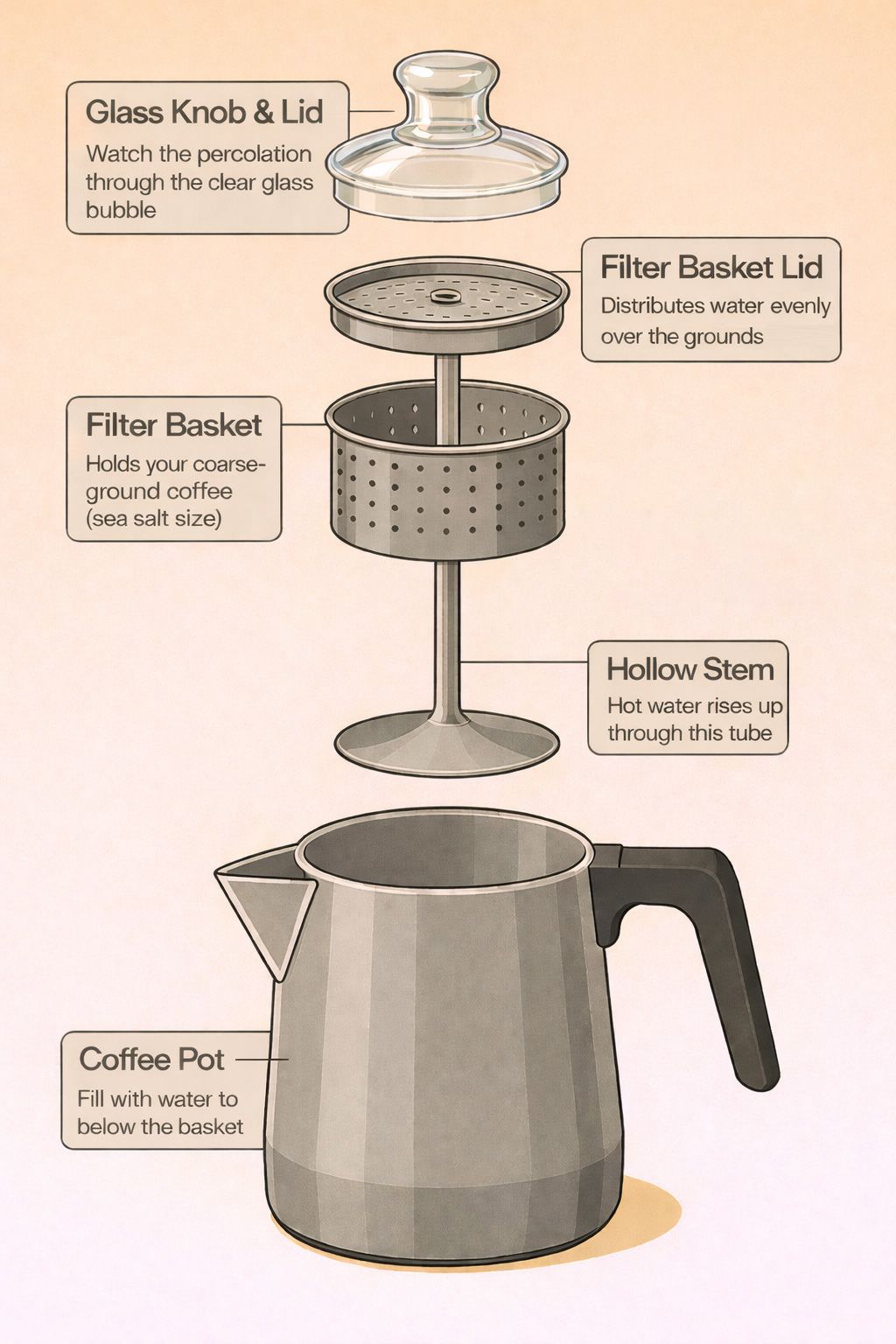
A coffee percolator has five main parts, and understanding each one helps you avoid the mistakes that give percolators their bad name.
There’s the percolator coffee pot itself, into which you put your water. There’s the stem, a hollow metal tube that fits into the bottom of the pot – in non-electric models, it has a flat round bottom that sits on the base. There’s the filter basket, which slides onto the tube and holds the ground coffee. There’s the filter basket cover, a round perforated lid that fits on top and makes sure the water showers the entire basket evenly. And finally, there’s the coffee pot lid, which often has a glass bubble in it.
That glass bubble just might be the most fun part of the entire contraption. It lets you watch the coffee splurting up from the tube and splashing inside before it spills back down onto the lid. Weirdly mesmerizing, like a little coffee fountain show happening right there on your stovetop.
Electric vs. Stovetop: Which Should You Choose?
Coffee percolators come in two distinct types – electric and stovetop. Each has its place, and honestly, both can make decent coffee despite their horrible reputation if you follow a few guidelines.
Electric percolators, including those coffee urns that can make up to forty cups at a time, are the set-it-and-forget-it option. They’re consistent, they shut off automatically, and they’re perfect for offices, church basements, and anywhere else you need to caffeinate a crowd without babysitting the process. The downside? You give up control over timing and temperature.
Stovetop percolators give you complete control, which is both a blessing and a curse. You can adjust the heat exactly how you want it, but you also have to pay attention or risk over-extraction. They’re great for camping since they don’t need electricity, and there’s something genuinely satisfying about the hands-on process. One of our readers pointed out they work differently at altitude too – at 5,300 feet, water boils at about 201 degrees, and percolators run roughly 10 degrees cooler than that, which actually makes the coffee come out better than at sea level. I thought that was fascinating.
What actually changes between the two (steps below stay the same otherwise)
- Heat: electric uses its own thermostat. Stovetop, you start at medium and drop to low the moment it perks.
- When it’s done: electric chimes or shifts indicator color. Stovetop, you watch the glass bubble and the clock.
- Pulling the basket: both still need the entire filter stem removed the second brewing finishes. Most electric models do not do this for you automatically.
- Capacity: stovetop models usually 4 to 12 cups. Electric urns scale up to 40 or 100 cups for events and offices.
For a deeper comparison and buying advice, see Electric vs Stovetop Percolators: Which Should You Buy?
How to Make Perfect Percolator Coffee
Here’s how to make percolator coffee that won’t make you question your life choices:
- Keep all parts of the percolator clean. This isn’t optional. Wash the entire thing with dishwashing liquid and hot water every single time you use it. Coffee oils go rancid faster than you’d think, and old residue will ruin even good coffee. Use a pipe cleaner for the inside of the stem. I learned this the hard way after wondering why my coffee tasted like the bottom of a week-old pot.
- Use freshly ground coffee – and make sure it’s coarse. This is where most people mess up. That pre-ground coffee from the grocery store? It’s ground for drip coffee makers and it’s too fine for percolators. You want a coarse grind, more like sea salt or coarse breadcrumbs. If you don’t have a grinder, look for coffee labeled as coarse grind, or ask your local coffee shop to grind it coarse for you. On a camping trip with no electricity? Carry your ground coffee in a vacuum container with a lid to keep the air out.
- Get your water level right. Disassemble the percolator and put the stem in place. Fill with water to below the line where the filter basket sits. Too much water and you’ll get weak coffee. Too little and it won’t perk properly.
- Don’t be stingy with the coffee. Put the filter basket on and add one heaping tablespoon of coffee for each cup of water. Some people go up to two tablespoons if they like it strong, but start with one and adjust from there. Put the basket lid in place.
- Start the heat. If you’re using an electric percolator, plug it in and turn it on – it’s on its own now. If you’re using a stovetop, put it over medium heat. Not high, not low – right in the middle.
- Watch for the magic moment. As soon as the first splurt of coffee hits that glass bubble, turn the heat down to low. This is crucial. You want just enough heat to keep percolation going, but not so much that you’re boiling your coffee. You’ll hear it change from rapid bubbling to a gentler, slower rhythm.
- Time it right. For most people, 4-8 minutes of perking is the sweet spot. Start checking at 4 minutes – the coffee coming up through the bubble should look like actual coffee, not weak tea. Don’t overthink it.
- Stop the process immediately. As soon as the pot stops perking or you decide it’s strong enough, pull it off the heat.
- Remove the filter stem – this is the step everyone skips. Carefully take off the lid and pull out the entire filter stem assembly, not just the basket. If you leave it in, steam from the coffee keeps condensing, dripping through the spent grounds, and making your coffee progressively more bitter. This is how perfectly good percolated coffee turns into undrinkable swill in about ten minutes.
- Let it rest, then enjoy. Give it about 30 seconds so any grounds that escaped can settle, then pour yourself a cup. You might be surprised by how good it actually is.
When Percolators Actually Shine
Despite what the coffee cognoscenti will tell you, there are situations where percolators are not just acceptable but actually the best choice.
Camping and outdoor adventures. Try bringing your French press on a camping trip and see how long it lasts. Percolators are practically indestructible, work on any heat source, and make coffee strong enough to get you moving after sleeping on the ground.
Large groups and events. Need coffee for 20, 30, or 50 people? A large electric percolator urn beats making pot after pot with any other method. They keep coffee warm for hours without that burnt taste you get from drip makers with hot plates.
The ritual of it. Sometimes the process matters as much as the product. There’s something deeply satisfying about the sound of a percolator bubbling away, the anticipation as you watch that glass bubble, the ritual of removing the basket at just the right moment. It connects you to decades of coffee drinkers who found comfort in exactly the same process.
Troubleshooting Common Percolator Problems
My coffee tastes bitter and terrible. Nine times out of ten, you’re using too fine a grind, perking too long, or both. Try a coarser grind and shorter brewing time. And make sure you’re removing that filter basket immediately when done.
My coffee is weak and watery. Not enough grounds, or the grind is too coarse and water’s flowing through too quickly. Try adding more coffee first, then adjust grind size if needed.
My percolator won’t start perking. Check that the stem is seated properly and the water level is right. It can take 5-10 minutes to get going, especially with electric models. Be patient.
The coffee is muddy and full of grounds. Your grind is definitely too fine. You want pieces about the size of coarse sea salt, not coffee dust.
Best Coffee Beans and Grinds for Percolators
Not all coffee works equally well in a percolator. Medium to dark roasts are your best bet because they’re less acidic and more forgiving of the longer extraction time. Brazilian, Sumatran, and other low-altitude coffees tend to be naturally lower in acid, which plays nicely with percolation.
French roast and Italian roast are particularly good choices. The roasting process has already broken down some of the compounds that turn bitter with extended brewing, and the bold flavors hold up well against the strong extraction.
For grind size – think coarse, then go a little coarser. If you’re grinding your own, a burr grinder set coarse gives you something that looks like coarse breadcrumbs or sea salt. Too fine and you get muddy, over-extracted coffee. Too coarse and the water flows through without pulling enough flavor.
The Bottom Line
I’m not going to pretend that percolated coffee is better than a well-executed pour-over or a properly pulled espresso shot. But it’s also not the coffee catastrophe that the experts make it out to be. Made properly – right grind, proper timing, remove the basket – percolator coffee is rich, full-bodied, and satisfying in ways my pour-over never quite manages.
The real problem isn’t the percolator. It’s people who don’t know how to use one. Master the technique, use good coffee ground to the right size, pay attention to timing, and you might find yourself reaching for the percolator more often than you’d ever admit in polite coffee company.
After all, our grandparents drank percolated coffee for decades. They weren’t wrong about everything.
Frequently Asked Questions About Percolator Coffee
Not if you do it right. The bad reputation comes from over-extraction – too fine a grind, perking too long, or forgetting to remove the filter basket after brewing. Follow proper technique and you might be genuinely surprised by how good it can be.
4-8 minutes depending on how strong you like it. Start checking at 4 minutes and taste-test. The coffee coming up through the glass bubble should look like actual coffee, not weak tea. Stop before it gets too dark or you’ll end up with bitter brew.
Coarse grind, like sea salt or coarse breadcrumbs. Fine grinds will give you muddy, bitter coffee that’s impossible to enjoy. If you’re buying pre-ground, look specifically for “coarse grind” or ask your coffee shop to grind it coarse for percolators.
Usually over-extraction from perking too long, grind that’s too fine, or water that’s too hot. Try shorter brew time, coarser grind, and lower heat once percolation starts. And make sure you’re removing the entire filter stem immediately when brewing is done – not just the basket.
Most store-bought ground coffee is too fine for percolators. It’s ground for drip coffee makers and will give you muddy, over-extracted results. Look for coffee specifically labeled as coarse grind, or better yet, grind your own beans.
Start with 1 heaping tablespoon per cup of water. If you like it stronger, go up to 2 tablespoons per cup – but don’t just brew longer to get more strength. That’s how you get bitterness. More grounds, not more time.
Yes, immediately. This is the step most people skip, and it makes all the difference. Remove the entire filter stem assembly, not just the basket. If you leave it in, steam keeps condensing and dripping through the spent grounds, turning your coffee bitter within minutes.
Electric is more convenient and consistent, plus it shuts off automatically. Stovetop gives you more control over heat and timing, and works great for camping. Both can make good coffee with proper technique. It really comes down to how hands-on you want to be.
Check that the stem is properly seated in the bottom of the pot and the water level is correct – it should be below where the filter basket sits. Be patient too. It can take 5-10 minutes for the water to heat up enough, especially with electric models.
Use fewer grounds rather than reducing brew time too much. If you cut brewing time too short, you’ll get weak, sour coffee instead. You can also dilute strong percolated coffee with hot water after brewing – think of it like making an Americano.
Wash all parts with hot soapy water after every use. Use a pipe cleaner or long thin brush for inside the stem – coffee oils build up in there and will make your next pot taste rancid. Once a month, run a cycle with white vinegar and water for a deep clean.
Let the water heat until it just starts to perk, then immediately drop the heat to low. You want hot enough to percolate but not a rolling boil. The percolation should be gentle and steady, not violent bubbling.
Use more coffee grounds rather than longer brew time. A darker roast also gives more intense flavor without extra bitterness. Some people swear by adding a tiny pinch of salt to cut bitter notes, though that’s definitely a personal preference thing.
Interestingly, many people with coffee-related heartburn actually find percolated coffee easier on their stomachs than drip. The longer brewing process and higher heat can break down some of the acids that cause problems. Dark roasted beans help even more with this.
Only on an electric coil or solid-hob stove. Those hold and spread heat unevenly, so a diffuser keeps the base from scorching the coffee closest to the metal. On a gas burner, skip it and set the pot directly over the flame. This is one of the most common questions in our comments, and it comes up because so many people inherit a percolator with no manual attached.
It is a genuine old-timer method, and there is real chemistry behind it. Crushed eggshell is calcium carbonate, which neutralizes some of the acid in the grounds and mellows the cup. Cleaned, dried, crushed shell gets mixed in with the grounds before brewing, and the filter or basket traps the sediment along with the coffee grounds. It works, but it is a lot of fuss for a marginal difference, and a coarser grind gets you most of the way there without cracking an egg.
Drop them in the comments below. With over 500 comments from fellow percolator users, our community has probably faced your exact issue before – and there’s always someone willing to share their hard-earned wisdom.
Discussion 582
I was at an antique show today and bought an old GE automatic percolator, cloth cord, because it was the most beautiful marbled metallic teal/blue color (my favorite!). Just brewed up a pot — delightful. My question is: any idea how old this bad boy might be?
Sandra, Sydferret mentioned specifically about oxidation from boiling water. Right away, I understood it as to what oxidation do to the taste of coffee because this is the same with making tea. I’m asian and drink tea daily. Boiling water is a no-no when making tea for this same reason. In addition, using boiling water will cook the tea leaves and prevent them from fully releasing the fragrance & taste of tea.
Your method of making a hole works well too, another good idea.
I think Sydferret was concerned with the water being boiled and research showing adverse effects to health-not adverse to the taste of the coffee. As for the filter-I use a regular unbleached paper drip filter, too. I gently fold it in a quarter fold and snip about a quarter inch or even less. The opening lets gives a fairly tight fit over the stem and i even put paper and all in the compost pile.
In coffee measurement:
1 cup of coffee = 6 oz. (SCAA defined)
However, it can be anywhere from 6-8 ounces.
I actually read all 396 posts! Many good tips, thank you. But you do need new tips to keep this post interesting, don’t you ;o).
First, let’s talk about the filter. I too, highly recommend using one for these reasons:
1) It minimizes grounds in the coffee. (Actually, I haven’t had any in my cup when using it correctly.)
2) You wouldn’t need to worry about how coarse to grind the beans. With a filter, the ground won’t fall through the holes.
3) The grounds won’t get stuck to the holes of the filter cup; thus, easy cleaning and won’t block the coffee from dripping through.
Second, the type of filter. For years, I’ve experience a sour taste in coffee. It took me awhile to figure out that it wasn’t’ the coffee blend nor the coffee maker. Using a bleached white filter makes the coffee tastes sour. (Unless, someone else find it otherwise.) Therefore, it is best to use natural unbleached filters. I have a Presto 12-cup electric perk and a 14-cup stovetop GSI Glacier Stainless Steel. I purchased the Melitta 8-12 cup regular filters from Amazon. They’re about 3 ½ inch in diameter. These fits both perks quite well. On the GSI stovetop, after adding the grounds, I fold the edge slightly in order to close it with the lid.
Third, how to make a hole. To make a hole in the center: Fold the filter in half, using a single-hole hand puncher, punch half a hole in the center. When you open the filter, you should have a perfect hole in the center. I normally do several filters at a time. Don’t forget to clean the head of the hole puncher thoroughly prior to using for the filters. Just to make sure that It’s sanitized, I normally just dip in rubbing alcohol for a few seconds after washing it.
Now, Sydferret (#295 & #306) mentioned not to boil coffee because of oxidation. Hate to tell you guys this but he’s quite right and please allow me to explain why. Boiling water creates oxidation. Oxidation releases unnecessary bitterness to the coffee. Therefore, if this is the case, then adding the eggshell to the grounds would take care of this problem. Another tip that Annie (#13) and David (#182) had mentioned, instead of using eggshell, add a pinch of salt will also take care of the bitterness in the coffee. Having said that, if you can avoid boiling the water, it will make a better cup of coffee.
I know that there are many tips on how long to perk and how much coffee ground to use, etc. However, I realize that our percolators aren’t all of the same size! Even that, we don’t always perk the same amount of coffee as others. Therefore, for those that are new with making perk coffee, start with this basic measurement; then, adjust it to your own light/strong taste later.
Use 1 Tablespoon per 1 cup (btw, it’s not the same cup as you use for cooking method). With an electric percolator, the timing is all set for you when the light comes on. With a stovetop percolator, when it starts to perk, perk 1 minute per 1 cup you’re using. So, if you’re making 6 cups of coffee, perk for 6 minutes. If you’re making 8 cups, perk for 8 minutes, and so on.
To adjust the above measurement.:
If you like stronger coffee, you can either add more coffee or perk a little longer.
If you like it lighter coffee, you can either use less coffee ground or perk less time.
Hope these tips help.
For SFC Marshall A. Brown,
I have been succesful with a Cuisinart DCG-20BK Coffee Bar Coffee Grinder, Black. Not what I had in mind as I do not think ‘professional’ enough, however, at least this was allowed by Amazon to be delivered! Hope it helps, if not let me know at wilsonmfw (at) gmail.com – good luck!
For SFC Marshall Brown,
I have just attempted through Amazon.Com to order and have delivered via your APO address, a De Longhi Professional Burr Grinder, however, when I enter your address according to Amazon guidelines I am being told that this item cannot be shipped! I will try for something a bit ‘lighter’ and see if that can go but there are apparent restrictions on some household and electrical items!
For SFC Marshall Brown,
I’ll see what I can do for you!
Mr. Wilson,
That would be awesome! As some of my younger soldiers in the platoon would say, “That’s beastin’ dude!”. It’s been hard using a rolling pin to grind out the beans…but there is so much more flavor in those beans.
Once again, thank you so much!
v/r
SFC Marshall Brown
For SFC MArshall Brown.
Am I correct to assume you have access to electric power, if so, would a ‘burr’ grinder get over your problem of what to do with lots of beans! Although you drink lots of coffee according to your comment, beans will hold their flavour longer and therefore the ability to grind them would be better than having pre-ground coffee! If of help would be happy to arrange to have one sent to you! I, like you, enjoy my coffee!
After a recent visit to ironbridge Gorge and stumbling across a dear little coffee and tea shop, we came across an ‘old friend’. Blue Mountain coffee beans. We used to drink that coffee back in the late 70s when we got married and memories of those days reminded us of the SONA Electric Percolator we used then. Today, that Percolator has been brought out of the closet and, still as good as the day it was purchased, we are looking forward to experiencing those early days of fresh percolated Blue Mountain coffee with the sounds of ‘coffee sighs’ eminating from the kitchen!
Hi! My name is SFC Marshall Brown. I came upon your site because I was looking for ways of making better coffee. I read all your comments from Feb. 2008 to the last one in Apr. 2011. Sure is a lot of great suggestions the world over.
My story starts with being deployed in Afghanistan. Alot of the guys, including myself, in my section drink ‘gallons’ of coffee. J/k. We actually drink quite a bit, though. When I got here, the guys had been using a 42-cup WestBend Percolator. The coffee was coming out kind of a strong…to put lightly. Come to find out, they were using way too many coffee grounds.
Now, I’m not a Coffee Master Mixologist, but I’ve been tinkering with the amount to get that right amount of flavor. I like to mix it up a bit and add a little of ground cinnamon or a crushed up peppermint to the grounds. The Joe’s seem to like it as well.
Because we are in such a remote location, we don’t receive mail like everyone else. If we’re lucky, it could get to us in a couple weeks…sometimes 10 days. One of the Joe’s grandmother sent us 7 bags of coffee beans…that was awesome! But they just sit on the shelf and look pretty, due to no one wanting to crush them by hand. We try to get coffee from the Mess Hall; usually they don’t mind giving up a few cans, sometimes giving us sugar & creamer packets, as well. I was wondering if anyone on your site would be willing to donate a few bags/cans of coffee. Any kind or flavor would be greatly appreciated.
My address here in Afghanistan is:
SFC Marshall A. Brown
101st Combined Action Team (CAT)
Gamberi Garrison
APO AE 09310
v/r
SFC Marshall Brown
Great thread, enjoyed reading through it. I recently read a description of how a percolator works, and if done correctly, the water should never boil. The base of the tube is a collection funnel, designed to gather up all the little air bubbles that begin to form on the bottom of the pot. This begins prior to boiling so the idea is, as soon as you see the first perk, turn down the heat and maintain that pre-boil simmer.
The second thing I want to mention is a caveat regarding using aluminum, any kind- food grade and from any country… evidence suggests there may be a link between aluminum and Alzheimer’s disease. Every autopsy finds excessive amounts of aluminum in the brains of Alzheimer’s suffers. Up to 20 time more.
OT FYI, aluminum can also be found in most antiperspirants so you may want to read the label in your bathroom.
Anyway, I use both a percolator and a French press, it just depends on how much I’m making and also what grind I have available. The stainless steel percolator (glass bubble top, NOT plastic) makes excellent classic coffee, but I can get a silkier, richer flavored cup from a glass & stainless steel French press. Either way you go, enjoy!
thanks for all the great info!
One more thing for coffee preparation. Similar to the cowboy recipe without the grounds. You can buy the empty tea bags at any tea store. Take these and fill with fine grind java. Bring to a boil and let boil on simmer for 8 minutes with the occasional loving squeeze and stir and Yahoo you have coffee that is magnífico!
Also I take one of those indoor outdoor xmas timers hook it up to the old percolator and set it for the AM and my coffee is ready when I get up.
I too came across this thread(longest post I read in a long time lol)looking to research the best perk. All kinds of tips here and FB from true coffee connoisseurs like myself.
I had a cuisinart electric but broke within a year. It was probably made in china, as pointed out by many others here. The new ones can be crap.
They just do not make perks like grandma and grampa use to buy. Like retailers think you are insane when you tell them, “I want this to last at least 5 years”. Kind of like the cell phone industry that wants you to buy a new cell phone every year when there is nothing wrong with the bloody one you got right.
Anyways, I picked up a “classic”(dam I feel old when they start calling perks(no not the kind you get high on) and music from the 80’s as “classic”)GE electric and you know that thing makes the best coffee ever!
I too remember the stove pot coffee @ my grandmas brewing on the old wooden stove and it was the best. Same with here tea. She used carnation condensed cream and it is the best that way.
I get coffee from all over the world. The guy I get it from goes to auctions and buys it in lots in those 100 pound gunny sacks and cooks it up himself and sells it @ his store. It is delicious.
I collect the empty coffee gunny sacks too for my rec room as they are from all over the world and and all gave very nice pics and graphics stamped on the bags(yes it is the fare trade coffee).
He has everything from Ethiopian, Honduran San Marcos Italian Roast(my fav right now), to your basic Columbian by the pound.
You pay a little more than your folgers or whatever you get at the corner store but it is worth it. Good coffee is like fine wine and woman. You spend a little more for it and grind it as required. Its all about the brewing and roasting or cooking this guy does with the coffee. Sometimes he says it was a perfect roast while other times he says he is “off” on the roast or whatever.
BTW, french press is my backup, but as someone else mentioned, the water has to be very hot and has to sit for at least 5 minutes.I wont use a drip EVER!!!
In regards to coffee grounds, no big deal as mentioned, they have to be course or you can use a paper filter. My daughter is into “reading them” at the bottom of the cup u know like a fortune teller does with tea leaves lol, or so she thinks lol. It is a good conversation piece too at the table when your done that great cup of coffee. Try it lol
Well thanks for giving me the opportunity to spout he! he!…my story on coffee.
To all coffee connoisseurs out there….Salute!! you!
update – YES, it makes coffee. Pretty good coffee, actually … especially for something that is 80 to 90 years old.
Next time I’ll use the right coffee grind since I used some drip I had on hand as the test.
It looks and feels very elegant to use.
Thanks for all the tips.
This past weekend I bought a 1920s electric percolator at an antique and collector’s show for a mere $40. It’s in like new condition with all the pieces. (I’m imagining it may have been the type of wedding gift that gets shoved to the back of the cupboard since it is too good for everyday use.)
It’s also quite beautiful: chrome with a chased decorative band, shaped rather like cross between a samovar and an old-fashioned prize trophy, with a spigot for serving the coffee.
I’m just trying it out for the first time. It is heating up – but I can see it’s not quick.
I just got a 9 cup pyrex stove top percolator and thought I’d give it a try. I ground 5 of the drip coffee scoops of fresh coffee beans to 6 cups of filtered water. Went by the directions given here. It turned out very good but a little weak. Will try 6 actual table spoons tomorrow. If it turns out good I’m a convert.
Thanks for all the great tips! after 5 pots, I can say with confidence that i make a better coffee than the one at Starbucks!
I use an aluminum 5 cup stove top perc. I drink from a glass 12 oz mug. So I use 24oz of water and 5 rounded TBLES. Works for most coffees. Flavored coffees definitely taste better perced, and perced coffee still tastes good when it goes cold in your cup. A few grounds in my coffee has never bothered me. LOL.
I also have a Keurig. I love it. I use the K cups twice. First run I drink straight. The second run I doctor up with cream, sugar, cocoa, what ever strikes my mood.
The stove top perc is a marvel. First class engineering with out electricity or moving parts.
I try to use the best of both old tech and new tech. I listen to old time radio shows on the computer.
At one time I worked for an aluminum cookware company. Made thousands of 5-7-9-14 cup stove top percs, and a few dripolators. Now they are made all over the world.
For old style cooking and canning utensils, modern replacement parts, etc., check your local TruValue hardware store, or any other old style hardware store.
BTW, can anyone tell me how i can pour 10 cups of water into an electric coffeemaker and only 5 cups come thru? Reservoir would be empty,no way the lines, pump or coffee basket will hold 5 cups. Never 5 cups of water all over the counter.
Anyway, that useless thing is gone now.
@Jim. That is just a version of the stovetop dripolator.
I just received an old stovetop percolator for Christmas. I tried it out this morning, but the coffee never got very strong. I’m wondering if it could be because the percolator is missing a spring. It has the basket, the water distributor (covers the basket), the stem/pipe, but no spring on the stem. Do all stovetop percs have springs? Or could I be doing something else wrong?
I used four tablespoons of coffee grounds (coarsely ground) for three cups of water (actual cups, like in a measuring cup). Is this just too little coffee for that much water?
Any help from the experienced percers here would be appreciated!
Thanks,
Jason
I have a 22 cup Kenmore perculator. I’ll need to use that for the holidays. I want my coffee to be perfect but I have one question. Won’t 1 tbl to 1 cup of water make it strong? My 12 cup Mr. Coffee pot tastes GREAT when I use less coffee.
How much less than 1 tbl coffee to 1 cup water could I use in this 22 cup perculator and still have it taste GREAT?
Thank you.
The automatic drip coffeemakers always produce lukewarm coffee.I have to reheat it on the stove.I’m going to get a percolater next.
Thanks Deb! I have been nuking the cold coffee in the microwave to reheat it during the day so it doesn’t go to waste.
Get a bigger cup! :-)
Oh, and when I googled my corningware percolator, I discovered some of them were recalled due to the stainless steel collar on the outside where the handle attaches coming loose and scalding people. Is this likely to happen with mine? It is from 1975 and has dutch style red flowers and blue birds on it.
Hi there,
I bought a stovetop corningware percolator at an op shop recently. It makes great coffee!
My question is, can I put it and the stainless steel components in the dishwasher?
Also, I tried just making one cup (as I am used to doing with my electric percolator) but nothing happened. It only worked with 6 cups of water. A bit too much coffee just for one person. Any tips on only making coffee for one?
Amazing what you can find with Google. After searching for the last 3 years, tonight I found an electric Corningware percolator at Goodwill…$5.99! I am more excited than I can say. I showed it to my hubby when I got home. He’s not impressed but he was complaining the other day that the Mr. Coffee isn’t getting it very hot..heehee. So in the morning I plan to plug that sucker in, put in 5 T of coffee and 6 cups of water and perk away. Of course, the coffee I bought tonight is ground too finely, but we’ll see. I can’t wait.
I drink decaf due to sensitivity…triggers migraines. Anyway, I like Dunkin’ Donuts and we also buy bulk coffee at Sunflower Market and grind it there. I only get the DD when I can find it on sale. I also like Caribou (I buy it at Albertson’s), If I can get a good price on Peet’s I’ll try it. Now I’m tempted to purchase the 8 o’clock too. Hubby is a coffee snob ;D of sorts. But I suspect he’ll come around. Then I just need to look for 3 years to find him one!
Jim, I saw one the other day, and it looked interesting. Apparently that way is making a comeback too.
Mr. Greer, you are one of my new heroes. Southern, conservative. ;D Texas born and bred, lived in GA/TN/MO for years, then back to Tx, then NC and now Colorado. I recognize fellow Texans/Southerners in the grocery store when they are standing in front of the ice cream section in a blizzard (I’m usually next to them), and we talk about tea in the fridge year round.
And thanks for all the great advice here.
Ooops, I meant “drips through the grounds into the cup?”
Does anyone make coffee by putting grounds in a plastic cone with a filter sitting on top of your coffee cup, then pouring boiling water that drips through the grounds into the water? After reading the comments on this site, I fear I am a neanderthal in a community of the cognescenti. But at least its fast!
Oops, I mean an 8-ounce measuring cup. 16 is the number of tablespoons in a measuring cup. So is a percolator measured in 8-ounce cups or 6-ounce cups?
Wow!! Couldn’t believe all the comments on perk coffee!! This is great! Thanks to everyone for all the tips.
I was so tired of lukewarm coffee from our drip maker and like so many others here I decided to buy a percolator. I did some web searching for reviews on makers because it had been many years since I owned a Farberware (which I loved!) but wasn’t certain if it was still a good brand. After a lot of reading, I decided to buy a Presto. It was rated a little better than the Farberware and was a little cheaper. Anyway, it came quickly and as soon as I got it unpacked and cleaned, my DH made us a pot of coffee. He couldn’t believe how good the coffee tasted AND it was HOT!!! He wasn’t too enthused when I told him I was buying a perk coffee maker but now he doesn’t want to go back to drip coffee ever again. YEA!!!
When the word “cup” is used here, to describe the capacity of a pot or to indicate the quantity of grounds to be used per pot capacity, is that a 16-ounce measuring cup or something different?
David, your best bet is to choose the bagged whole beans you like and use the in-store grinder. It will have several grind settings, including coarse. I know Walmart has these coffee grinders available because that’s what I use, as well as several other stores do also. You just pour the whole bag in, choose your grind, and wait a minute for it to finish.
i have sworn off drip machines. even the expensive ones never poured right, the coffee was lukewarm and the machine looked clunky and took up too much space on my counter top! With that said, i am in love with my GE electric percolator. it pours great, the coffee is hot and rich, and not watery! but.. with that said, I do notice that there’s a TON of coffee grounds floating in it, and.. for every 12 cup pot, i probably lose at least 2 cups that are completely muddy. Can anyone recommend an already ground (course) coffee made for percolators specifically? I do have a coffee grinder, but that grinds it extremely fine unless i grind it in extremely small batched, which is too much work! thanks for your input!!
There’s a description here:
http://www.worthpoint.com/worthopedia/jet-omatic-automatic-coffee-maker-model-10
Does anyone know where I can find information about the jet-o-matic coffee maker. I got one (and a buyer for my West Bend :)) and I really like it, but when I did research online, some listing say that it’s not a percolator. Hmm, it has all the parts of an electric percolator, and works like an electric percolator.
we love perked coffie (stovetop) this is not the same coffie you get in the 50 cup urn at a baby shower….we use fresh ground coffee …dont over perk,,and it is the best coffee ever tasted…better than starbucks…
Dear folks; Bear with me; 70 plus yrs experiences; You make too much of what should be simple; Mild/slow roast coffee is not worth the effort, try tea: Quality is the first: Arabica; then the Robusta, not bad but lessor quality. Next: Roasting brings out the inherent nature of coffee which; contrary to slobs/snobs of drip-type coffee (dish-water) coffee needs to be cooked (not boiled) in a percholator;i.e..200 degrees F and smoothly passed thru the grounds…French-press-type coffee is same as above but only is very-fine grind and very hot water/not unlike Greek/Turkish coffee which use the actual ground beans..Good stuff, but over-use can cause a coffee “high”.. I recently discovered my Save-A-Lot w/a very fine MaxwellHouse medium blend to be of high quality.
My point is; Look around, you can find good quality coffees at good prices But, avoid those noted to be low/light-roast quality..No better than saw-dust.. Note: Those of you that enjoy tea..We in the South drink iced tea year-round/after morning coffee; Afternoon and night. Buy quality family-pack size teas: I find Family Dollar, etc., to be of good quality plus Lipton, etc..
Then, instead of utilizing the bags as intended via instructions, Make a gallon of iced-tea.. Bring to boil a pot of water on the stove and then cut open 8 bags of family sized bags into a container and dump into the pot. Turn-down the heat or remove from heat source.
Stir the loose leaves in the pot and leave alone for at least 15 minutes, to steep. Drain through a screen or other into your recepticle for storage in the frig..Limit sugar? Utlize sacchrarin, adjust according to your tastes.
Other products (NutraSweet)suck. You new generation folks are inclined to make life too damn complicated..It ain’t that difficult! Keep it simple!..Enjoy!
In terms of favorites, I really like the Melitta half caf, but the grinds are too fine for a percolator, and I don’t think they sell whole beans in my area. I’ve bought Old City Coffee (Phila) which I like; Equal Exchange coffee at my local co-op. Trader Joe’s makes good coffee. I’ll try a med-dark roast, next time I need coffee. The best I’ve made so far was with Equal exchange dark roast coffee mixed in with light roasted flavored coffees (small packs I got from Target). And I really like the fact that the coffee stays HOT after I put in my 2% milk.
BigDAve,
I’ve been working on my stovetop perc technique. I would say the coffee “simmers” as opposed to boils. I’ve been experimenting with different roasts too, the best I’ve made so far on the stovetop has been a combo of medium and dark roast. The medium came from a small pack of flavored coffee with finer grinds, I added the course grind to balance it out.
I haven’t used my West Bend too much. I figured out the the light goes off when it’s done, and like you said, flashes from time to time to keep the coffee hot. I saw a vintage presto super speed that looks good. I tried to get a jet-matic on ebay as well. I’ll probably sell my West Bend for one those other brands.
Hi Deidre,
I’m certanly no expert but I believe a coarse grind is needed for percolators so it doesn’t prevent the reciculating water from flowing through the basket. I fine grind would clog the holes and overflow the basket.
I have used a drip grind in a percolator but only when making four cups in a twelve cup pot. I have to wait a few minutes after perking for the water to seep through the “coffe cake” at the bottom of the basket.
Can anyone tell me what is the best grind for the coffee. If I buy it at starbucks and have it ground for the percolator it will be coarse. What does the size of the grind have to do with the type of pot? For the strongest coffee what would be the best grind when using a percolator?
I’ve seen some on here asking what’s a good coffee to be using. I know we all have our own favorites, and that’s a good thing. However, there may be brands, because of what areas we live in, may not be available, or a name we’ve ever heard of.
I enjoy the old time varieties like 8 o’clock brand, JFG is another I just discovered and adore it. Our Family is another brand a co-worker turned me on to which I now can’t find anymore, but makes a divine cup ‘o joe!! These lists can go on and on, but sharing our favorites might entice others to take a shot and give them a try, and maybe they’ll now have a new favorite.
So….what’s your favorite?
Why my wife would rather drink instant than a good cup of real honest to god coffee is beyond me. I however, have been hooked on brewed coffee from the start. I’ve always used electric coffeemakers, but find the coffee is not very hot, and warming it in the microwave for 30 sec to me, makes the coffee taste bitter.
I just found a camping style Paul Revere Ware percolator. I even found filters at Kroger that are for that style. (The big square paper with the hole in the center, and a hole at each corner.)I got the water boiling, and turned it down as it started bubbling. Somewhere between 5-10 min.
I turned it off, and got the filter out. Best cup of coffee I’ve had in awhile. Whover makes the coffee at work puts too much grounds in, and when it’s done brewing, no one ever takes the filter out.
Nastiest, most bitter tasting coffee one could ever hope to drink. (lol) By the way, I enjoy a rather large cup of coffee, and have found using a shot glass to the brim for a measuring source, makes me the best tasting cup. Hardy, but not overly strong.
I think the light on the West Bend stays on from the time you plug it in until you unplug it. Unless it is a new development percolators do not cut off automatically like the Mr. Coffee.
They stop percolation and keep the coffee hot at 200F. How much coffee to use is entirely the choice of the person making coffee. I like strong coffee, and don’t buy that “don’t boil” opinion, so I use a stovetop percolator, and I leave it on the stove until I am sure that all of the coffee flavor is washed out of the coffee grounds.
If I did not like coffee, I would drink another beverage instead of wasting coffee grounds and making slightly colored water with a Mr. Coffee. Instant coffee is pretty good, but expensive, so if I only want a cup or two, I boil water in the microwave in a pyrex cup, stir in cofee grounds, let it steep, microwave a little more, and pour through a stainless steel strainer into my cup.
It works well and makes small amount of coffee quickly. Everybody can suit themselves where coffee is concerned, no reason for arguments.
I got my percolators on Saturday. I like using the stove-top perc; kinda fun to watch it do its thing. I do have a question. Does any one know how the West Bend Flavomatic works? I know some electric percs have a light that turns on when the coffee is ready, but this one has the light already on, so I don’t know if it automatically turns off, or if I have to wait certain time period. I’m trying (in vain) to find directions online.
Hi,
We like using vintage Pyrex perculators because you can see them working and make adjustments while brewing.
1)beverlyw6868 sells paper filters designed just for vintage Pyrex percs and sells them on Ebay. They work well for a clean cup and remove dangerous byproducts that all coffee makers produce. I show pics of them in 6 and 9 cup Pyrex baskets.
2) To make a complete vintage perculating setup, without using a modern stove, we are using the base half (the burner) of a 1940’s HandyHot cat. no. 2101 popcorn maker. This fits the base of either a 6 or 9 cup Pyrex like a glove and is perfect in physical size and wattage for use underneath the pots. The base is 4-1/2 inch burner size and is rated 400 watts: perfect! I just perc for 5 minutes, unplug and the perc will continue another 4 minutes. If longer, just remove from burner onto a trivet.
The HandyHot was purchased online from http://www.toastercentral.com/ , a place to see or even purchase completley restored vintage kitchen appliances. Nowadays they just don’t make them like they used to!
pictures:
http://i247.photobucket.com/albums/gg153/CrowDriver/5.jpg
http://i247.photobucket.com/albums/gg153/CrowDriver/2.jpg
http://i247.photobucket.com/albums/gg153/CrowDriver/4.jpg
http://i247.photobucket.com/albums/gg153/CrowDriver/1.jpg