Quick verdict
Most of the coffee brands on your supermarket shelf are owned by a small handful of large food conglomerates. Knowing who owns what does not necessarily mean you should boycott anything, but it does change how you read the marketing.
- Three companies own most American supermarket coffee. JDE Peet’s, JM Smucker, and Nestle between them control the majority of household coffee brand names in the United States.
- Starbucks and Seattle’s Best are the same company. Starbucks acquired Seattle’s Best in 2003 and wound it down significantly over the following two decades. Other “rival” chains and brands often have similar overlaps.
- If brand ownership matters to you, the cleanest way to support independent coffee is to buy from small specialty roasters (most cities have one), Fair Trade certified brands, or directly from the farm cooperatives that grow the beans.
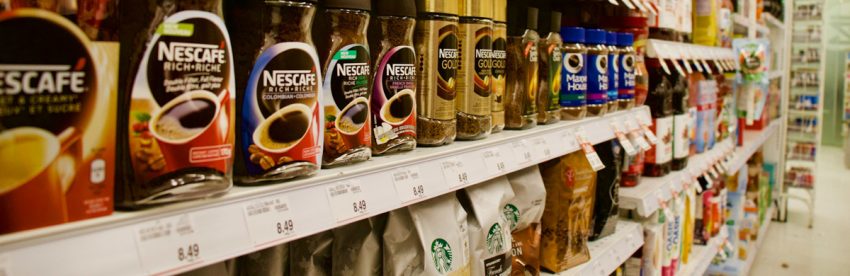
You walk into the supermarket coffee aisle and you have what looks like a real choice. Maxwell House, Folgers, Yuban, Hills Bros., Eight O’Clock, Gevalia, Caribou, McCafé, dozens of K-Cup brands. The shelves suggest a competitive marketplace with many independent companies fighting for your dollar.
The shelves are misleading. Most of those brand names trace back to one of a small number of parent companies, and the consolidation has accelerated significantly over the last decade. Knowing who owns what does not necessarily change which coffee you should buy, but it does change what claims you should believe and what your alternatives actually are.
The three big players in American supermarket coffee
JM Smucker
Smucker owns Folgers (acquired from Procter and Gamble in 2008), Dunkin’ branded coffee (the supermarket K-Cup and bag line, licensed from Dunkin’ Brands), Cafe Bustelo (the Cuban-style coffee popular with Latin American consumers), Millstone, and a handful of smaller regional brands. Smucker is probably the single largest American supermarket coffee company by volume.
JDE Peet’s
Created in 2020 through the merger of Jacobs Douwe Egberts and Peet’s Coffee, JDE Peet’s owns Peet’s Coffee (the Berkeley-based specialty roaster), Stumptown (acquired by Peet’s in 2015), Intelligentsia (acquired by Peet’s in 2015), Gevalia (the Swedish coffee brand sold by mail order and supermarket), L’Or, Jacobs, and dozens of European brands. The “premium coffee” section of most American supermarkets is dominated by JDE Peet’s portfolio.
Nestle
Nestle owns Nescafé (the world’s largest instant coffee brand), Starbucks at-home coffee products (Nestle bought the rights to sell Starbucks-branded grocery products in 2018, though Starbucks itself remains independent), Nespresso, Coffee mate creamer, and a long list of smaller regional brands. Hills Bros. and MJB, both mentioned in older versions of this article as Nestle properties, were sold to Massimo Zanetti Beverage Group in 2018.
The Starbucks tangle
The coffee shop ownership picture is messier than the supermarket one. A few facts worth knowing.
Starbucks acquired Seattle’s Best Coffee in 2003. For about a decade, Seattle’s Best was Starbucks’ second brand, often appearing in supermarkets, fast food restaurants, and grocery stores while Starbucks focused on its flagship stores. Starbucks largely wound Seattle’s Best down between 2015 and 2020, closing most cafe locations and reducing the wholesale and retail footprint. The brand still technically exists but is significantly smaller than it once was.
Starbucks also owned Tazo Tea from 1999 to 2017 (sold to Unilever) and Teavana from 2012 to 2020 (closed). Starbucks branded grocery products are licensed to Nestle since 2018, which is why you can buy Starbucks-branded K-Cups and bagged coffee at the supermarket even though the cafe business and the supermarket business now operate independently.
McDonald’s coffee, sold under the McCafé brand, was historically supplied by Green Mountain (now part of Keurig Dr Pepper) for K-Cup distribution and other suppliers for the cafe brewing. McDonald’s itself does not own a coffee brand, but McCafé branded coffee at supermarkets is licensed and supplied through a partnership.
Why this matters (and when it does not)
The consolidation story matters for three specific reasons.
First, marketing claims about “small batch”, “artisan”, or “independent” coffee from major supermarket brands are usually marketing. The Stumptown bag at your supermarket is still Stumptown coffee, but the company is owned by JDE Peet’s, which is itself owned by a consortium dominated by JAB Holding (the German investment company that also owns Krispy Kreme, Panera, and Pret a Manger). “Small specialty roaster” stopped being an accurate description of Stumptown the moment Peet’s acquired them in 2015.
Second, when you switch from one supermarket brand to a different supermarket brand because of a quality complaint or a values disagreement, you may be giving your money to the same parent company. Folgers customers angry about a recipe change who switch to Dunkin K-Cups in protest are still buying from JM Smucker.
Third, the consolidation has reduced real choice in some categories. Coffee categories where one or two parent companies own 70 to 80 percent of the brand names tend to compete on packaging and price rather than on meaningful product differences. The bags compete; the underlying business does not really.
It also matters less than it sounds. The coffee in a Folgers can is not made worse by Smucker owning Folgers. The coffee in a Stumptown bag is not made worse by Peet’s owning Stumptown. The corporate ownership affects strategy, capital, and long-term direction, but the actual cup in your hand is the same cup it was before the acquisition closed.
If brand ownership genuinely matters to you
The clean alternative to supermarket consolidation is to buy from genuinely independent coffee businesses. The path:
Small local roasters. Almost every metropolitan area in North America has at least one independent specialty roaster, often several. The coffee is fresher (roast date measured in days, not months), the supply chain is shorter, and the ownership is genuinely the people running the business.
Fair Trade certified coffee. Fair Trade certification means farmers were paid a minimum price set above commodity rates and the supply chain has been audited for labor practices. Most major coffee brands offer at least one Fair Trade variety, and small Fair Trade specialty roasters are easy to find online.
Direct trade. Some specialty roasters source directly from named farms and cooperatives rather than through commodity exchanges. The traceability is high (you know which farm grew the beans), and the prices paid to producers are usually well above Fair Trade minimums.
Cooperative-owned brands. A few brands like Equal Exchange are structured as worker-owned cooperatives that source from farmer-owned cooperatives. The ownership chain is genuinely democratic at both ends.
None of these options are perfect, and they all cost more per pound than supermarket commodity coffee. The premium reflects real differences in supply chain economics and ethics, not just marketing.
Frequently asked questions
Who actually owns Starbucks?
Starbucks Corporation is publicly traded on the Nasdaq under the ticker SBUX. It is owned by institutional and retail shareholders, with no single dominant owner. The largest shareholders are typically index funds like Vanguard and BlackRock holding shares on behalf of millions of retirement and investment accounts. Starbucks the cafe company is independent; Starbucks-branded grocery products are licensed to Nestle.
Is Peet’s still independent?
No, not in the original sense. Peet’s was acquired by JAB Holding (the German investment company) in 2012 for $1 billion, then merged with Jacobs Douwe Egberts to form JDE Peet’s in 2020. The Peet’s cafes still operate under the Peet’s name and the Berkeley roastery still exists, but the company is part of a much larger European-headquartered conglomerate.
Does Philip Morris (Altria) still own coffee brands?
No. Older articles often mention Philip Morris ownership of coffee brands, but the relationship ended decades ago. Philip Morris owned Kraft Foods, which owned Maxwell House, Sanka, Maxim, and General Foods International Coffees. Kraft was spun off from Altria in 2007 and later split into Kraft Heinz and Mondelez. Maxwell House and the other coffee brands are now owned by Kraft Heinz.
How can I tell where my coffee actually comes from?
The bag should name a country at minimum, and ideally a region or farm. Vague language like “premium blend” or “select beans” is a tell that the supply chain is anonymous. Specialty roasters typically list the country, region, farm or cooperative, processing method, roast date, and cupping notes on every bag. Supermarket brands rarely provide all of those.
Are there any genuinely independent national coffee brands left?
Very few at the major-supermarket-distribution scale. Most brands that grew large enough to be on most supermarket shelves got acquired during the consolidation wave of the 2010s. The remaining independents tend to be either much smaller specialty roasters with regional distribution, or cooperative-structured brands like Equal Exchange.
The coffee industry got smaller in terms of owners while getting larger in terms of brand names. The shelf looks crowded, but the conference rooms making the decisions are not. If knowing this changes how you shop, the small specialty roaster down the street from your house is genuinely a different transaction. If it does not change how you shop, you are not the only one, and there is nothing morally wrong with buying the bag of Folgers you have always bought.
Discussion 1
It is good to note also that with these giant corporations, selling fair trade coffee is simply a means of catering to a niche market. It does nothing really to assist the movement or the producers really. Take someone like starbucks for example, who barely pushes the 1% mark as far as their total sales of FT coffee compared to their other coffees.