
Affiliate disclosure: As an Amazon Associate, TalkAboutCoffee earns from qualifying purchases. Our picks are based on editorial judgment, not commission rates.
If you found this page, there is a decent chance your Cuisinart DTC-975 is overflowing onto your counter and you want it to stop. Good news: that is almost always fixable, and you do not need a new machine. Let me give you the fix first, then the honest verdict on the machine itself. One quick note up front: the DTC-975 and the DTC-975BKN are the same coffee maker. The “BKN” is just the black version; the plain DTC-975 is white with stainless accents. Everything here applies to both.
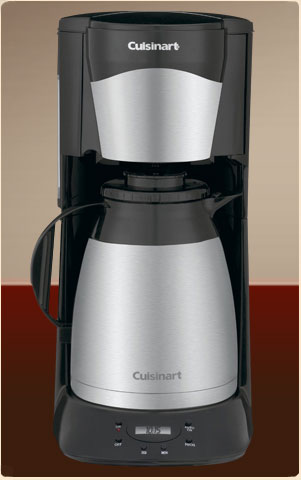
This is a 12-cup programmable coffee maker with a double-wall stainless thermal carafe, a 24-hour programmable timer, a brew-pause function, and roughly a 12-minute brew. Cuisinart has since discontinued it, so this is written for the people who already own one, or who are eyeing a used unit.
First, the overflow fix (why you are really here)
When a DTC-975 overflows the carafe or leaks onto the counter, it is almost never the machine dying. It is a clog or a part that is not seated right. Work through these in order; the first one solves most cases.
- Clean the carafe lid, especially the water-entry dome. This is the fix that readers keep confirming works. On the underside of the carafe lid there is a small dome with a little button-looking piece, the point where the brewed coffee enters the carafe. Dried coffee sediment builds up under it and chokes the flow, which backs the water up until it overflows. Pry that area open and clean it out. People are routinely shocked at how much hardened sediment comes loose. A run under the hot tap, getting in under that dome, and the machine “runs beautifully again.”
- Unscrew the top of the carafe lid and clear the vent ball. There is a small ball inside the lid that controls venting. Grounds can jam it, and a jammed vent causes the coffee to back up and overflow. Unscrew the lid top, rinse the grounds out, reassemble.
- Clean the anti-drip valve under the filter basket. The brew-pause feature works by a little valve on the bottom of the basket that stops the flow when you pull the carafe. Grounds collect there too, and a stuck valve causes leaks and overflows. Clear it.
- Make sure grounds are not bypassing the filter. If even a few grounds slip around the paper filter, they clog the works and it overflows. Seat the filter properly, and consider switching to the gold-tone permanent filter, which several owners find more forgiving and less prone to letting fines through.
- Fill the reservoir using the carafe, and seat every part fully. The reservoir holds more than the carafe, so filling it straight from the carafe keeps you from overfilling, which is a common overflow cause on its own. And snap the basket, lid, and carafe fully into place every time; a part that is not clicked in is the single most common reason for leaks.
Do those, run a plain water cycle to confirm, and the overflow is usually gone. Make the lid-and-valve cleaning a monthly habit and it tends to stay gone.
Slow brewing, or stopping partway?
The other classic DTC-975 complaint is brewing that crawls, a pot that used to take 12 minutes now taking 30 or more, or a cycle that quits before the carafe is full. Before you write the machine off, descale it. The usual culprit is mineral scale built up on the heating element from months or years of hard water, which chokes the flow the same way the lid clog does, just from the other end. Run a full cycle of equal parts white vinegar and water with no coffee, let it sit partway through for fifteen minutes if the scale is heavy, then run two cycles of plain water to rinse. In hard-water areas this is worth doing every month or two. A surprising number of “my coffee maker is dying” cases are really just a heating element wearing a sweater of limescale.
Cleaning the thermal carafe
The stainless thermal carafe is genuinely awkward to clean; the opening barely fits a bottle brush. The trick owners swear by is simple: drop a scoop of dishwasher powder into the carafe, fill it with hot water, and let it sit for a few hours. The stainless comes out bright. One honest caveat, though: unlike glass, a stainless carafe tends to hold onto coffee odor over the years no matter how much vinegar and baking soda you throw at it. That is a property of the material, not a defect in yours.
The missing manual
A lot of these shipped without an instruction book, which is why “where do I get the manual” is one of the most common questions about this machine, and why programming the timer trips people up. Cuisinart still hosts manuals for discontinued models on its support site; search the Cuisinart support pages for “DTC-975” or “DTC-975BKN” and you can download the PDF. For the timer specifically, the usual snag is the AM/PM setting on the clock, so double-check that before assuming the programming is broken.
The honest verdict
When it works, the DTC-975 does the core job well: it brews at a decent temperature, the thermal carafe keeps coffee hot for hours without a hot plate scorching it, and 12 cups on a timer is genuinely convenient. The carafe insulation is good enough that you do not really need to preheat it. It is on the loud side while brewing, which a few owners compare to living near an airport, but that is a quirk rather than a fault.
The catch, and the reason Cuisinart moved on from it, is durability. A meaningful share of owners report the unit slowing down or simply dying within two or three years, sometimes inside the warranty window, and these are not serviceable machines, so a failure means replacement, not repair. If yours is running, the maintenance above will extend its life considerably.
That durability record is also why I would steer you away from hunting one down used. A secondhand DTC-975 comes with no warranty, an unknown amount of wear on the one part most likely to fail (the heating system), and very possibly the exact clogs and scale described above already baked in. You would be buying someone else’s maintenance backlog on a machine the manufacturer already retired. If the thermal-carafe, grind-and-program convenience is what appeals to you, that is a reason to buy it new in a current model, not to gamble on this one’s twin from a marketplace listing.
So if you are shopping new, this is not the model to chase down. Buy a current machine instead. We cover the ones worth owning in the best coffee makers for home and office, and if you specifically want the grind-and-brew-into-a-thermal-carafe setup this Cuisinart was going for, a current Cuisinart thermal model gets you the same idea with a fresh warranty.
Frequently asked questions
Is the Cuisinart DTC-975 still made?
No. Both the DTC-975 and the DTC-975BKN have been discontinued. You can still find used units and parts, but if you want a new machine with a warranty, look at current models.
Why does my DTC-975 overflow?
Almost always a clog or a misseated part, not a dead machine. The top causes are a clogged carafe-lid water-entry dome, grounds jamming the vent ball in the lid, a gummed-up anti-drip valve under the basket, grounds slipping past the filter, or simply overfilling the reservoir. Clean those and seat everything fully and it usually stops.
What is the difference between the DTC-975 and the DTC-975BKN?
Color. The DTC-975BKN is the black-and-stainless version; the DTC-975 is white with stainless accents. Mechanically they are the same coffee maker, so every fix here applies to both.
How do I descale it?
Fill the reservoir with equal parts white vinegar and water, run a full brew cycle with no coffee and an empty filter, then run two cycles of plain water to rinse thoroughly. Do this every one to three months depending on how hard your water is. It is the fix for slow brewing and short pots.
Discussion 18
Dave Mann (#5/7) Thank you so much! I wish I would have done my research a year ago. My first pot, 12 cup programmable grind and brew with small internal hopper, began overflowing last summer, and thinking it had served me faithfully for over 6 years, I replaced it with a similar model, only with 2lb hopper atop the unit. I was distressed at the beginning of this week when it began overflowing after only one year.
I found this blog, and took Dave Mann’s advice. I cleaned the lid of the carafe by getting under the little “water entry dome” where the little “button looking piece” is. The amount of dried coffee sediment that came loose was surprising. Although I had started running it through the dishwasher, and later opted to just run it under the hot tap, still, the amount that I “pryed free” was enlightening.
It runs beautifully now, and I am so relieved. In my Dad’s words, “take care of your things, and they will last you a very long time.”.
Thank you Dave.
Now that mine just up & died for no reason, I think back on all the times it misfired & made a mess if the apparatus wasn’t completely snapped in snug each time and the length of time it took to fill the pot. And now that Cuisinart denied honoring the warranty, I’m realizing that this wasn’t a good purchase. Getting a different brand next time.
http://www.cuisinart.com/share/pdf/manuals/dtc-975bkn.pdf
Follow this link to get
I have tried twice to program the coffee maker, and it didn’t work. after the first time, I thought I didn’t have the AM/PM at the correct setting. So the second time I made sure that the time was right and it still didn’t work. Can someone help? I know I must be doing something wrong.
Thanks
Cuisinart has an excellent three-year warranty but John (#6) has a point. They aren’t serviceable coffeemakers. Most appliances these days aren’t. Manufacturers and retailers want consumers to buy and upgrade to the latest/greatest —— not to service the appliance when it breaks down.
Long before “Green” came into vogue household electrics were more green in the sense that they were built to stand up to actual use. That’s why there are still working ranges, mixers, percolators and other kitchen electrics from the 40s/50s/60s/70s to be found in antique shops. Very little of our modern electronics and appliances will be around 40-50 years from now to bring back the nostalgia that you can find today in any antique/collectible store. I own a Sunbeam hand mixer that is older than I am, a family hand-me-down. Dropped it and it still works — can’t say I’ve had that sort of luck with anything built in the past 20 years.
John, Cuisinart really isn’t guilty of starting this trend. As soon as globalization came along in the late 1970s and things got cheaper to produce overseas, the disposable mentality came into vogue just as soon as consumers realized that it was cheaper to buy a new widget than repair the old one. One way to fight the wastefulness is to buy a product that is essentially unchanged from the way things were built prior to the advent of cheap imports. That product is the electric perc. Contrary to conventional wisdom, not all percs boil coffee, at least not the Presto Percolator I bought and decided to keep. Not only are there fewer parts to break down when compared to a drip coffeemaker but those parts that are in contact with the coffee are made of metal, which means you skip the health hazards associated with hot liquid + plastic in other coffeemakers.
I’m not sure how much longer Cuisinart will keep their generous 3-year warranty. There are a disproportionate amount of people complaining in reviews on the web about the durability of their entire product line, from coffeemakers to immersion blenders. The exceptions are out there, but there are a whole lot more people who report that the warranty isn’t even up when the item stops working. Sure, you get other complaints with the cheaper competitors, but frequent reports of the item simply failing to power on are not typically among them. Cuisinarts brew coffee at a decent brew temperature but the price is no indicator of how long their product will last.
After seven years, my unit is still going strong. I can only guess that other experiences are user issues.
I DID FIGURE OUT HOW TO CLEAN THE CARAFE.
Take some dishwasher powder, put it into the pot and fill with hot water. A few hours later, the stainless steel looks bright as new!
This coffee maker is a throw-away, non-repairable device. I was very dissapointed to find that out from the factory service center. I will never buy another Cuisinart product, since I feel it is socially irresponsible to manufacture such a large disposable item that barely lasts for 2 years.
What do you mean, “moderation”?
See my comment, #4 above.
Ditto! I paurchased a Cuisinart Model DTC-975BKN,
in about February, 2010 and did not receive a manual. Where can I obtain one???
Unique among compounds, liquid WATER DOES NOT EXPAND APPRECIABLY when it is heated. It does, however, expand as it freezes, which is why glass containers can shatter when used for freezing liquids. Simple high-school science.
The carafe should indeed be used to fill the reservoir. That way, you know that you are not overfilling. Besides, the markers inside the reservoir are difficult to read.
I have had my unit since they were first released some years ago. It has been totally reliable, no problems at all. Yes, cleaning the several parts is inconvenient, but quick and easy once you get the hang of it. It is worth noting that the grinding unit must be dry to be used … so if you want a second carafe of coffee, you’ll need dry that beforehand.
Leakage described by some is entirely user error … failure to seat the parts properly, and/or failure to follow the instructions to periodically do a complete cleanup of the unit. As with any device that grinds product, there will be product buildup in various places. I clean mine thoroughly about once a month. I take it to my shower and use the hand-hled shower unit, being careful not to spray onto the control surface.
A hot plate causes far more damage to coffee being kept warm than does a thermal carafe. Hot plates generate hot spots … the coffee in contact with those hot spots burns. A thermal carafe has drawn its heat energy from the hot coffee itself and is never hotter than the liquid; carafe and coffee are part of a system that is cooling together. A knowledge of simple physics would show you that the carafe itself is slightly cooler than the coffee at all times. Think about it.
I certainly agree that this carafe is hard to clean. I have not yet worked out that problem. On the other hand, I have not noticed any degradation in coffee flavor. Has anyone worked out a simple chemical cleaning technique?
There is an interesting comment in one of the reviews on amazon about the overflow problem. The reviewer makes a good point that the water reservoir is larger than the carafe so the carafe should be used to fill the reservoir, which leaves plenty of room in the reservoir for the water to expand as it heats. This should prevent the water leaking from the reservoir and also from overflowing the carafe. A simple solution and well worth a try!
It is possible to avoid overflows by making sure everything is hinged, snapped into place, aligned properly and clean, including the Brew Pause mechanism and the lid, for the reason Terry stated. Also, I find that using an inexpensive unbleached paper filter absorbs some of the coffee flavor. I get better taste using a permanent filter, whereas on my Mr. Coffee MRX35 with shower-head dispersion and flat-bottom permanent filter I find it more forgiving and less likely to produce a bitter note to the brew.
Unlike John, I find that the DTC-975’s biggest advantage when compared to competing models is that it more effectively seals in heat so well that it really doesn’t need the carafe to be preheated with hot water prior to brewing. The coffee will keep warm as long as it is at least half full. The caveat is that the last cup will cool down faster just because most of the carafe is empty. This would be true of any coffeemaker with an insulated stainless steel decanter, however.
The biggest drawback to this type of coffeemaker, in my experience, is that the stainless steel carafe is hard to clean. The opening on this model won’t let anything bigger than a bottle brush inside. And unlike glass the inside of a stainless carafe doesn’t deodorize with cleaning. No matter how much baking soda, vinegar and dish soap I use it still smells of coffee from the initial use onward. I question how fresh the coffee will taste after a year or two of this when there is no way to completely get the odors of old coffee to stop clinging to the metal lining. I think these thermal carafes should be lined with glass just like an Air Pot or a normal thermal carafe that you buy separately for keeping coffee hot. Glass doesn’t react or retain odors the way stainless steel seemingly does. Yet you see people saying the coffee is so much better when brewed into a stainless steel thermal carafe because it doesn’t bake on a warming plate. Well, yes and no. Personally, I feel this type of coffeemaker is a better solution not for improved taste but for those who seek a carafe that is less likely to break (for the accident prone who don’t want the glass around), and secondarily for those who want to save electricity and/or eliminate the risk of the electrical warming plate malfunctioning, burning pets or small children or leading to a fire hazard. As for taste, however, you really want to consume the coffee that brews into a thermal decanter within one hour just like you would with any other coffeemaker. That is because an hour or less is the optimum timeframe for best taste. After that it is going to degrade whether the source of warming is a hot plate or the trapped heat inside a thermal carafe. That’s my 2¢ anyhow.
I am having the same problem of overflowing, there was no manual in the box. Where can I get one
It’s really poorly designed. If even a few grounds get around the paper filter the machine clogs and overflows onto the counter and possible the floor. This could also be a safety problem with children around who could get burned ! Would highly recommend not buying this coffee maker. I’ve had quite a few coffee makers and never had this problem.
I also have a 12 cup cuisinart 24 hour programmablecoffee maker and did not receive a manual. are they available?
2 comments:
1. As with any machine with a carafe, pre-heat the carafe with hot water to keep the coffee hotter for longer.
2. Regarding leaking: Remove the device that cuts off the coffee if you remove the carafe (on the bottom of the coffee basket). Coffee grounds can collect here and cause that problem. Also, screw off the top of the carafe lid, and remove coffee grounds from there. They jam the ball that shuts off the vent and causes the coffee to overflow.
Otherwise a great machine!
Have just purchased a 12 cup Cuisinart 24hr Programable coffee maker. A manual did not come with the product. Whare can I ge a manual?