
Affiliate disclosure: As an Amazon Associate, TalkAboutCoffee earns from qualifying purchases. Our picks are based on editorial judgment, not commission rates.
The first time I really looked at Juan Valdez, I was standing in a friend’s kitchen in Brooklyn while Marisol scrolled through photos from a trip home to Colombia. One of them was a coffee shop with the poncho and the mustache on the sign, the same face that had been on coffee cans in American supermarkets for as long as I could remember. I said something about how strange it was to build a whole chain around an old advertising character. Marisol put the phone down and asked if I knew he was not a real person.
I did know, in the loose way you know the Marlboro Man was not really a cowboy. What I did not know was that the fictional farmer in the poncho is probably the most successful piece of coffee marketing ever made, that three different men spent their lives being him, and that the last of them died only recently. The story is better than the ads.
So is Juan Valdez a real person?
No. Juan Valdez is a character, invented in 1958 by the New York advertising agency Doyle Dane Bernbach for the National Federation of Coffee Growers of Colombia, the grower-owned organization known in Spanish as the Federación Nacional de Cafeteros. He made his print debut in a full-page ad in the Sunday New York Times on January 6, 1960, walking beside a mule loaded with coffee sacks.
The part people get wrong is assuming that because the man is invented, the whole thing is a fiction. It is not. The Federation behind him was founded in 1927 and it is owned and controlled by Colombian coffee growers themselves, more than half a million of them, most working small family farms on steep Andean slopes. Juan Valdez is a made-up face attached to a very real cooperative of very real farmers. He is closer to a mascot elected by a union than to a character dreamed up by a corporation.
Why Colombia invented a man to sell coffee
In the 1950s, Colombian beans had a problem that had nothing to do with quality. They were good, and they mostly disappeared into blends. A can on an American shelf said the brand name in large letters and said nothing at all about where the coffee grew. Colombian growers were selling into a market where their beans earned a commodity price and somebody else’s label got the credit. The numbers were bleak. In the late 1950s the price of Colombian coffee slid from around 85 cents a pound to 45, and in the United States, the largest coffee market on earth, only about 4 percent of consumers knew that Colombia grew coffee at all.
The Federation’s answer was to sell the origin instead of the roast. Give the country a face, attach that face to the words “100% Colombian,” and let shoppers start asking for it by name. Marketing people call this ingredient branding, the same logic that later put “Intel Inside” stickers on laptops. You are not buying the computer for the chip, but you have learned to check for the chip.
It worked to a degree that is genuinely hard to overstate. The name was registered as a trademark in 1960 and is now protected internationally. Within a generation, “Colombian coffee” had stopped being a shipping origin and had turned into a quality claim that ordinary shoppers recognized and would pay more for. Almost no other coffee-growing country has managed the same trick, and Venezuela’s collapse from coffee power to coffee importer is partly the story of a neighbor who never tried.
The three men who wore the poncho
Only three men have played him in more than sixty years, which is a remarkable run for any advertising character.
José F. Duval (1959 to 1969) was the first, and one of the small ironies of the campaign is that he was Cuban rather than Colombian, a working actor and singer in New York. He carried the character through its first decade in print and on television. Duval died in 1993 at the age of 72.
Carlos Sánchez (1969 to 2006) is the one most Americans picture, because he held the role for thirty-seven years. His commercials were voiced by Norman Rose, whose deep narration is half the memory for anyone who watched television in the 1970s and 1980s. Sánchez was recognizable enough by the 2000s that he turned up in a brief sequence in the 2003 film Bruce Almighty, playing himself playing Juan Valdez. He announced his retirement in 2006.
Carlos Castañeda Ceballos (2006 to 2024) was the closest thing to the real article. The Federation ran a search to replace Sánchez, and the job posting was blunt about the requirements, including the ability to work with a mule. They chose Castañeda, an actual coffee grower from the town of Andes in Antioquia, one of the departments at the heart of Colombia’s coffee country. He was a farmer who became the face of farmers. Castañeda died in April 2024.
Conchita, and why the mule matters
He is rarely drawn alone. Conchita, the mule carrying the sacks, has been part of the image since the beginning, and she is doing quiet work in that picture.
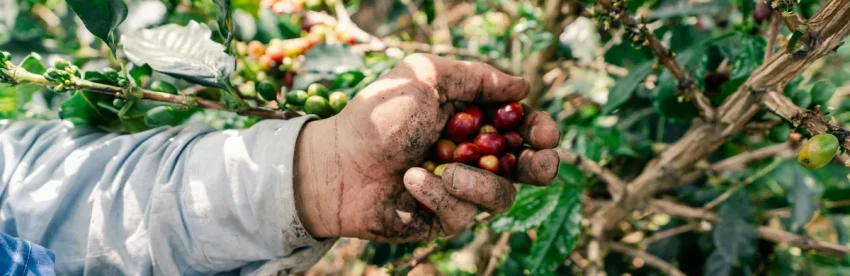
The mule is the argument. Colombian coffee grows high on slopes too steep for machinery, which means the cherries get picked by hand, selectively, by people who can tell ripe from nearly ripe. That is expensive and slow and it is also why the coffee is good. A tractor in the frame would have said industrial efficiency. A mule says this was carried down a mountain by somebody who cared. The whole quality claim is compressed into an animal.
Can you actually buy Juan Valdez coffee?
Yes, and this is where the character stops being a museum piece. Unlike most of the coffee brands from those old commercials, which are discontinued or hollowed out, Juan Valdez turned into a functioning business.
The Federation launched Juan Valdez Café as an actual coffee shop chain in 2002, and it opened its 500th store in 2022. Most are in Colombia, with the rest scattered across Latin America, Spain, Turkey, Kuwait and elsewhere. If you are in Bogotá or Medellín you will trip over one at the airport.
The packaged coffee is easier to get. Juan Valdez whole bean and ground coffee is sold in American supermarkets and online, and the ratings are consistently strong. It is a solid, clean, mild Colombian cup, chocolatey and low in acid, the flavor profile the campaign taught two generations to expect. Be honest with yourself about what it is, though. This is very good supermarket coffee with an unusually direct line back to the growers, not a competitor to a single-lot bag from a specialty roaster who can name the farm.
If what you actually want is the taste rather than the label, any well-sourced Colombian whole bean coffee will get you there, and buying whole bean and grinding it yourself will do more for the cup than the name on the front of the bag ever will.
What the campaign actually accomplished
There is a fair criticism of Juan Valdez, and it deserves saying out loud. A cheerful cartoon farmer is a comfortable image, and comfortable images can paper over hard economics. Coffee growing is precarious work, prices swing violently, and Colombian growers have gone on strike over exactly that. The poncho does not fix any of it.
What the campaign did do is unusual enough to respect. Growers organized, pooled money, and spent it on making their own origin famous, and they kept ownership of the result. The trademark belongs to the Federation, which belongs to the farmers. When you compare that to the ordinary arrangement, where the value accumulates entirely at the roasting and retail end and the farm gets the commodity price, it looks less like a mascot and more like an early and fairly effective piece of producer leverage.
Marisol was right to correct me, but she buried the more interesting half. The man is fake. The half-million families who own him are not.
For more coffee objects that ended up in the historical record, see our piece on the world’s most famous coffee pots.
Frequently asked questions
Was Juan Valdez based on a real farmer?
No. He was created as a composite character in 1958 to represent Colombian coffee growers generally. The third actor to play him, Carlos Castañeda, was a genuine coffee farmer, but the character came first.
Who plays Juan Valdez now?
Carlos Castañeda held the role from 2006 until his death in April 2024. The Federation has continued to use the character in its branding and on packaging.
What is the mule’s name?
Conchita. She has appeared alongside him since the earliest advertisements.
Is Juan Valdez coffee grown in Colombia?
Yes. The entire point of the brand is single-origin Colombian arabica, and the Federation’s certification exists specifically to separate 100% Colombian coffee from blends containing beans from other countries.
Is Juan Valdez the same as Colombian Supremo?
No. Supremo refers to bean size, which is a grading term rather than a brand or a quality guarantee. Juan Valdez is the Federation’s own brand, and it sells coffee in several grades and roasts.
Discussion