
Affiliate disclosure: As an Amazon Associate, TalkAboutCoffee earns from qualifying purchases. Our picks are based on editorial judgment, not commission rates.
The first time I understood what “Colombian” was actually doing on a coffee label, a roaster named Esteban was refusing to sell me any. He had three Colombian lots on the shelf that week, all from different departments, and he would not let me buy the one marked simply Colombia. Pick a region, he said, or you are buying an average. He was not being difficult. He was telling me that the most famous origin word in coffee is also the least specific one.
Colombia is the third-largest coffee producer on earth, behind Brazil and Vietnam, and the largest producer of arabica anywhere, averaging around 11.5 million bags a year. That much coffee cannot possibly taste like one thing. What follows is where it grows, what it actually tastes like, and how to buy it so you get the good version.
Why Colombia grows so much good coffee
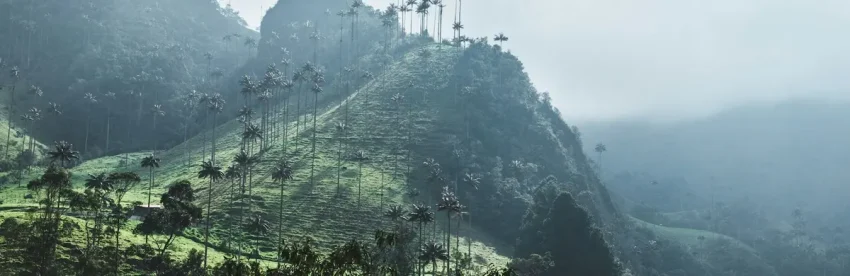
Coffee wants a narrow set of conditions and Colombia happens to have them across an unusual amount of land. The growing regions sit in the Andes, where temperatures run roughly 8 to 24 degrees Celsius (46 to 75 Fahrenheit) and the terrain is steep, high and volcanic.
Altitude is doing most of the work. Cool air slows the cherries as they ripen, and slow ripening concentrates sugars and acids, which is what gives good coffee its sweetness and structure. The slopes are also too steep for machinery, so cherries get picked by hand and selectively, which means a picker can take the ripe ones and leave the rest to come back for later. That is expensive and it is exactly why the coffee is good.
The other advantage is stranger. Colombia straddles the equator with mountain ranges running in several directions, so different regions harvest at different times of year. There is no single national harvest, which is part of why Colombian coffee is available fresh for more of the year than most origins.
The regions worth knowing
The heart of the industry is the Eje Cafetero, the Coffee Axis, sometimes called the Coffee Triangle. It covers the departments of Caldas, Risaralda and Quindío, along with northwestern Tolima, parts of Valle del Cauca and southwestern Antioquia. This is the volume region, and it is the landscape UNESCO named a World Heritage Site in 2011.
The names specialty buyers reach for tend to sit outside that triangle. Huila, in the south, and Nariño, higher still near the Ecuadorian border, are both major producing departments and both have reputations for brighter, more acidic, more distinctive cups than the national average. Tolima, Cauca and Norte de Santander also turn up regularly on specialty bags.
The outlier is the Sierra Nevada de Santa Marta, an isolated massif on the Caribbean coast that rises straight out of the sea. It grows for quality rather than volume, and much of the coffee comes from Arhuaco, Kogi, Kankuamo and Wiwa communities, who have been growing there since coffee pushed into their territory in the late 1800s. Arhuaco coffee in particular has a serious reputation.
What Colombian coffee actually tastes like
The house style, if there is one, is balance. Expect medium body, caramel and milk chocolate sweetness, a clean citrus brightness and enough acidity to keep it lively without being sharp. It is the profile that taught most of North America what coffee is supposed to taste like, which is why it can read as “normal” rather than exciting.
Region changes it considerably. A Nariño grown near the upper limit of where coffee will survive tends to be brighter and more acidic, closer in character to an East African coffee than to what people expect from Colombia. A lower-grown Eje Cafetero lot is rounder, sweeter and heavier. Almost all of it is washed process, which is part of why Colombian coffee tastes so clean, though naturals and honeys have started appearing from specialty producers.
How half a million farms got organised
Colombia’s real advantage is not its mountains. Plenty of countries have mountains. It is that the growers organised themselves and stayed organised.
Coffee reached Colombia by 1790, and the oldest written record of it is from a Jesuit priest, José Gumilla, who noted its presence in his 1730 book The Orinoco Illustrated. It was first grown commercially at Salazar de las Palmas in Norte de Santander, and early on the growers had to be talked into it, because a coffee tree takes about five years to produce a first harvest and that is a long time to wait on a promise.
The turning point was 1927, when growers formed the Federación Nacional de Cafeteros, a cooperative owned by the farmers themselves. It founded a research institute, Cenicafé, in 1938, and built an extension service that put agronomists in front of smallholders. It later invented Juan Valdez, the fictional farmer who made “100% Colombian” mean something to shoppers who could not have found Colombia on a map. The European Union granted Colombian coffee protected designation of origin status in 2007.
Compare that with Venezuela, which started from almost the same place and let its coffee industry collapse, and the difference looks less like geography and more like a choice.
The industry is more fragile than it looks
Over 500,000 families depend on Colombian coffee, and the sector has taken several hard hits in living memory.
In January 1999 an earthquake measuring 6.4 struck the coffee zone directly, though the region recovered faster than anyone expected. In August 2008 long-distance truckers went on strike, and because Colombian coffee has to travel from the mountains to the ports by road, the effect was immediate: roughly 30,000 sixty-kilo bags a day stopped moving. The strike grew from 200 trucks in Bogotá to a nationwide shutdown, the government declared it illegal, and coffee futures climbed to a three-week high. Nobody’s crop failed. The roads simply stopped working.
Climate is the current worry, and it deserves an honest accounting rather than a scary one. In 2011 the New York Times reported that production had fallen from around 12 million bags to 9 million between 2006 and 2010, with average temperatures up a degree since 1980 and rainfall up sharply, and the coverage at the time suggested Colombian coffee was in terminal decline. That is not what happened. Production climbed again and reached 14.2 million bags by 2018.
The threat is real but it is specific rather than apocalyptic. Warmer conditions favour leaf rust, a fungus that wrecks yields, and the Federation has spent years breeding varieties that resist it and tolerate a changed climate. That work is why the recovery happened, and it is also why the cooperative structure matters more than any single harvest.
How to buy Colombian coffee well
Esteban’s advice holds up. A bag that says only “Colombian” is a country blend, and country is the loosest origin claim there is, covering everything from commodity supermarket coffee to exceptional lots. It is not a warning label, it is just uninformative.
Look for a department on the bag, ideally Huila, Nariño, Tolima, Cauca or a named estate. Check for a roast date rather than a best-before date. Buy whole bean, because grinding fresh will do more for the cup than trading up to a more expensive origin. And if you want to understand what the fuss is about, buy a single-region Colombian and a supermarket “Colombian” in the same week and drink them side by side. The gap is not subtle.
For where Colombia sits against other origins, our guide to single-origin coffees by regional flavor covers fourteen of them, and if you are curious about the famous names and the label games played around them, that is in our piece on the world’s best coffees and how to spot a fake.
Frequently asked questions
Is Colombian coffee the best in the world?
No origin is. Colombia is the most consistently good at scale, which is a different and arguably more useful thing. For sheer distinctiveness, Ethiopian and Kenyan coffees usually beat it.
Why is Colombian coffee so popular in America?
Partly the balanced profile, partly seventy years of deliberate marketing by the growers’ federation, and partly proximity. The United States is one of the largest buyers of Colombian coffee.
What is Colombian Supremo?
A size grade, not a quality guarantee. Supremo beans are simply the largest screen size, with Excelso a step down. Bean size correlates loosely with growing conditions and not at all with how the coffee tastes.
Is Colombian coffee arabica or robusta?
Arabica, essentially entirely. Colombia is the world’s largest arabica producer.
What roast suits Colombian coffee?
Medium. It is where the caramel sweetness and the citrus acidity both survive. Dark roasting flattens exactly the balance you paid for.
Discussion