
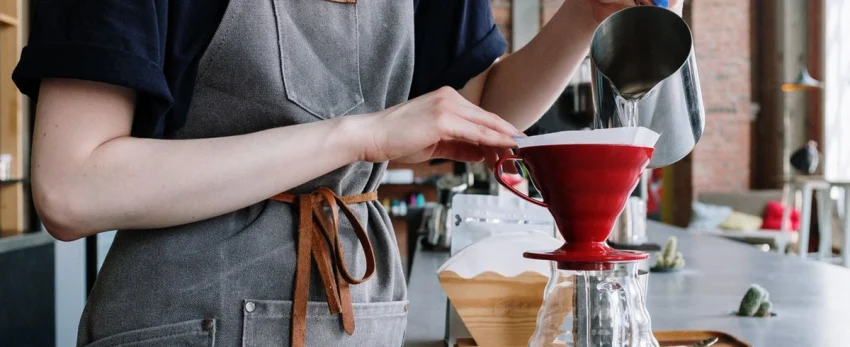
I spent years obsessing over beans, grind size, brew ratios, water temperature – the whole routine. And for years my coffee was good but never quite right, and I couldn’t figure out why. Then I moved apartments, and without changing a single other variable, my coffee tasted completely different. Better, actually. Turns out the old place had hard water. The new one didn’t. That was the whole mystery.
Water is 98% of your finished cup of coffee. If you’re dialing in everything else and ignoring the water, you’re solving the wrong problem.
Why mineral content changes the taste
Coffee extraction is a chemical process. Hot water dissolves soluble compounds from the ground coffee – acids, sugars, oils, bitter alkaloids – and the mineral content of that water determines which compounds get extracted first, how much of each dissolves, and how the final cup tastes.
Two minerals matter most: calcium and magnesium. Magnesium is particularly good at extracting the bright, fruity, acidic flavors. Calcium pulls more of the heavier, rounded notes. The balance between them shifts what you taste in the cup, even with identical beans and identical technique.
Then there’s bicarbonate, which acts as a buffer. Too much bicarbonate neutralizes the acids in coffee and makes it taste flat and chalky. Too little, and the cup reads as sharp and sour. This is why some tap water produces coffee that tastes dull no matter what you do – the bicarbonate content is drowning the brightness.
TDS: the number everyone throws around
TDS stands for Total Dissolved Solids, measured in parts per million (ppm). It tells you how much stuff is dissolved in your water – minerals, salts, trace metals, everything. A TDS reading doesn’t tell you which minerals are present, just how much total dissolved material there is. Think of it as a rough volume dial, not a recipe.
The Specialty Coffee Association (SCA) recommends a target of 150 ppm TDS for brewing water, with an acceptable range of 75 to 250 ppm. Below 75, the water doesn’t have enough mineral content to extract properly, and the coffee tastes thin and underdeveloped. Above 250, extraction gets unpredictable and heavy minerals start interfering with flavor.
You can test your tap water with a cheap TDS meter – they’re $10 to $15 (about 8 to 12 GBP) online and give you a reading in seconds. It won’t tell you everything, but it tells you whether you’re in the ballpark or way outside it.
Tap, filtered, bottled, distilled: what actually works
Tap water varies wildly by city and even by neighborhood. Some municipal water is excellent for coffee right out of the faucet. Some is terrible. If your tap water tastes good on its own – no chlorine bite, no metallic edge, no sulfur smell – it’s probably fine for coffee. If you wouldn’t drink a glass of it happily, your coffee won’t fix that.
Carbon-filtered water (a basic Brita or PUR pitcher) removes chlorine, chloramine, and some organic compounds that cause off-flavors. This is the single best upgrade most people can make. It doesn’t change the mineral content significantly, so if your tap water has decent minerals but tastes like a swimming pool, a carbon filter solves it for $20 to $30 (15 to 25 GBP).
Reverse osmosis (RO) water strips out almost everything, including the minerals you want. Straight RO water has a TDS near zero, and coffee brewed with it tastes flat and sour because there’s nothing to drive proper extraction. If you have an RO system, you’ll need to remineralize – either with a post-filter or with mineral drops sold specifically for coffee brewing.
Distilled water has the same problem as RO – it’s too clean. The SCA explicitly recommends against using distilled water for brewing. It also tends to be more aggressive on equipment, pulling minerals from metal boilers and group heads over time.
Bottled spring water works well for coffee in many cases, but check the label. Look for a TDS between 75 and 250 ppm and relatively low sodium. Some brands publish a full mineral analysis on their website. Crystal Geyser, for example, tends to land around 100 to 200 ppm depending on the source, which is solid brewing territory.
Hard water vs. soft water: what each does to your cup
Hard water is high in calcium and magnesium. Soft water is low in both, sometimes because it’s naturally low, sometimes because it’s been treated with a water softener (which replaces calcium and magnesium with sodium).
Very hard water over-extracts. It pulls too many compounds too fast, resulting in bitter, heavy, muddy coffee. It also scales up your equipment – those white deposits inside your coffee maker are calcium carbonate from hard water, and they’ll eventually clog internal tubing and reduce heating efficiency.
Very soft water under-extracts. The coffee tastes weak, sour, and one-dimensional, even if you grind finer or brew longer. Sodium-softened water adds its own problem: the sodium itself can introduce a slightly salty or flat quality that doesn’t belong in coffee.
The sweet spot, per the SCA, is moderate hardness: around 50 to 175 ppm of calcium carbonate equivalent. If you’re in that range, your water is doing its job.
One thing people miss: water hardness can change seasonally. Municipal water supplies that draw from surface reservoirs tend to run harder in late summer when water levels drop and mineral concentration increases. If your coffee tastes different in August than it did in March, same beans and same gear, the water is the variable.
The practical version: what to actually do
If your coffee tastes fine and your equipment isn’t scaling up, your water is probably fine. Don’t fix what isn’t broken.
If your coffee consistently tastes flat, bitter, or thin despite good beans and good technique, test your water. A TDS meter gives you a starting point. If you’re below 75, your water is too soft. Above 250, it’s too hard. Either one is worth addressing.
For most people, the fix is simple: a basic carbon filter for chlorine removal if your water tastes like a pool, or bottled spring water if your tap is extremely hard or soft. The specialty coffee rabbit hole goes deeper – you can buy Third Wave Water mineral packets, mix your own mineral recipes from magnesium sulfate and sodium bicarbonate, or install an under-sink filter with a bypass for mineral retention. But those are for people who’ve already optimized everything else and are chasing the last 5%. A Brita pitcher gets you 80% of the way there for a fraction of the effort.
And if you’re wondering whether this matters for espresso specifically: yes, more. Espresso uses less water and higher pressure, so every mineral imbalance gets amplified. The difference between good water and bad water in a drip brewer is noticeable. In an espresso machine, it’s obvious.
Frequently asked questions
Can I use tap water for coffee?
Yes, if your tap water tastes good on its own and has a TDS between 75 and 250 ppm. If it tastes like chlorine or metal, a carbon filter usually fixes it. If it’s very hard or very soft, you may need a different source.
Is distilled water good for coffee?
No. Distilled water has almost no mineral content, which means it can’t extract coffee properly. The result tastes flat, sour, and thin. The SCA recommends against it. Use it only if you remineralize it first with mineral drops or packets.
What TDS should water be for coffee?
The Specialty Coffee Association recommends a target of 150 ppm with an acceptable range of 75 to 250 ppm. You can test your water with an inexpensive TDS meter available online for around $10 to $15 (8 to 12 GBP).
Does a Brita filter help coffee taste better?
It helps if your tap water has a chlorine taste or other off-flavors. Carbon filters like Brita remove chlorine and some organic compounds without stripping the minerals your coffee needs. It’s the simplest, cheapest upgrade for most households.
Does hard water damage coffee machines?
Over time, yes. Hard water causes mineral scale buildup inside boilers, heating elements, and tubing. Regular descaling helps, but very hard water (above 250 ppm TDS) can cause problems faster than you can keep up with descaling, especially in espresso machines.
Discussion