
This article is for general information only and does not replace medical or dermatological advice. If you have a skin condition, consult your dermatologist before trying new topical products.
Caffeine is in your eye cream. It’s in your body scrub, your face serum, your under-eye patches, and that lip balm someone gave you at Christmas. Coffee grounds are showing up in exfoliants. Coffee oil is listed on ingredient panels. And the whole trend is growing fast enough that it’s worth asking the obvious question: does any of this actually work, or is it just another ingredient du jour riding the wellness wave?
The answer is somewhere in the middle, and it depends on what you’re using it for.
What caffeine actually does to skin
Caffeine is a vasoconstrictor. Applied topically, it tightens blood vessels near the surface of the skin, which temporarily reduces puffiness and discoloration. This is the mechanism behind most caffeine eye creams – they make the blood vessels under your eyes constrict, which means less visible pooling and a brighter appearance (Cleveland Clinic – Is Caffeine Good for Your Skin?).
Caffeine also has antioxidant properties. A 2023 review in Molecules found that topical caffeine offers measurable protection against UV-induced skin damage and may play a role in reducing the appearance of photoaging, the premature aging caused by sun exposure (PMC – Caffeine in Skincare: Its Role in Skin Cancer, Sun Protection, and Cosmetics). It’s not a replacement for sunscreen, but as a supporting ingredient, the evidence is real.
And caffeine penetrates skin reasonably well. Studies on topical caffeine formulations show it can reach the dermis (the deeper skin layer where blood vessels sit) within minutes of application, which is why the vasoconstriction effect is visible quickly – you can see under-eye puffiness decrease within 15 to 20 minutes of applying a caffeine product.
Dark circles and puffiness: the strongest use case
This is where caffeine in skincare has the most evidence behind it. A clinical study using a caffeine and vitamin K eye formulation showed a 26% reduction in dark circles and a 38% reduction in puffiness after four weeks of daily use (PMC – Evaluation of an eye counter pad containing caffeine and vitamin K). Those are modest numbers, but they’re real, measured results from a controlled study, not marketing copy.
The important caveat: caffeine helps with dark circles caused by blood vessel dilation and fluid retention. If your dark circles are structural (hollowing under the eye from bone structure or volume loss) or pigmentary (melanin deposits, common in darker skin tones), caffeine won’t change much. It can reduce the purple-blue tint from visible blood vessels, but it can’t fill in hollows or bleach pigmentation. If you’ve tried every eye cream on the market and nothing works, the issue might be anatomical, not circulatory.
Coffee scrubs: exfoliation or just a mess?
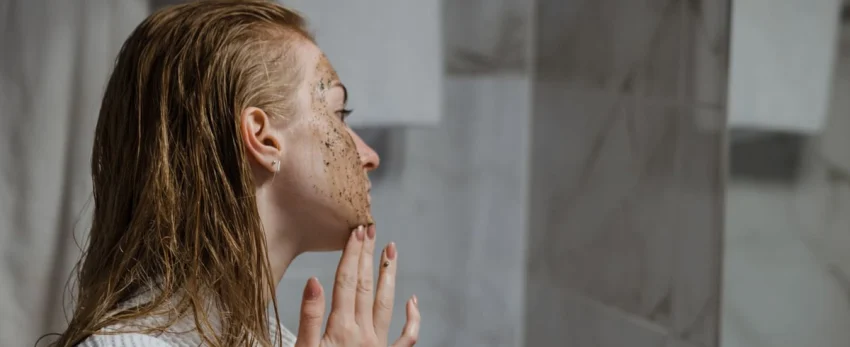
Coffee ground scrubs are everywhere, from boutique brands to DIY Pinterest recipes (mix used grounds with coconut oil, apply, rinse). The marketing usually claims they “boost circulation,” “reduce cellulite,” and “energize the skin.” Let’s break those down.
Exfoliation: yes, coffee grounds are a physical exfoliant. They’re about as abrasive as sugar scrub and less abrasive than walnut shell, so they work. But any granular material exfoliates. The coffee grounds aren’t doing anything special that salt, sugar, or oatmeal can’t also do. And physical exfoliants in general have fallen out of favor with dermatologists, who increasingly recommend chemical exfoliants (AHAs, BHAs) as gentler and more consistent.
Cellulite reduction: this claim shows up constantly. The idea is that caffeine’s vasoconstrictive and lipolytic (fat-breakdown) properties can smooth the appearance of cellulite. Some small studies have shown temporary skin-tightening effects from topical caffeine, but the key word is temporary – it’s a cosmetic effect that lasts hours, not a structural change. No cream, scrub, or topical treatment permanently reduces cellulite. Any product that claims otherwise is lying.
Circulation: physically scrubbing your skin with anything increases local blood flow. That’s the massage, not the coffee. The “energized glow” after a coffee scrub is the same flush you’d get from vigorous rubbing with any exfoliant.
What’s actually worth buying
If you want to use caffeine in your skincare, here’s what the evidence supports:
Eye creams with 1 to 5% caffeine – genuinely useful for morning puffiness and vascular dark circles. Look for caffeine listed in the first five to ten ingredients on the panel. If it’s buried near the bottom, the concentration is too low to do much.
Caffeine-containing sunscreen formulations – the antioxidant benefit is a real complement to UV protection, though caffeine alone is not sunscreen. Think of it as an ingredient that makes your SPF work slightly harder.
Caffeine body lotions and serums – some body care products include caffeine at effective concentrations for general skin-firming effects. These won’t reshape your body, but they can temporarily improve skin texture and tightness. Reasonable expectations are the key here.
What to skip: coffee ground scrubs marketed as cellulite treatments ($30 to $50 for a product whose active ingredient is used coffee grounds), “coffee-infused” products where caffeine is the last ingredient on a 40-item panel, and anything claiming permanent skin-tightening effects from topical caffeine. The ingredient is real. The overclaiming around it is not.
A note on DIY coffee masks and scrubs
Making a coffee scrub at home is cheap and simple – mix used grounds with a carrier oil (coconut, olive, or jojoba), use gently, rinse. It’s a perfectly fine body scrub. Just don’t use it on your face unless you’re gentle and your skin tolerates physical exfoliation. And don’t expect it to do anything that a store-bought sugar scrub can’t also do. The caffeine content in used coffee grounds is significantly lower than in commercial caffeine formulations, so you’re mostly getting the mechanical exfoliation, not the active ingredient.
One thing to watch: fresh grounds are more abrasive than used ones. If you’re making a DIY scrub, used grounds that have already been brewed are gentler on the skin. And keep the scrub away from broken skin, sunburned areas, and anywhere you’re already using exfoliating acids like glycolic or salicylic.
When to talk to your dermatologist
Topical caffeine is generally well tolerated. But if you notice redness, irritation, or dryness after using caffeine products (especially around the eyes), stop using them and talk to your dermatologist. If your dark circles are persistent and severe, a dermatologist can determine whether the cause is vascular, pigmentary, or structural, which determines what actually helps.
Frequently asked questions
Does caffeine in skincare actually work?
Yes, for specific uses. Topical caffeine is a proven vasoconstrictor that reduces puffiness and vascular dark circles, and it has antioxidant properties that complement sun protection. It does not permanently tighten skin, reduce cellulite, or replace sunscreen.
Can I use coffee grounds on my face?
You can, but be gentle. Coffee grounds are a physical exfoliant that can be too abrasive for sensitive facial skin. They work better as a body scrub. The caffeine content in used grounds is low, so the benefit is mainly mechanical exfoliation, not the active ingredient.
Does caffeine help with dark circles under the eyes?
It helps with dark circles caused by blood vessel dilation and fluid retention. Clinical studies show measurable reductions in puffiness and discoloration with regular use. It does not help with dark circles caused by bone structure, volume loss, or melanin pigmentation.
Do coffee scrubs reduce cellulite?
Not permanently. Topical caffeine can create a temporary skin-tightening effect that lasts a few hours, but no cream or scrub permanently reduces cellulite. Any product claiming otherwise is overstating the evidence.
How much caffeine should a skincare product have?
Effective concentrations in clinical studies range from 1% to 5%. Check the ingredient list: caffeine should appear in the first five to ten ingredients. If it’s listed near the bottom, the concentration is likely too low to produce noticeable effects.
Sources
- Cleveland Clinic – Is Caffeine Good for Your Skin?
- Herman A, Herman AP (2023) – Caffeine in Skincare: Its Role in Skin Cancer, Sun Protection, and Cosmetics. Molecules.
- Ahmadraji F, Shatalebi MA (2015) – Evaluation of an eye counter pad containing caffeine and vitamin K. Advanced Biomedical Research.
This article is for general information only and does not replace personalized dermatological advice. If you have concerns about how caffeine-based products affect your skin, consult your dermatologist.
Discussion