
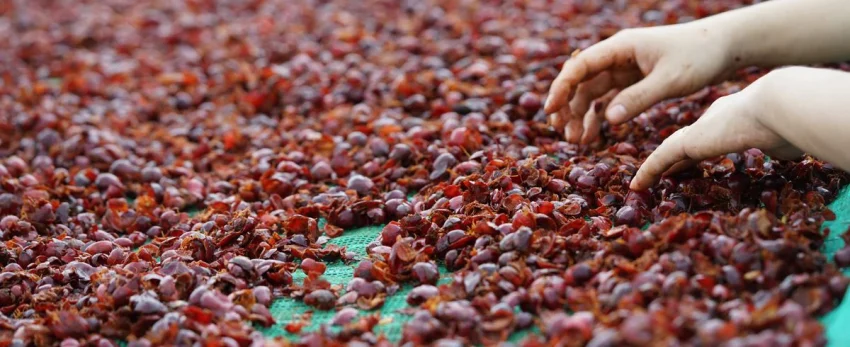
In coffee-producing countries, the fruit of the coffee plant has been consumed for centuries. In Ethiopia, where coffee originates, farmers have dried and brewed the husks of coffee cherries into a drink called qishr or hashara for as long as anyone can remember. In Yemen, a similar preparation has been part of daily life for generations. In Bolivia, it’s cascara tea, sipped casually in the afternoons. The coffee bean gets all the global attention, but the fruit around it was the original drink.
When specialty coffee shops in London and Portland started putting cascara on their menus around 2012, they treated it like a discovery. It wasn’t. It was just new to them.
What cascara actually is
Cascara is the dried skin and pulp of the coffee cherry, the fruit that surrounds the coffee bean. After the beans are extracted during processing (washed, natural, or honey), the remaining fruit is typically composted or discarded. Cascara dries that fruit layer instead and uses it as a brewing ingredient.
The word “cascara” comes from the Spanish for “husk” or “shell.” Despite being called “coffee cherry tea” on many cafe menus, it isn’t technically tea. Tea comes from Camellia sinensis, and cascara comes from Coffea arabica or Coffea canephora (robusta). Calling it tea is a convenience, not a botanical statement. It’s more accurately a tisane, the same category as chamomile or rooibos, but brewed from the fruit of the coffee plant rather than a flower or a leaf.
What it tastes like
If you’re expecting it to taste like coffee, it doesn’t. Not even close. Cascara tastes more like a tart, fruity herbal tea. The most common flavor notes are hibiscus, rose hip, dried cherry, tamarind, and sometimes a light mango sweetness. There’s a gentle acidity and a natural sweetness that comes from the fruit sugars in the cherry.
The flavor varies with origin. Cascara from Ethiopian farms tends to be more floral and citrusy. Central American cascara (El Salvador and Honduras are significant producers) leans more toward dried fruit and tamarind. Bolivian cascara, one of the oldest commercial sources, often has deeper, raisin-like sweetness.
The taste also depends heavily on how the coffee cherries were processed before the cascara was dried. Naturally processed coffee (where the bean dries inside the fruit) produces cascara with more residual sweetness because the sugars had longer to develop. Washed process cascara tends to be cleaner and more tart.
The caffeine question
Cascara contains caffeine, but significantly less than coffee. A typical cup brewed from 5 to 7 grams of cascara in 8 oz (240 ml) of hot water contains roughly 25 to 50 mg of caffeine, depending on the variety and steep time. For comparison, the same volume of brewed coffee has 80 to 100 mg, and a cup of black tea sits around 47 mg.
So it’s roughly in the range of a mild tea. Enough to notice if you’re very caffeine-sensitive, but not enough to replace your morning coffee if you’re drinking it for the energy.
How to brew cascara
Brewing cascara is closer to steeping tea than making coffee. Here are two methods that work well:
Hot brew: Use 5 to 7 grams of cascara per 8 oz (240 ml) of water heated to around 200 to 205 degrees Fahrenheit (93 to 96 degrees Celsius). Steep for 4 to 5 minutes, then strain. Longer steeping extracts more sweetness and body but can also pull tannic, astringent notes past the 7-minute mark. A fine-mesh strainer works better than a tea infuser since the dried fruit pieces are irregularly shaped.
Cold brew: Combine 15 grams of cascara with 12 oz (350 ml) of cold water. Steep in the refrigerator for 12 to 24 hours, then strain. Cold-brewed cascara is smoother, sweeter, and makes an excellent base for iced drinks. Some specialty shops use it as a mixer in cocktails or blend it with sparkling water for a soda-like drink.
Unlike coffee, cascara is fairly forgiving with ratios and timing. An extra minute of steeping won’t ruin it. And the dried husks can sometimes be resteeped for a lighter second cup, though the flavor drops off noticeably.
The regulatory situation
For years, cascara existed in a regulatory gray area in Europe. The European Union classified it as a “novel food” – meaning it wasn’t widely consumed in Europe before 1997 and needed formal safety approval before it could be sold. This effectively blocked commercial sale of cascara in EU countries while it was freely available in the US, Canada, and, of course, the producing countries where people had been drinking it for centuries.
The EU approved dried coffee cherry pulp as a novel food in January 2022, clearing the legal hurdle. You can now buy cascara in European specialty shops and cafes, though selection is still limited compared to North America. If you tried to find it in a European shop before 2022 and couldn’t, that’s why.
Why cascara matters beyond the cup
The coffee industry produces an enormous amount of waste. For every kilogram of green coffee beans, roughly 1 kilogram of coffee cherry pulp is generated. Most of it is discarded. When that pulp decomposes in large quantities near processing stations, it can contaminate local waterways and release methane as it breaks down.
Cascara turns that waste into a product. It gives farmers an additional revenue stream from a harvest they’re already doing, and it reduces the environmental footprint of coffee production. For small-scale farmers, the extra income from selling dried cascara can be meaningful. It won’t transform anyone’s economics overnight, but it’s the rare specialty coffee trend that genuinely benefits producers rather than just giving consumers a new thing to Instagram.
Some roasters and importers specifically highlight cascara as part of their sustainability story. Aida Batlle, a fifth-generation coffee producer in El Salvador, was one of the first to market cascara internationally as a premium product rather than a byproduct. Her approach helped shift the conversation: cascara isn’t leftover fruit. It’s a second crop from the same plant, and pricing it accordingly respects the labor that goes into producing it.
Where to find it
Specialty coffee roasters are the most reliable source. Many roasters who source directly from farms now offer cascara alongside their bean lineup. Online retailers like Trade Coffee, Sweet Maria’s, and various single-origin roasters stock it seasonally. Some specialty grocery stores carry it, though availability varies by region.
Expect to pay roughly $10 to $20 for a 4 to 8 oz (115 to 225 g) bag, which yields about 15 to 30 cups depending on how strong you brew it. That’s cheaper per cup than most specialty coffees. Shelf life is long if kept dry – a year or more in a sealed bag away from moisture and direct light.
Frequently asked questions
Is cascara tea or coffee?
Neither, technically. Cascara comes from the coffee plant but is made from the fruit, not the bean. It’s not tea either, since tea comes from Camellia sinensis. Cascara is a tisane, the same category as chamomile or rooibos, but it tastes more like a fruity herbal tea than like coffee.
Does cascara have caffeine?
Yes, but less than coffee or black tea. A typical cup of cascara contains roughly 25 to 50 mg of caffeine, compared to 80 to 100 mg in a cup of brewed coffee. The exact amount depends on the variety, steep time, and how much cascara you use.
What does cascara taste like?
Cascara tastes like a tart, fruity herbal tea with notes of hibiscus, dried cherry, rose hip, and tamarind. It has natural sweetness from the coffee cherry’s fruit sugars. It does not taste like coffee despite coming from the same plant.
Is cascara legal in Europe?
Yes, since January 2022. The EU classified cascara as a novel food and required safety approval before it could be sold commercially. That approval was granted in early 2022, and cascara is now legally available in EU countries, though selection in shops is still more limited than in North America.
How do you brew cascara?
Hot brew: steep 5 to 7 grams in 8 oz (240 ml) of water at 200 to 205 degrees Fahrenheit (93 to 96 degrees Celsius) for 4 to 5 minutes, then strain. Cold brew: combine 15 grams with 12 oz (350 ml) of cold water, refrigerate for 12 to 24 hours, then strain. Both methods are forgiving with ratios and timing.
Discussion