Affiliate disclosure: As an Amazon Associate, TalkAboutCoffee earns from qualifying purchases. Our picks are based on editorial judgment, not commission rates.
Quick guide to the grocery coffee aisle
- If you want cheap and surprisingly good: walk past the main coffee aisle and find the Latin/Hispanic grocery section. Café Bustelo, Café Pilon, and Café La Llave vacuum bricks run $4 to $6 for 10 oz / 283 g and brew above their price point.
- If you want a step up without going to a specialty roaster: Peet’s Major Dickason ($11 to $14 a bag), Eight O’Clock Original, Starbucks Pike Place, or your local store-brand program (Kirkland, 365, Trader Joe’s). All sit a meaningful tier above the cheapest stuff.
- Roast date on the bag matters more than brand. Whole bean with a printed roast date within the last 6 weeks beats any pre-ground tin, regardless of name.
- Skip: the open scoop-your-own bulk bins (stale), the “natural” or “gourmet” supermarket gimmick brands at $20+ per pound (overpriced and usually old), and pre-ground tins without a roast date.
- If you actually want great coffee: the supermarket aisle is the wrong place. A small online roaster shipping you a bag within a week of roasting beats every option above.
For more on what makes a good bag of coffee, see our best whole bean coffee picks, our coffee storage guide, and our how to save money on coffee.
The original version of this article was a brand-by-brand palate review of the supermarket coffee aisle, written in 2006. Folgers was rated harshly, Maxwell House politely, Eight O’Clock dismissed. Eighteen years and 60 comments later, several readers had pointed out (correctly) that palate ratings of mass-market coffee are mostly opinion and that the bigger question wasn’t “which brand tastes best” but “what’s actually worth my money in this aisle in 2026.” This is the rewrite that tries to answer that question. The original reviews are preserved in the comments below for anyone curious.
Quick disclosure on what supermarket coffee is. Almost every brand on a US grocery shelf is roasted by one of three or four big roasting companies and sold under different labels. Kraft Heinz owns Maxwell House, Yuban, Gevalia, and Sanka. JM Smucker owns Folgers, Café Bustelo, Dunkin’ (the bagged supermarket version), and 1850. Massimo Zanetti owns Chock Full o’Nuts, Hills Bros, and Segafredo. There are fewer independent supermarket roasters than the shelf suggests. None of this is bad. It just means a lot of what looks like brand competition is actually the same factory making different bags at different prices.
Why supermarket coffee has a bad reputation
Three reasons. First, freshness. Coffee that has been roasted, ground, packed, shipped, and sitting on a shelf for four to six months is past its aromatic peak no matter how good the beans were going in. Most supermarket coffee is at least three months from roast date by the time you pick it up. The vacuum brick or vacuum can extends the life some, but it doesn’t reset the clock.
Second, bean quality. The blends sold at $7 to $10 per 12 oz / 340 g bag are usually a mix of lower-grade arabica and robusta. Roasted dark, packed quickly, sold widely. It is not a coffee designed to surprise you. It is designed to be acceptable, consistent, and cheap enough to be a daily drinker. By that standard, most of it succeeds.
Third, how people brew it. A $10 bag of mid-tier supermarket coffee, brewed in a $25 Mr. Coffee that doesn’t hit 195 to 205 F (90 to 96 C), with a tablespoon-per-8-oz ratio, sitting on a warming plate for an hour, will taste flat and bitter and weak regardless of brand. The same bag brewed correctly tastes meaningfully better. Reader DN909 made this point in a comment back in 2010 and it is still the most underweighted variable in this entire conversation. Brew first, then judge the bag.
The bargain aisle most Americans walk past
The most useful tip in the 60-comment thread on the original version of this article came from reader BJK in 2010: if you live near a neighborhood with a Dominican, Cuban, Mexican, or Puerto Rican population, the Latin/Hispanic aisle of any reasonably stocked grocery store carries a different category of supermarket coffee. Vacuum-packed bricks of pre-ground espresso-grind dark roast, mostly from Florida-based roasters that serve the Caribbean diaspora.
- Café Bustelo ($4 to $6 for a 10 oz / 283 g vacuum brick) is the gateway. Dark roast, fine grind, a touch of robusta in the blend that gives it the punch a moka pot or espresso machine wants. Owned by JM Smucker since 2011 but the product itself hasn’t changed much. Brews a stronger cup than its price suggests.
- Café Pilon ($5 a brick) is Bustelo’s twin from the same Caribbean-coffee tradition, also widely distributed. Some palates prefer it; it has a slightly cleaner finish. Pick whichever your store has.
- Café La Llave ($5 a brick) leans a touch sweeter and is the third leg of the same stool. Common in Hispanic supermarkets and increasingly in mainstream chains.
- El Pico ($6) is the NYC-area entry. Roasted by Rowland Coffee (same parent as a few of the above through the JM Smucker acquisition). Solid all-around.
These are designed for stovetop moka pots and espresso machines, not drip. You can brew them in a drip maker if you use a finer-grind setting and a slightly coarser ratio, but they are at their best in a moka pot or as a strong base for a milk drink. The flavor profile is intentionally bold, dark, and slightly bitter in the European-Caribbean style rather than the cleaner Pacific Northwest specialty profile. If you have only had Folgers and Starbucks and you want to try something different without driving to a specialty roaster, the Latin aisle is your move.
The major mass-market brands
The big four names you will see on every shelf, with what they actually are and when each makes sense:
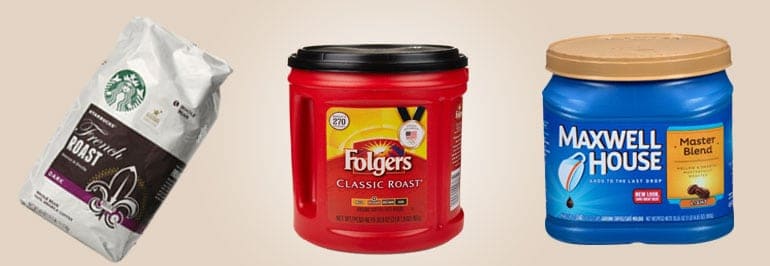
- Maxwell House. The default American supermarket coffee since the 1920s. Medium roast, gentle, inoffensive, sweet leaning. The Original Roast is the one most older readers grew up on. Works for cream-and-sugar drinkers and for offices where someone is going to dump it after sitting on the warmer for two hours anyway. Reader Wilu (2012) wrote that he hated all Maxwell House and preferred Folgers; reader DN909 was the opposite. Both are valid. This is genuinely a palate question.
- Folgers. Slightly bolder than Maxwell House, with what some palates call a “bite” at the finish that others call harsh. Classic Roast and Black Silk are the two most-distributed lines. Folgers also makes a respectable instant; the freeze-dried Folgers Instant is one of the better mass-market instants and is a useful pantry item even if you don’t drink it every day.
- Eight O’Clock. Owned by Tata Consumer Products since 2018. Sells whole bean at supermarket prices, which is the actual reason to buy it. A $9 bag of Original Whole Bean ground at home in a $25 burr grinder beats $9 worth of any pre-ground supermarket coffee. The Royal Signature Blend and 100% Colombian lines are both worth trying.
- Yuban. The cleanest of the four in profile. Made by Kraft Heinz, originally a J. A. Folger brand that became the more upscale alternative to Folgers proper. The 100% Colombian is the standard pick. Slightly more expensive than Maxwell House, slightly better, still firmly in the mass-market tier.
What all four share: they will be drinkable. None will be exciting. If you brew them on a SCAA-certified machine with a 1:16 ratio of fresh-ground beans, you will get a cup that is genuinely good. If you brew them the way most Americans brew supermarket coffee (cheap machine, weak ratio, hour on the warmer), you will get a cup that is genuinely bad. The brand has less to do with the outcome than the brewing does.
Mid-tier: the step up that’s worth the money
Roughly $11 to $16 per 12 oz / 340 g bag gets you into the tier where supermarket coffee starts feeling like real coffee. The economics are interesting: at this price point, you’re paying the major roasters to do less blending and more single-character work, and the difference shows up in the cup.
- Peet’s Major Dickason Blend ($13) is the standard upgrade pick at the supermarket. Dark roast, full body, decades-old blend named after Peet’s founding head roaster. The whole bean version is widely available in major chains and warehouse clubs. If you want the mass-market dark roast experience done well, this is the bag.
- Starbucks Pike Place ($14) is the medium-roast house blend. Smoother and less aggressive than Starbucks French Roast (which is genuinely over-roasted for most palates). Pike Place is the bag to buy when someone asks you to grab “Starbucks coffee” and you want them to actually like it.
- Dunkin’ Original Blend ($11) at the supermarket is a different product from what’s brewed in Dunkin’ stores but the bagged version has its own following. Medium roast, sweet, very approachable. Owned by JM Smucker since 2018.
- Allegro Coffee ($14) is the Whole Foods house roaster and sells outside Whole Foods too. Sources transparently, dates bags, and roasts a wide enough range to find a profile you like.
- 1850 ($12), JM Smucker’s premium Folgers-adjacent line, is more interesting than its packaging suggests. The Black Gold and Lantern Glow lines are real medium-dark roasts.
Store-brand and warehouse-club programs
This is the under-rated tier in 2026. Major retailers contract real roasters to produce their store-brand coffee at lower margins than the equivalent name-brand. The packaging is plain. The coffee is often the same beans or better than the $13 name-brand on the next shelf.
- Kirkland Signature (Costco). The Kirkland 100% Colombian Whole Bean and Kirkland House Blend are roasted by Starbucks; the bag literally says so. $20 for 2.5 lb / 1.1 kg, which works out to about $8 per 12 oz / 340 g. The math is hard to beat at supermarket scale.
- 365 Everyday Value (Whole Foods). Roasted by Allegro, sold at a discount from Allegro’s branded line. Decent house picks.
- Trader Joe’s. Sources from various small and medium roasters that sell under the Trader Joe’s label. The Bay Blend and 100% Colombian are reliable; the rotating seasonal beans are sometimes surprisingly good. Bags do not carry roast dates, which is the one downside.
- Aldi Beaumont. Aldi’s house brand, made by major US roasters. The cheapest acceptable coffee in any mainstream chain. The 100% Colombian Premium Whole Bean is the pick.
- Target Good & Gather. Newer than the others. Some lines are roasted by Allegro. Hit and miss but the dates are usually current.
What to skip in this aisle
- Scoop-your-own bulk bins. The bins aren’t airtight, beans sit in them for weeks, and there is no way to know how long any given scoop has been there. Stale coffee at fresh-coffee prices.
- “Gourmet” supermarket brands at $20+ per pound. Same factories, fancier bags, older roast dates than the legitimate specialty roasters who would actually charge that much. The price is signaling, not quality.
- Flavored coffees in plastic tubs. Whatever is added to coffee to make it taste like “Hazelnut Vanilla Crème” is rarely flattering to the underlying bean. If you want flavored coffee, buy a flavor syrup separately and use it on plain coffee. Cheaper, and you can vary it.
- Decaf without a process listed. Decaffeination methods matter. “Swiss Water Process” and “CO2 Process” are the chemical-solvent-free decaf processes you want. Decaf that doesn’t say either has likely been done with methylene chloride or ethyl acetate, which are technically food-safe but not what most informed buyers choose.
- Pre-ground tins with no roast date. If the bag doesn’t print a roast date or a “best by” within 12 months of today, assume it has been sitting too long.
If the supermarket aisle isn’t working for you
The honest answer is that supermarket coffee in 2026 is fine for daily drinking and is the wrong place to look for great coffee. Great coffee, by current specialty standards, requires beans roasted within the last four to six weeks, ground within the last hour, and brewed at the right temperature. Almost nothing at a major grocery chain checks all three of those boxes.
If you’re at the point where you want to push past supermarket quality without sourcing it yourself, the modern path is a small online roaster or a subscription service. Trade Coffee, Atlas Coffee Club, and Mistobox all curate from small roasters and ship within days of roasting. Direct from a roaster (Counter Culture, Stumptown, Intelligentsia, Onyx, Sey, Heart, Verve, and dozens of regional names) is the next tier up. Multiple readers in the comment thread below have linked their own favorite small roasters going back to 2009; the recommendations are still mostly current.
None of this means you should stop buying supermarket coffee. It is convenient, cheap, and consistently acceptable. It is also a clean baseline against which to taste better coffee, so you know what the upgrade actually buys you. Both can be true at once.
Frequently asked questions
What’s the best cheap coffee at the grocery store?
For the lowest reasonable price, Café Bustelo or Café Pilon in a 10 oz / 283 g vacuum brick at $4 to $6. For a mainstream brand experience, Eight O’Clock Whole Bean (around $9) ground at home is the price-to-quality leader. For warehouse-club shoppers, Kirkland 100% Colombian Whole Bean (roasted by Starbucks, $20 for 2.5 lb / 1.1 kg) is the best dollar-per-quality math.
Is whole bean really worth grinding at home?
Yes. The difference between coffee ground 30 minutes ago and coffee ground three months ago is real and large. A basic blade grinder runs $15. A basic burr grinder runs $40 to $75 used or $100 new. Either upgrade is the highest-leverage move you can make for coffee quality short of buying a better brewer. For drip and French press, even a blade grinder is meaningfully better than pre-ground.
Why do you recommend Café Bustelo over Folgers and Maxwell House?
Different category. Bustelo is a dark-roast, fine-grind, espresso-style coffee designed for stovetop moka pots and espresso machines. Folgers and Maxwell House are medium-roast drip coffees. Bustelo at $4 a brick is a better stovetop coffee than $7 of Folgers; Folgers in a drip maker is more familiar than Bustelo brewed the same way. The right answer depends on what you’re brewing with.
Are store-brand coffees actually the same as name brands?
Often, yes. Costco’s Kirkland 100% Colombian Whole Bean prints “Custom Roasted by Starbucks” on the bag. Whole Foods 365 is mostly Allegro Coffee. The store-brand pricing is the same beans in plainer packaging with a different margin structure. You are usually paying less for the same product, not less for a worse product.
What happened to brands like Savarin and Maxim?
The 1960s and 1970s supermarket coffee landscape had dozens of regional brands that have since been acquired, consolidated, or quietly discontinued. Savarin is still sold under the Rowland Coffee umbrella in some Northeast markets but is much less visible than it was. Maxim was discontinued by Kraft years ago. Brim is gone. Postum is back (revived in 2013) but as a niche product, not a mainstream one. Several readers in the comments below have asked about these brands going back to 2007; if you remember one and can’t find it, it has probably been acquired or shelved.
How can I tell if a supermarket coffee bag is fresh?
Look for a printed roast date (best) or a “best by” date that’s at least 6 months out (acceptable). Vacuum-sealed bags or bricks are fresher than non-vacuum-sealed. A “one-way valve” on the bag is a good sign; it means the coffee was packed fresh enough to still be releasing CO2. Bags with no date and no valve are the oldest and stalest on the shelf.
Why this article changed
The original version of this article was a 2006 palate-rating of eight specific brands, several of which (Millstone, Thanksgiving Coffee, the specific Folgers and Maxwell House products mentioned) have shifted, been reformulated, or been redistributed since. Sixty comments accumulated over the years, many of them politely disagreeing with the original ratings (Wilu in 2012 disagreed with almost everything in the article, and was within his rights). The rewrite drops the per-brand palate ratings in favor of a more useful framing: how to navigate the 2026 grocery aisle by tier and use case. The Latin/Hispanic aisle bargain section is from reader BJK (2010). The “brewing matters more than brand” emphasis is from DN909 (2010). The original brand-by-brand reviews are still in the comment thread below for anyone curious. As ever, the thread is open. If your favorite brand isn’t here and should be, leave a comment.
Discussion 60
I love Starbucks French Roast and Seattle’s Best #5 is a favorite as well. Yes I like it dark and strong and my friend who is a coffee roaster says I like it burned. I am looking for other brands that are as good as Starbucks French Roads.
I found one better .. If you have facebook try this page .. it has info on it .. Smooth taste and good for you.. not over priced either ..
https://www.facebook.com/CrownJewelofCoffee/?fref=ts
Yes .. I found one
Nothing compares with the European coffees of France and Germany. Is there an American coffee that comes close?
MAXWELL HOUSE Dark Roast. Just made a pot, 4 scoops for 12 cups. Weak and tasteless, not happy with this at all.
I am wondering why it is so hard to find a dark roast flavored coffee? Green Mountain used to make Bold Hazlenut but it has been discontinued. I am looking for an alternative.
I disagree with almost everything the author of this article says. I find all the Maxwell House varieties found in supermarkets to be among the worst I ever tasted: mediocre taste while drinking, muddy nasty aftertaste. I find Folgers to be the best of all the lower priced, off the shelf grocery store coffees. I find all varieties of Starbucks, especially the freshly ground, to be the most enjoyable, with an extra certain “lift” that other coffees don’t have, and which seems to be above and beyond caffeine.
I don’t see how this article’s author got to be considered an expert.
Not a fan of Starbucks. Out of nostalgia I recently picked up a can of Savarin, it’s what my parents drank back in the 1960s. It’s the first time I purchased coffee in a can. I have to say I liked it. I also tried like Gary above to research Savarin on the internet and found virtually nothing–interesting considering how long this brand has been around. The Rowland Coffee website says they go back to 1865, but doesn’t indicate whether that was always their name, nor whether they were the first to market Savarin. The site also says that Smucker’s (most famous for their jams & jellies) acquired Rowland Coffee.
To Tony post #50. Try Kicking Horse 454 Horse Power. Great coffee, strong and bold but not bitter.
Illy Coffee is the best coffee I’ve ever had. As it is fairly expensive, I tend to purchase Caribou’s medium roasts often. Other brands that frequent my coffee apparatuses are Trader Joe’s and Target’s “Archer Farms” blends.