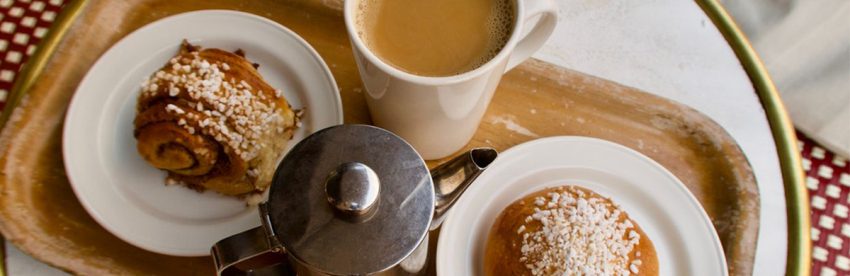
Walk into a Swedish office around three in the afternoon and something odd happens: everyone just stops. Not for a fire drill, not for a meeting. For fika, the coffee break so deeply embedded in Swedish life that at plenty of companies, taking two of them a day isn’t a perk, it’s practically a mandate. I spent time in Stockholm a few years back and it took me a solid week to stop feeling guilty about sitting down mid-afternoon with a cinnamon bun and doing, by design, absolutely nothing productive.
What fika actually is
Fika is the Swedish word for a coffee break, but calling it just that undersells the whole institution. It’s coffee, almost always paired with something sweet, fikabröd, usually a kanelbulle (cinnamon bun) or another baked good, shared with someone else. Drinking coffee alone at your desk while scrolling your phone is not fika. The social part is the point, not a side effect. It’s a scheduled pause built specifically for conversation, and skipping it isn’t seen as extra productivity, it’s seen as a little bit antisocial.
Coffee’s rocky start in Sweden
Coffee arrived in Sweden in the mid-1670s and took roughly a century to catch on beyond the wealthy. When it did, the Swedish crown responded the way governments often responded to a popular new vice: it taxed the stuffing out of it, starting in 1746, and the public simply refused to comply. The government kept trying, and failing, to stamp out the coffee habit for decades, and by the 1820s it gave up the fight entirely. That stubborn public refusal to give up coffee, even under direct pressure from the crown, tells you something real about how quickly it became part of the culture rather than just a fashionable import. Fika itself, as the specific pairing of coffee with pastry in a dedicated social pause, emerged later, in the early 20th century, as Swedish coffeehouses evolved into konditori, the combined bakery-and-coffeehouse format that’s still recognizable in Sweden today.
Where the word actually comes from
Fika has a genuinely charming etymology: it comes from flipping the syllables of the 19th-century slang word for coffee, kaffi, essentially Swedish back-slang. It’s a small detail, but it tells you fika was never a marketing invention or a recent lifestyle trend dressed up as tradition. The word itself is old enough to have been playground slang once.
Beyond the cinnamon bun
Kanelbulle gets all the international attention, partly thanks to Kanelbullens Dag, Sweden’s officially recognized Cinnamon Bun Day every October 4th, but real fikabröd rotates through a much wider spread. Pepparkakor, thin spiced gingersnaps, show up constantly around the holidays. Semlor, cardamom buns filled with almond paste and whipped cream, have their own dedicated season leading up to Lent and inspire genuine debate over the correct almond-paste-to-cream ratio. Prinsesstårta, a dome-shaped marzipan-covered sponge cake, tends to appear for something closer to an occasion than a daily fika. The common thread isn’t any specific recipe. It’s that the pastry is homemade or bakery-fresh rather than a mass-produced snack, and it’s substantial enough to justify sitting down for it.
Why a coffee break became a national institution
Sweden, along with Finland and the Netherlands, sits among the highest per-capita coffee consumers in the world, so the raw appetite for coffee was always there. What made fika specifically endure, rather than just “Swedes drink a lot of coffee,” is the deliberate social structure around it. A scheduled, shared pause resists the thing that erodes most breaks in other work cultures: the slow creep of eating lunch at your desk, checking email during coffee, treating rest as something to be optimized away. Fika survived specifically because it was never framed as optional self-care. It was framed as a shared, expected part of the day, which is a much harder thing to skip than a break you’re supposed to take for yourself.
Bringing an actual fika into your own day
You don’t need Swedish coworkers to borrow the actual mechanics of this. The parts that matter are the ones people skip when they try to import fika as a personal habit: it has to be at a set time, not “whenever there’s a lull,” it should involve something to eat alongside the coffee, and it works best done with someone else rather than solo. A cinnamon bun is traditional but not mandatory; the structure is what makes it fika, not the specific pastry. If your current coffee break is a to-go cup consumed while walking back to your desk, that’s not a small version of fika. That’s just caffeine. Fika asks you to actually sit down.
Frequently asked questions
Is fika actually mandatory at Swedish workplaces?
Not legally, but socially it functions that way at many companies. Some formally schedule two fika breaks into the workday; at others it’s an unwritten expectation strong enough that skipping it regularly gets noticed. The exact norm varies by company and industry, but treating it as optional in a Swedish office is genuinely unusual.
Can you fika by yourself?
You can drink coffee and eat a pastry alone, but most Swedes wouldn’t call that fika specifically. The social component is central enough to the concept that solo coffee, however leisurely, is generally described differently.
Do other countries have something similar to fika?
Several do, though rarely with as much cultural weight attached. Sweden, Finland, and the Netherlands rank among the world’s highest per-capita coffee consumers, and Finland in particular has its own strong coffee-break culture, though fika specifically, as a named, structured institution, is distinctly Swedish.
Whatever variation of a coffee break you actually take, the Swedish version’s real lesson isn’t about coffee or pastry specifically. It’s that a break survives being cut from a busy day only when it’s treated as a shared expectation, not a personal indulgence you’re supposed to feel a little guilty about.
Discussion