
Capresso 454 CoffeeTEAM – the quick answer
- The 454 model number is retired, but the line is still made. Today it’s sold as the Capresso CoffeeTEAM TS (#465), and there’s a step-up CoffeeTEAM GS as well. Same core idea: grind-and-brew in one machine.
- Cleaning the burr grinder: a reader asked how, since Capresso doesn’t want you disassembling the unit. Covered below with what’s actually safe to do.
- Known weak point: the digital display and electronic controls, reported to fail well before the mechanical parts do.
- Current price: the CoffeeTEAM TS runs $150-$200 depending on retailer and color.
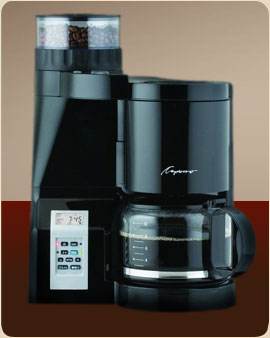
Reader Sharron Levey left a comment on the original version of this page asking how to clean the burr grinder’s internal components, since Capresso’s own guidance discourages taking the unit apart. It’s a fair question that the original review never addressed, and it’s the kind of practical detail that matters more than the feature list once you actually own one of these.
What a grind-and-brew combo actually buys you
The CoffeeTEAM concept, unchanged from the 454 through today’s TS and GS models, is a conical burr grinder built directly into a programmable drip coffee maker. Set it the night before, and it grinds fresh beans and brews automatically at whatever time you programmed, so you wake up to coffee made from beans that were whole ten minutes earlier rather than pre-ground days or weeks ago. That freshness gap is real and noticeable, particularly compared to supermarket pre-ground coffee that’s often been sitting on a shelf for months.
The trade-off is mechanical complexity. A basic drip machine has very little that can fail. A grind-and-brew combo has a grinder motor, burr assembly, and usually a digital control board layered on top of the same drip mechanics, which means more parts that can eventually wear out or malfunction.
Cleaning the burr grinder without taking it apart
This is Sharron Levey’s question, and the honest answer is that Capresso’s discouragement of full disassembly is reasonable advice, not corporate liability-covering. The conical burr assembly is precisely fitted, and reseating it incorrectly after a full teardown is a common way people accidentally ruin the grind consistency on these machines. What you can safely do without disassembly:
- Run grinder cleaning tablets (widely sold for burr grinders, roughly $8-10 for a supply) through an empty grind cycle every few weeks. These absorb built-up coffee oils that accumulate on the burrs and are the single most effective thing you can do without opening anything up.
- Brush out the hopper with a small, dry pastry or grinder brush after emptying it, particularly around the opening where beans feed into the burrs. Oil residue collects there first.
- Wipe the exterior grind chamber opening with a barely damp cloth, never wet, since moisture and ground coffee oil together turn into a paste that’s harder to remove than dry residue.
- Do not use water inside the grinder housing itself. This is the mistake that actually damages these units, not routine use.
If the burrs are visibly caked after months of use, that’s a sign you’re overdue for cleaning tablets, not a sign you need to open the housing.
The failure that actually ends these machines early
Complaints about this model line consistently point to the same thing: the digital display and electronic cup-count controls failing well before the mechanical grinder or brew components do, sometimes within a year or two of regular use. When the display goes, the grinder and brewer typically still work, but you lose the ability to program cup count and timing, which is most of what you bought a digital machine for in the first place.
There’s no reliable home fix for a failed control board on a machine at this price point; if it happens outside the warranty window, replacement is usually the practical answer rather than repair. Worth knowing before you buy: this is a documented pattern on this product line, not a fluke.
What to buy if you want this today
The direct current version of what the 454 was is the Capresso CoffeeTEAM TS (#465), which keeps the same grind-and-brew concept with a stainless thermal carafe and five brew-volume settings. If you want a step up with different capacity and finish options, the CoffeeTEAM GS is Capresso’s current higher-tier version of the same idea.
Frequently asked questions
Is the Capresso 454 the same as the CoffeeTEAM TS?
Functionally, yes. The 454 was an earlier model number in the same product line; today the equivalent machine is sold as the CoffeeTEAM TS (#465), with the CoffeeTEAM GS as a step-up option.
How do I clean the burr grinder without taking it apart?
Run grinder cleaning tablets through an empty grind cycle every few weeks, brush out the hopper opening where oil residue collects, and wipe the exterior with a barely damp cloth. Never introduce water inside the grinder housing.
Why did my display stop working?
This is a documented weak point on this product line: the digital display and electronic controls tend to fail before the mechanical grinder and brewer do, sometimes within a year or two. There’s no reliable home fix once the control board itself fails.
Is a grind-and-brew combo worth the complexity over a separate grinder and drip machine?
If wake-up-to-fresh-coffee convenience matters more to you than long-term reliability, yes. If you’d rather have two simpler machines that are each easier to repair or replace independently, a standalone burr grinder paired with a basic drip machine is the more durable long-term setup.
Why this article changed
The original version of this page described the Capresso 454 as a current product; it’s been superseded by newer model numbers in the same line for years. Reader Sharron Levey’s question about cleaning the grinder went unanswered in the original. This rewrite updates the model information, answers her question directly, and adds the display-failure pattern that owner reports consistently mention but the original review never covered.
Discussion 1
I have a Capresso Team TS#465. How do you suggest cleaning the burr grinder components. The company does not want me to take the unit apart to clean out the oils that accumulate.