Affiliate disclosure: As an Amazon Associate, TalkAboutCoffee earns from qualifying purchases. Our picks are based on editorial judgment, not commission rates.
I have tested somewhere north of 200 espresso machines over the years, and the single most common question I get is “which type should I buy?” Not which brand, not which model. Which type. Because the difference between a semi-automatic, a fully automatic, and a super-automatic espresso machine is not just a feature list. It is a fundamentally different relationship with your morning coffee. One type wants you involved. Another wants you out of the way. And the third is somewhere in between, which is either the best of both worlds or the worst, depending on what you care about.
Here is what each type actually does, what it costs, and who it is for.
Semi-automatic espresso machines
This is the type you see in most coffee shops and the type that most home espresso enthusiasts start with. A semi-automatic machine heats the water, builds the pressure, and pushes it through the coffee. Everything else is on you. You grind the beans, dose the grounds into the portafilter, tamp them down, and decide when to start and stop the shot. The machine provides the muscle. You provide the brains.
The design goes back to 1938, when Achille Gaggia patented a lever-driven pump machine in Milan. Modern semi-automatics replaced the lever with an electric pump, but the principle is the same: pressurized water through a puck of ground coffee.
What makes semi-automatics appealing is control. If you learn how to dial in your espresso, adjust the grind, the dose, and the extraction time, you can pull shots that rival a good café. If you do not learn those things, you will spend a frustrating month making bad coffee and blaming the machine. I have done both.
What to look for
A quality semi-automatic has a few non-negotiable parts: a brass group head and portafilter (not aluminum or plastic), a boiler with decent temperature stability, a pressure gauge so you can see what the machine is doing, and a steam wand if you make milk drinks. The portafilter should be a standard 58 mm size so you can find aftermarket baskets and accessories easily.
Entry-level semi-automatics like the Breville Bambino and DeLonghi Stilosa start around $100 to $300. Solid mid-range machines from Gaggia, Rancilio, and Breville run $400 to $800. Above $1,000 you are into prosumer territory with dual boilers, PID temperature control, and build quality that will last a decade or more.
Browse semi-automatic espresso machines on Amazon
Who it is for
Someone who wants to learn espresso as a skill, not just drink it. You will need a good burr grinder (the machine does not grind for you), and you should expect a learning curve. But if you enjoy the process of getting better at something, a semi-automatic is the most rewarding type of espresso machine you can own.
Fully automatic espresso machines
A fully automatic machine does everything a semi-automatic does, but it also controls the water volume. You still grind, dose, and tamp, but when you press the button, the machine delivers a pre-set amount of water at the right temperature and stops itself. No more watching the shot and guessing when to cut it off.
The practical difference is consistency. A semi-automatic in the hands of someone who is half asleep at 6 AM might produce a wildly different shot than the same machine after a second cup and full attention. A fully automatic removes that variable. The shot comes out the same way every time, assuming your grind and tamp are consistent.
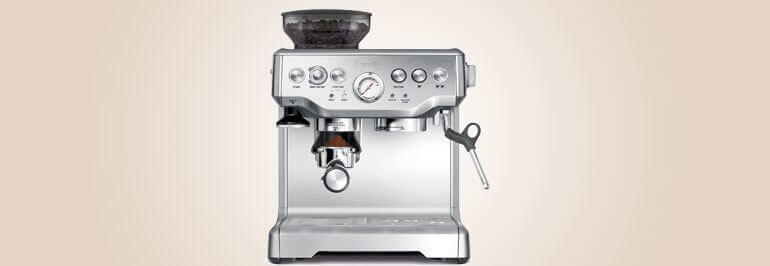
Most modern machines in the $300 to $800 range that call themselves “semi-automatic” actually have programmable volumetric buttons, which technically makes them fully automatic. The Breville Barista Express, one of the most popular home espresso machines sold, is a fully automatic with a built-in grinder. The line between semi and fully automatic has gotten blurry enough that the distinction matters less than it used to.
Browse fully automatic espresso machines on Amazon
Who it is for
Someone who wants good espresso with less guesswork but still wants to be involved in the grind and the tamp. If you are the kind of person who likes a morning routine but does not want to think too hard before the first cup, a fully automatic with a built-in grinder is probably the sweet spot.
Super-automatic (bean-to-cup) machines
Here is where automation takes over completely. A super-automatic machine has a built-in grinder, a bean hopper, a water reservoir, and usually an automatic milk system. You press a button. The machine grinds the beans, tamps them, brews the shot, and in many cases froths and pours the milk. Some of them can make a dozen different espresso drinks with a touch screen. The spent puck drops into an internal container that you empty every few days.
I will be honest. I spent years dismissing super-automatics as the microwave ovens of espresso. Then I tested a few current models and had to admit that the good ones produce genuinely decent shots. Not the same as a dialed-in semi-automatic with a $500 grinder, but close enough that most people would not notice the difference in a latte or cappuccino. The milk systems on the high-end machines, Jura, Breville, DeLonghi’s Dinamica and Eletta lines, are especially impressive.
What to look for
The grinder is the most important part. Cheaper super-automatics use blade or flat ceramic grinders that produce inconsistent grounds. Look for conical steel burr grinders with adjustable settings. You also want a machine with adjustable brew temperature, strength settings, and a milk system that produces actual microfoam rather than just hot bubbly milk.
Entry-level super-automatics start around $400 to $600. Good mid-range machines from DeLonghi and Philips run $700 to $1,200. Premium models from Jura, Breville, and Miele can reach $2,000 to $3,000 or more. The price difference is mostly in build quality, grinder quality, and how many drink options the machine supports.
Browse super-automatic espresso machines on Amazon
Who it is for
Someone who wants good espresso every day without learning espresso as a hobby. If you drink multiple cups, if multiple people in your household drink different drinks, or if you just want a button that produces a cappuccino in sixty seconds, a super-automatic is the right call. No shame in it. The machine does the work so you do not have to.
Which type should you actually buy?
The decision comes down to one question: do you want making espresso to be a process or a result?
If the process is the point, if you want to learn something, taste the difference when you change one variable, and slowly get better over months, buy a semi-automatic and a separate grinder. Budget $300 to $500 total to start, split roughly evenly between the machine and the grinder. The grinder matters more. I have written about that at length.
If the result is the point, if you want good espresso with minimal effort and you are willing to pay more upfront, buy a super-automatic. Budget $700 to $1,200 for a machine that will last and produce quality drinks. Read reviews carefully because the spread between a good super-automatic and a bad one is enormous.
If you are somewhere in between, a fully automatic with a built-in grinder gives you some control and some convenience. The Breville Barista Express and the DeLonghi La Specialista are both in that zone.
One thing I have learned after testing machines in all three categories: the best espresso machine is the one you actually use every day. A $2,000 semi-automatic that intimidates you into using the drip machine instead is a worse purchase than a $600 super-automatic that makes you a cappuccino every morning. Buy for your actual life, not your aspirational one.
Discussion 1
I’m looking for an espresso maker on a budget of less than $200. I will mainly use this for lattes. So with my budget, I’m pretty realistic to the quality of the espresso I’ll be making. With that said, I want to buy a durable espresso maker and not necessarily the quality of the espresso shot itself. I’m basically wanting the best value for the buck! I need your advice!!!