
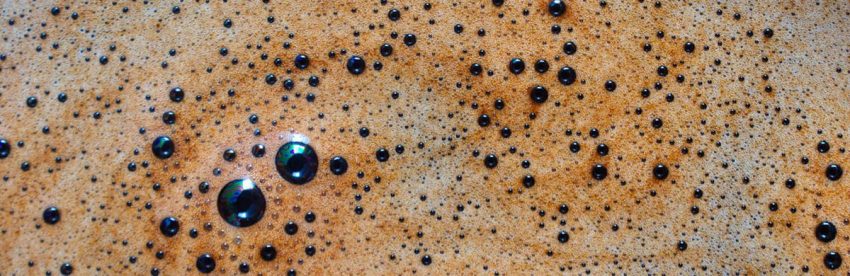
For years I judged my own espresso shots almost entirely by the crema, more crema, better shot, thin crema, bad grind. I was wrong about that in some genuinely useful ways, and right about it in others, and it took actually digging into the chemistry to sort out which was which. If you’ve ever stared at a thin, patchy layer on top of your shot and wondered what it’s actually telling you, here’s the honest answer.
What crema actually is, mechanically
Crema is not foam in the way milk foam is foam. It forms because espresso brews under roughly 9 bars of pressure, and that pressure forces carbon dioxide, trapped inside roasted coffee beans since the roasting process itself, to dissolve into the hot water passing through the grounds. The instant that pressurized liquid hits the cup at normal atmospheric pressure, the dissolved CO2 rushes back out of solution, exactly like opening a shaken soda, forming thousands of tiny bubbles. Those bubbles get trapped by an oil-in-water emulsion, coffee’s natural oils suspended in the liquid, which is what gives crema its stable, slightly thick texture instead of just fizzing away like soda foam does.
What crema thickness actually tells you (and what it doesn’t)
Here’s the part that surprised me: crema thickness correlates more with bean freshness than with how good your extraction technique is. More CO2 trapped in the beans means more crema, and CO2 content is highest right after roasting and steadily drops as beans sit, a process called degassing. A thick, dome-like crema is mostly telling you the beans are fresh, not that you pulled a technically perfect shot. A properly extracted shot from stale beans, a few weeks past their roast date, will produce noticeably thinner crema even with flawless technique, because there simply isn’t much CO2 left to release. This is why judging a shot purely by crema volume misleads people: you can nail your grind, dose, and extraction time and still get thin crema, just from bean age.
What actually good crema looks like
Roughly 2 to 3mm thick, a reddish-brown “tiger stripe” color rather than pale tan or stark white, tiny uniform bubbles rather than large uneven ones, and it should last a couple of minutes before noticeably thinning, not vanish in twenty seconds. Pale, thin crema that disappears almost immediately usually means either stale beans or an under-extracted shot (grind too coarse, or not enough contact time). Crema that’s dark and bitter-tasting on its own, sometimes with big uneven bubbles, tends to point toward over-extraction or beans roasted darker than the machine and grind are dialed for.
The robusta crema myth
You’ll sometimes hear that robusta beans produce more crema than arabica, and that’s actually true, robusta contains roughly double the chlorogenic acid and different oil content, both of which affect crema production, which is part of why some commercial espresso blends include a small percentage of robusta specifically for a thicker, more Instagram-friendly crema layer. But more robusta crema is not the same thing as better-tasting espresso. Robusta is generally considered harsher and more bitter than arabica on its own, so a blend chasing maximum crema is making a real flavor trade-off, not just an aesthetic choice.
Why decaf almost never has much crema
This trips people up constantly. Decaffeination processes, whether it’s the Swiss Water method or a solvent-based one, strip out more than just caffeine. They also wash away a meaningful share of the oils and disrupt some of the CO2 retention structure inside the bean, so decaf consistently produces thinner, less stable crema than caffeinated beans from the same roast, even at identical freshness. If you’ve ever assumed your decaf espresso was under-extracted because the crema looked sad, it probably wasn’t. That’s just what decaf does, and it’s not a fixable technique problem.
Storage habits that actually preserve crema-producing freshness
Since crema is mostly a freshness indicator, the practical lesson is about storage, not brewing technique. Keep beans in an airtight, opaque container away from heat and light, buy in quantities you’ll use within two to three weeks of the roast date, and resist the freezer for beans you’re using daily, since repeated temperature cycling from freezer to counter accelerates staling more than steady room-temperature storage does. Check the roast date on the bag before you buy, not just the “best by” date, which is usually set far later than when the coffee actually stops producing good crema.
So what should you actually do with this
Stop using crema volume alone as your quality signal, especially if you’re comparing shots from beans of different ages. Use it instead as one input among several: pair it with taste, extraction time, and how the shot actually smells, and pay closer attention to color and bubble texture than to sheer thickness. And if your crema has gotten noticeably thinner over the past couple of weeks with no change in your technique, check your roast date before you blame your grinder. Nine times out of ten, it’s not you. It’s just older beans finally running out of gas, literally.
Frequently asked questions
Why did my espresso suddenly have almost no crema?
Check the roast date first. A sudden crema drop with no change in your routine almost always means the bag is older than you think, not a machine or grind problem. If the roast date is genuinely fresh, check your grind size next, too coarse under-extracts and produces thin, pale crema.
Does more crema always mean better espresso?
No. More crema mostly means fresher beans and, to a lesser extent, a bean blend engineered for crema volume rather than flavor. A shot with modest crema from a well-dialed grind can taste better than a thick-crema shot from a robusta-heavy blend chasing appearance over taste.
Does pre-ground coffee ever produce good crema?
Rarely, and this is really a freshness problem in disguise. Ground coffee loses its CO2 far faster than whole beans because grinding exposes vastly more surface area, so pre-ground coffee has usually lost most of its crema-producing gas within days of grinding, regardless of the bag’s roast date.
Discussion