
All right, kids. You’ve got your espresso machine. You’ve got your coffee. You’re all set to make coffee-shop quality coffee drinks – especially espresso – right in your own kitchen. You pack your portafilter, flip the switch and get…. something that doesn’t even resemble espresso. What went wrong?
While you can’t expect to pull the perfect shot of espresso your first time out – some world-class baristas practice for years and are never quite satisfied with the results – understanding the elements of the espresso process can help you improve your shots, and eventually, get you to the point where you can consistently pull excellent shots of espresso.
In a Nutshell
There are multiple elements to getting your espresso shot right, which is why many baristas – home and pro versions – develop a ritual that ensures they don’t miss any of the steps Each of these elements affects the others, and the closer to right you get each of them, the closer to perfect your espresso shot will be. Pulling the perfect espresso shot is an exercise in experimentation and constant adjustment to get everything working together and produce consistently excellent coffee.
Preheat the Group Head and Portafilter
Before you start, pull a blank shot – that is, run water through the portafilter into your cup without any coffee. Warming the group head, portafilter and holder will help keep the temperature right while you pull your shot.
Grind
- The grind texture of your coffee is one of the most important aspects of pulling a good shot of espresso. Consider this: the flavor of your coffee is determined by the amount of coffee oils and chemicals extracted by the water as it flows through the ground coffee. The longer the water is in contact with the coffee, the more various flavors are developed. If the grind is too coarse, the water flows through too quickly and your coffee will be weak. If it is to fine, the water will take too long to flow through and will extract many of the bitter constituents of coffee, resulting in a cup that is sour and cooked.
- The texture you want for espresso is close to granulated sugar, but every coffee has its own precise grind that works best. To make it even more complicated, the same coffee may need a finer or coarser grind if the weather is humid, or if the coffee is older.
- Experiment to get the right flow rate for your coffee – about 20 to 30 seconds to pull a 2 oz. double shot of espresso.
Dose
- Baristas refer to the amount of coffee grounds used for a shot as the “dose”, like a dose of medicine, and express the doses in grams of weight, which is a much more accurate measurement than volume. You can buy a small digitial pocket scale
for less than $20, and it will make an amazing difference in your espresso quality.
- The starting point for a double shot of espresso is 14 to 18 grams, adjusted for your espresso machine and your personal tastes.
Tamp
- Tamping the coffee grounds levels and packs them so that you get uniform extraction. When water is forced through the coffee in the portafilter, it will seek out the paths of least resistance – where coffee is packed more loosely – if there are any. If your tamper is too small for the portafilter, for example, the coffee will be loose around the edges and water will flow through there without touching the bulk of the coffee in the center, and you’ll have a weak, under-extracted shot.
- Use a tamper that’s the right size for the portafilter.
- Hold your elbow at 90 degrees, put the portafilter on an even, flat surface, and apply 30 lbs. of pressure until the coffee looks smooth and polished. Finer coffee will need less pressure and coarser coffee will need more.
Pour
- Place the portafilter into the espresso machine’s brew group and put your cup – preheated, of course – under the spout.
- Start the pull based on your machine and your experience. Some espresso machines are very finicky and require you to get the temperature precisely right to get the best espresso shot. Others are very forgiving and hold the temperature well. Semi-automatic machines often signal that the boiler has reached the correct temperature with a light or something similar. When the machine is heated and ready, check your watch (so you can time the shot, which is critical) and start the pour.
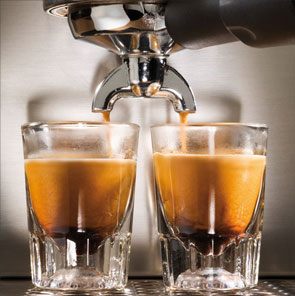
- If you’ve done a good job of dosing, grinding and tamping, the espresso should start out dark, then turn into a thin, golden brown stream of foam that just holds together. It should take between 20 and 30 seconds to pull a 2-ounce shot. If you’re not getting that volume in that amount of time, check your grind, dose and tamp, make adjustments and try again.
- If the espresso comes out unevenly from the two spouts, your tamp is uneven. If the flow is too fast, your grind needs to be finer or the tamp firmer, or a combination of both. If the flow is too slow, go coarser on the grind to slow the water down.
The end result should be a rich, dark brew topped with a thick layer of fine, gold crema – the foamy end of the shot. When you taste the shots you’re pulling, you’ll thank yourself for taking the time to learn how to pull a proper shot of espresso.
51 Comments
@Slav – You’re definitely correct – Second pull espresso is nasty and horrible. You are owed a lb. of free coffee!
That said, I’ve found that a latte made from a second-pull from a quality coffeeshop (the one I have in mind competes at both national and world levels) was actually more palatable than one from Starbucks, so I guess it’s a matter of standards.
pulling a quality espresso shot
Settle a bet for me.
A barista friend of mine pulls a second shot from a spent espresso. I explain to her this is sacrelige. She claims this to be the norm. I claim once a proper shot is pulled, you discard the grounds and pull a new shot, not run it through again.
We agreed your decision would render a winner. Loser must buy a pound of espresso beens for the winner.
Hi Joe, Welcome to the addictive world of coffee. You first pour in the espresso then the smooth velvety foamy milk. Shannon, In this world we all live to satisfy our customers right? I take it you work @Starbucks, and where you are now is because you trying to outsmart the rest of the competitors so they wouldn’t understand the route you chose. Happy espressing guys
Hi Joe, Welcome to the addictive world of coffee. You first pour in the espresso then the smooth velvety foamy milk.
Shannon, In this world we all live to satisfy our customers right? I take it you work @Starbucks, and where you are now is because you trying to outsmart the rest of the competitors so they wouldn’t understand the route you chose.
Happy espressing guys
New to a home machine but wanting to use it well. Lots of useful advice, thanks. I agree drink the coffee you enjoy rather than do it perfectly but it’s great to have the ‘best’ way of doing it if you want to improve or get the best for your machine.
Question:
Milk in the cup first then espresso or espresso in first then milk? ( I think it’s the latter)
Starbucks has automated machines because of the immense flow of customers, they converted to automatic to quicken the process. I personally wish we still hand pulled shots but you cannot criticize Starbucks as a whole for trying to improve. If all you said was true every drink would be perfect. But that is not the case because there are many factors into our drinks the most important is the barista. Our machines pull shot in 27 seconds. You compare Starbucks to McDonald’s because they are so wide spread and “automated” but last time I check neither me nor my co-workers are robots. We work hard not only to make the best drinks possible but also to interact with our customers and make their day a little bit better. I know 85% of my customers by name, drink, and their careers. I take my brother to the McDonald’s in town once a week or so for the past 3 years, and no one their knows my name. I appreciate everyone hopping on the hate big businesses bandwagon but the barista makes the Starbucks as well as the quality of the drink.
It’s interesting how espresso differs across the world. Starbucks did not do well here at all and closed many of it’s stores. I personally found Starbucks coffee to be weak, watery and totally uninteresting. I spent many years repairing, servicing and setting coffee machines and training outlets in the making of and how to improve their coffee. The norm here is 9 gms of coffee per shot, 9 Bars espressing pressure and 1.3 Bars boiler pressure although recently there has been a tendency to drop this a little giving a lower espressing temperature. You can talk about how to make the perfect cup of coffee till the cows come home but my perfect cup of coffee probably isn’t your perfect cup of coffee so it’s all relative really. What is really the main criteria is that you, your friends, or your customers love your coffee and come back for more
Hi Gary. if you use a double portafilter, there shouldn’t be a need to make any adjustments. As long as you have 14gr of coffee in your portafilter and press the double shot button on your machine, that will be all. ( I assume your machine is automatic). hope i was helpful.
Question …
Is the cook time for a double shot twice the time for a single shot?
I have the Delonghi EC702 and the single shot is perfect around 24 seconds.
What do I have to change when pulling a double shot 60 ml?
The holes in the portafilter look like the same size and number.
Hello there. I’ve gone through the whole debate and agree with most. I am a barrister and been trained by three different Coffee Co. They all run in more or less the same lines.
1- A machine can never operate without an experienced driver, (the Barrister)
2- Good coffee beans (fresh dark roast),
3- A PERFECT grinding machine
4- And a PERFECTLY SET Espresso machine.
With the above you will have 7gr of ground coffee beans, tamped (its best to place the portafilter at the edge of a counter and tamp down until your elbow makes a right angle), run on an espresso machine for 25 – 30 seconds and measuring +- 25 -30ml. If the above have been carefully followed, you will have a perfectly extracted espresso shot with a strong aroma, thick crema and taste.
We just purchased a Silvano by quick mill. Very happy with it. I’ve got the micro foam down but still disappointed with the espresso. Have a burr grinder. The problem: my latte tastes more like a milk drink than a coffee drink. It is taking longer than 27 seconds. Sometimes up to 40 seconds for a double shot basket. I’ve adjusted the grinder to a coarser grind and still not satisfied. Any suggestions? Good fresh beans are being used.
Unfortunately, you don’t seem to know as much about Starbucks as you claim. Firstly, they use superautomatic machines in their stores, and so there is no skill whatsoever in the shots that are pulled – you press a button and the espresso comes out – the machine grinds the shot, tamps the shot and pours the shot. That’s why the comparison with McDonalds. Secondly, you have obviously been taken in by the marketing hype around ‘Fair Trade’ Coffee – this is a badge used to make customers who don’t do their homework think they are doing something good – whereas the main benefactors from ‘Fair Trade’ are the richer farmers and the coffee is often mediocre because of the cooperative model it encourages. I don’t have space to go into all the ills of ‘Fair Trade’ here, but we really don’t ‘know’ the farmers are being treated humanely, and I have plenty of well researched evidence to show that this is not necessarily the case. In the end, the espresso shot relies on good coffee, good grind, accurate tamp and a decent length of time for extraction. The long time standard in Europe and more specifically Italy, where espresso was invented is around 27 seconds – that’s not what you are going to get at Starbucks. Just calling a spade a spade, I think the comparison with Mcdonalds is fair, and I think Starbucks are better generally, but not by enough to allow them to charge the premium prices.
A lot of things have been left out of this article, as mentioned in numerous comments here. Everybody seem to have their own opinion and ways to make the perfect espresso shot. In the end it is all a matter of taste. Now spitting on Starbucks is just stupid. If you actually knew the company, you might review your opinion. They serve some of the best coffees you can find on the market, and the farmers they get their beans from are treated humanely, something that cannot necessarily be said for any other coffee importers. There is no such thing as a “Starbucks espresso machine” and there never was. Starbucks used to sell espresso machines, but they never were branded “Starbucks”. The most notorious one was the “Barista” model, which I own among two other machines. While the machine itself is important, it is not what makes the best shot. A great tool won’t make a fine building. The builder will. The same applies to shots. How you prepare your grind, the type of beans you select according to your taste, the type of water, and the experience in pulling your shots are what make a great shot. Comparing Starbucks to McDonalds is as ludicrous as thinking that Football is better than Hockey. Those are two different things that cannot be put at the same level. Before hating on something, know what you are talking about guys.
Whoever wrote this article knows very little about making a good espresso shot. Nothing mentioned about the good quality grinder? That’s a basic. Mentioning a Starbucks brand espresso machine? This is ridiculous.
To Kim and others … as a starting point pick up a pinch of sugar and feel how gritty it is. Grind your coffee beans to that grittiness. Then fill your portafilter either single (7 grams) or double (14 grams) depending on the size of basket you are using. When making the shot, time it and try and get the shot at around 25 to 27 seconds before you see it starting to run clear in color. Oh yeh, tamp the coffee with a 30 pound pressure. Pressing on a bathroom scale will give you an idea how much pressure will get you to 30 pounds. It’s quite a bit.
The coarser the grind the faster the water will run through and hence faster you’ll get that 1 or 2 oz shot. Adjust grind in your grinder. A BURR grinder is a necessity. Blade grinders cannot be used for espresso. In fact, the grinder is more important to making espresso than the espresso machine, providing the latter is capable of sending the water through the coffee at the right temperature and correct pressure which most machines are designed to do. Kim, that was info for others, as your machine must have a burr grinder. A good burr grinder by itself will cost as much or more than what your Breville sells for. :-)
Hi again…
Opps…see it is todays date…of course you still own yours…lol. Do you have any tips to pass along?
Thanks
Hi,
I just purchased a Breville Barista Express. Just wondering if you still own yours. I’m having a problem with the right grind number.
I just bought a Breville Barista Express and am trying to perfect pulling shots. It’s taken me quite a few shots to get a good one but am finally getting decent ones with a nice crema on the top. I’ve heard some negative things about this machine and am wondering if I should take it back and try another one. Did I pay too much for a poor machine?
Why roasting and brewing methods have an impact on caffeine contain?
hi! i had read your debate regarding on how to make a perfect shot of espresso maybe you consider also those elements of quality espresso.which freshly grind beans at the right grind.to follow the standard of shelf life.Fine grind for espresso,coarse grind for dripped coffee.Water with no after taste,used soft water.Excellent condition of espresso machine.Barista skills.Milk.
Mam can you send me an article of any coffee tips and standard operating procedure for steaming of milk and proper machine calibration.thank u.BGU
What coffee machine was popular and resonable price
Navin, after reading your comments, I am almost certain your problem lies with stale beans. Check that your beans are less than 3 weeks old. Order from reputable online roasters who sort of roast to order and get it to you in under a week, or approach a gourmet roaster if you happen to live near one.
Machine is LaCimbali M29 Select. Not sure bout the grinder. Will find out today
what kind of machine & grinder do you have.
If it’s a Krups, Delonghi, Breville that’s probably normal due to low end internals.
Hello, i am stuck with a trouble. Even when i change the grind to fine or coarse, my espresso shot falls exactly at 10 secs. the only difference is that at a finer grind, it does not produce a shot with a crema and at a coarses grind, it produces a lovely crema top. Could this be the espresso machine calibration problem?
Oh my gosh. There may be a science behind espresso making with exactly 27 seconds and what not, but the true espresso is hte one you enjoy, not the on someone told you to brew in a certain time frame with certain coffee at a certain tempreture and a certain pressure. So relax, experiment and enjoy your coffee…
what? 5-7seconds? people should stick to the cardinal rule of 27 seconds for the perfect espresso.
Well, after reading the article how could you even mention the name “Starbucks”? They brew the worst coffee I’ve ever had. When my husband goes there, I take my own cappuccino that I make at home with an automatic Seaco machine, filtered water and freshly ground imported Italian espresso beans…and in a china cup!!! Do you think I’m going to drink a beverage that tastes like burnt coffee and made by a high school student” Here’s the scope…been to Italy four times and never had a bad espresso/cappuccino…here in the USA I can’t find a good espresso/cappuccino unless I make it at home. Yes…you need to cover ALL bases when it comes to making a GREAT cup of espresso. The best beans, filered water and the machine…and of course the barista!
RepublicEspresso: Seems like you should have written this article. Well put. 5-7 seconds is ridiculous. I usually pull around 20-25 seconds with a nice creamy head. 30 seconds and it can start tasting a little burnt.
In my experience, a well executed shot comes out looking like a freshly poured pint of Guinness.
hey i agree, the sooner the espresso be ingulped the better the taste of it would be. Though 5-7 sec r to short, it should be 15 seconds for adding milk or for makingany other coffee with espresso
Hello, Calling all Bialetti users!
maybe someone here can help me with my Espresso “. I use a Bialetti stovetop esspresso maker.But i cant seem to get the recipe right. Have you ever used one and if so can you help me configure it? I am desperate to make a decent shot of espresso at least.I have to admit typically I am a coffee only girl,but I do occasionally like a shot or a cappuccino.
Starbucks shouldn’t even be anywhere close to considered in this debate, they don’t tamp or pull shots, their machine is their barista.
excuse me while i whip this out:
27 seconds @ 9 BAR pressure with 195 degree water with the correct grind and tamp will give you what u are looking for. shot times are the same regardless of whether its a single or double shot(as it should be because shot time is cooking time) because the flow thru is regulated on your single shot portafilter by the smaller basket with less holes, which increases the pressure inside so you get infusion. when using a single shot portafilter it is your water volume thats halved, not your shot time.
also: starbucks is a robotic mcdonalds and should only be used as an example of how not to make espresso with a real machine.
from the point your shot starts, its cooking until you cool it. once its done coming out, IMMEDIATLY pour it in your milk, or even an unheated empty cup will do it. if you let it sit, it will burn (overcook) in the shot glass.
climate affects espresso by humidity affecting your grind.
and yes this article needs to be rewritten
Help! I just received a Starbucks Athena Barista Espresso Machine from my in-laws that has NO INSTRUCTIONS. I have never worked an espresso machine and need help – can anyone point me in the right direction of where I can either find instructions online or get my hands on a manual? Thanks!
does the climate affect the taste of espresso
Most of this has already been covered, but please don’t use the burnt under-extracted super-automatic 15 second shot from Starbucks who are little more now than a competitor for McDonalds. In Europe, and particularly Italy, the 27 second shot is legendary and so the 5 – 7 second shot has to be a typo – though the author has not corrected it I see. I also note that there is no discussion on ristretto, doppio and lungo type shots – this all has to do with weight of ground coffee to water ratios. This means a ristretto would typically be a 100% ratio and a doppio a 50% ratio – ie for arguments said – 1oz of espresso pulled with 16 grams of coffee is a ristretto shot and 2 oz of espresso pulled with 16 grams of espresso a good doppio. There needs to be a lot more clarification of what is posted here to ensure that we get some real quality out there – I rarely visit an independent coffee house that has really mastered this properly, and if we want to show Starbucks how it is done, we do need to pay attention to how it should be done. All that aside, I do think there is room for the intuitive and personal tweaking that produces that unique brand of espresso for individual places – though it has to be somewhere in the region of theses more scientific parameteres.
Hey Clearfish, I couldn’t agree with you more. Great info. The thought that you can get a good shot in 5 seconds is frightening to say the least.
Shocking. I thype “Top 10 Espresso Tips” into Google and was initially impressed then horrified that things discussing a 5 to 7 second shot could be publish on the web. Yes there is some variance but from the press of the button (on a commercial traditional machine) you will get the perfect shot in 20 to 30 seconds. If you’ve set your grinder up correctly you’ll get the perfect shot in 28 seconds from the button press. And it’s all down to the grind size. You need to get this right. Extract 2 x 30ml of espresso from 15 grams of fresh ground coffee in 28 seconds and you’ll be spot on. But yes you do need; a stopwatch, accurate scales and 2 x 30ml (1 fl Ounce) shot glasses. If you haven’t tried this, and been totally accurate don’t comment back at me!
I totally agree with this. I’ve let shots run for 45 seconds. The taste was FANTASTIC using a triple filter of course which tends to help with dosing and
tamping errors as well as machine extraction variables. CHEERS!!!
The 5 to 7 seconds is too short but bear in mind that each espresso machine produces differently. The tail of a mouse effect is crucial and yes this often takes longer time to produce, typically between 25 – 30 seconds.
Experts often tend to argue just to prove who’s right – but what is most important is if you like the taste, crema and heat of the drink. So feel free to break the 25 – 30 seconds and produce your perfect espresso shot.
Seldom I write comments but resource really cool
KRUPS? STARBUCKS? MACHINES!..you should be ashamed if your being serious about this….
That’s like saying a LADA car is the same as a LEXUS.
You missed alot of notes in here…what about …the barista technique. what about the why’s in terms of water?…you missed tons..who wrote this.
btw: I wouldn’t use Starbucks as a standard. That’s kind of like talking BBQ burgers with McDonalds…
12-20 secs:
– less than 9 bars puts you in the 20+ range
– more than 9 bars puts you in the 12 range
– if shot draws in less than 10 I would check your tamper and your grind
There is a huge variety of machines out there. I notice the basket designs on many are too constrictive for proper flowthrough; especially a lot of the cheap machines.
Anyway… once you find the grind, practice and yee shall find the flowcount. I am finding Vienna Roasted Mandheling makes a great, chocolaty-flavoured shot as an alternate to basic blends. Add some medium-high roast Ethiopian or medium roast Brazilian to blend. Mmmm…
Starbucks is Gay!!!ha, it’s all about THE COFFEE SHOP. buy local first
Anyone know why Starbucks dont use the Single shot button?
The Starbucks time standard is for pulling a double shot, which obviously isn’t the same as pulling a single shot. For the Verismo 801, the ideal time to pulling a double shot is 15 to 19 seconds.
Starbucks recently had a “training meeting” on this. They said do not let the shot sit for more than 15 seconds before mixing it in the milk mixture. and about 20 seconds is the “optimal” brewing time for a shot of espresso.
Ooo. Dispute. 25 is the top end for a shot, 30 would have let the espresso blonde & sour excessively in most machines. Though I agree, 5 – 7 is pretty low.
Hello. I think you have a typo in your espresso shot article. 5 to 7 seconds for an ounce of espresso is way too short. 25 to 30 seconds makes the optimal espresso shot. This is the agreed upon time limit for espresso lovers around the world. Take care.