Affiliate disclosure: As an Amazon Associate, TalkAboutCoffee earns from qualifying purchases. Our picks are based on editorial judgment, not commission rates.
I owned a DeLonghi Stilosa for two years before upgrading. Then I tested a Magnifica Evo for a month. The two machines bracket DeLonghi’s reputation perfectly: the cheapest DeLonghi espresso machines are some of the most disappointing coffee equipment I’ve ever used, and the mid-range Magnifica is one of the best-value automatic machines on the market.
Here’s how the DeLonghi espresso lineup actually breaks down, what’s worth buying, and what to skip.
Entry-level steam-pump machines ($100-200) – mostly skip
The Stilosa ($120), the EC155 ($120), and the EC685 ($200) are DeLonghi’s entry-level pump espresso machines. They have 15-bar pumps (which is more pressure than you actually need; real espresso uses 9 bar at the puck), pressurized portafilters (which fake the appearance of crema without real extraction), and steam wands that are functional but unimpressive.
The Stilosa ($120) is actually a reasonable pick at this price point. With practice and a non-pressurized portafilter modification, you can produce decent espresso. Read our full DeLonghi Stilosa review for the working approach.
The EC155 and EC685 are mostly disappointing. Compared to a Breville Bambino ($300), they don’t compete. Save up the extra $180 for the Bambino instead of buying an EC155 you’ll be frustrated with within months.
Picking a DeLonghi machine solves half the problem; the other half is technique. Our guide to pulling the perfect espresso shot covers the grind, dose, distribution, and timing that turn a Dedica or Magnifica into consistent shots once you have the hardware.
Slim pump machines ($300-400)
The DeLonghi Dedica Style ($300) is a slim 6-inch wide pump espresso machine that’s better than the entry level. Real espresso capability, decent steam wand, compact footprint for small kitchens.
At this price point, the Breville Bambino ($300) is the direct competitor and generally produces slightly better espresso. The DeLonghi Dedica wins on footprint if counter space is tight, and on aesthetics for some kitchen styles.
Magnifica super-automatic ($600-1,200)
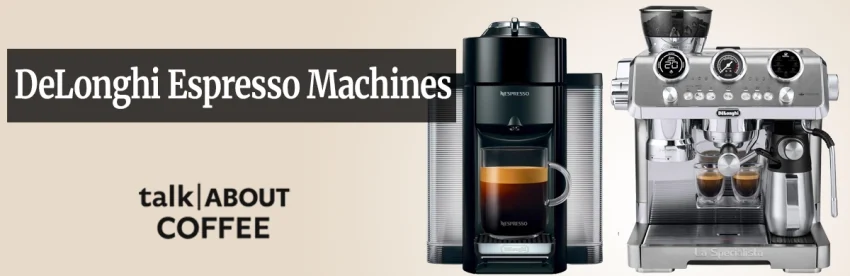
This is where DeLonghi shines. The Magnifica line is a series of bean-to-cup super-automatic espresso machines that grind, dose, tamp, brew, and steam milk at the press of a button. The Magnifica Evo ($800) is the current standard. The Magnifica S Smart ($900) adds a touchscreen and customization features. The Magnifica Plus ($1,000) adds milk frother integration.
These machines are genuinely good. They produce drinkable espresso from bean to cup in 45 seconds. The integrated grinders are functional (not specialty-grade, but consistent). The milk frothing is automatic. For someone who wants real espresso and lattes at home without learning espresso technique, the Magnifica Evo is the sweet spot at $800.
The trade-off vs. a semi-automatic + manual workflow (like the Bambino Plus): super-automatic espresso is less precisely controlled. You can’t dial in the shot the way you can with a manual machine. But for 90% of users who just want a good cappuccino in the morning, the Magnifica is the right choice.
Eletta and Maestosa ($1,500-3,000)
The DeLonghi Eletta Explore ($1,500) and Maestosa ($3,000) are premium super-automatic machines with more saved profiles, integrated cold brew functions, app connectivity, and finer customization. They produce roughly the same quality coffee as the Magnifica, with more programmable convenience.
Honest assessment: you’re paying for features, not coffee quality. The Magnifica Evo at $800 makes coffee that’s about 95% as good as the Maestosa at $3,000. The remaining 5% is in the cup customization and the ability to save your spouse’s exact morning recipe vs. yours. Whether that’s worth $2,000 is a personal decision.
DeLonghi drip and combo machines
DeLonghi also makes drip coffee makers (the Magnifica drip line, the BCO320T espresso-drip combo). These are competent but unremarkable. Cuisinart or Technivorm makes a better drip coffee maker at the same price. DeLonghi’s strength is espresso; their drip lineup is an afterthought.
My actual recommendation
Under $200: Skip the DeLonghi entry-level espresso. Buy a moka pot ($35) or AeroPress ($35) and a Bonavita variable-temp kettle ($90). Better coffee, less frustration.
Around $300: Stilosa ($120) is acceptable if you commit to the learning curve. Breville Bambino ($300) is the better choice. DeLonghi Dedica ($300) is comparable to the Bambino with a slimmer footprint.
$800: The Magnifica Evo ($800) is the best-value super-automatic espresso machine on the market right now. Real espresso, automatic milk frothing, bean-to-cup workflow. Set it on the counter, fill the bean hopper once a week, press a button every morning.
$1,500-3,000: Eletta or Maestosa for users who want premium super-automatic features. Note that at this price, a Rocket Appartamento prosumer ($1,800) plus a Niche Zero grinder ($600) produces meaningfully better espresso, if you’re willing to learn manual technique.
DeLonghi’s reputation is built on the Magnifica line, which has earned it honestly. The brand’s entry-level espresso machines are where they cut corners; the mid-range super-automatic machines are where they shine.
Discussion