


If you’ve been drinking coffee for any length of time, you’ve probab...

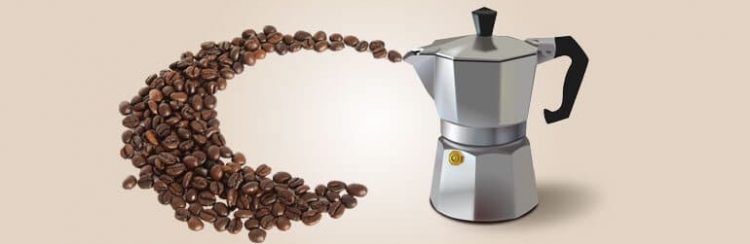
I grew up understanding the difference between ‘everyday coffee’ brewed in the stainless steel percolator and ‘real coffee’. My grandmother made the first for my mother and her friends. It was, to quote my mother, an acquired taste. I know now that it was an acquired taste because, frankly, percolators make terrible coffee. When we were at home alone, my grandmother made real coffee on top of the stove with a moka pot. I never had to acquire a taste for this coffee. It was rich and dark and flavorful, a symphony on the tongue. As a little girl, one of my favorite breakfast treats was Nana’s moka pot coffee poured over my cornflakes with the milk.
A moka pot is a three part metal pot that you use to make coffee on top of your stove. Fully assembled, it is shaped like an hourglass. The bottom part holds the water for your coffee. The middle part is a metal filter that fits between the top and the bottom pieces and holds ground coffee. When the water in the bottom part of the moka pot heats, the steam is forced up through the grounds in the filter into the top pot, where it condenses into a liquid again. You can find moka pots in nearly any department store or supermarket for far less than you’ll pay for them through a specialty coffee shop. If you want the best, though, Bialetti makes several different models in 100% culinary grade stainless steel. Most moka pots that you’ll find in supermarkets are made with aluminum, which can affect the taste of the coffee.
Coffee brewed in a moka pot can be a heavenly experience – or it can be a huge disappointment. There is an art to making coffee in a moka pot that includes the amount of water, the amount and grind of the coffee, the compactness of the coffee grounds in the filter and the heat of the water used to brew it. It is possible, however, to make excellent coffee without any acidity or bitterness in a moka pot if you follow a simple procedure.
First, keep your moka pot scrupulously clean. Coffee flavor is the result of extracting oils naturally found in coffee beans. Those oils cling to any surface that they touch. Disassemble the moka pot after every use and clean the filter and top pot, being sure that you clean the underside of the top pot. Every few weeks, run some vinegar through the moka pot as if you were brewing coffee to get rid of any mineral deposits left behind by hard water.
Before you use your moka pot for the first time:
Follow the directions below using spent coffee grounds or inexpensive coffee that you don’t mind wasting. The first pot of coffee you brew in this should be thrown away. The intent is just to clean the machine out before using it for the first time.
To Make Coffee in a Moka Pot
Unscrew the top part of the moka pot and set it aside. Take out the filter basket.
Fill the bottom part of the moka pot with water to the pressure gauge line.
Drop the filter basket into place and add a heaping tablespoon of finely ground coffee for every three ounces of water in the pot. Do not tamp the coffee. The coffee will expand when the steam is forced through it, effectively producing its own tamp.
Screw the top part of the moka pot into place.
Put the pot over low heat and wait. It will take about five minutes for the coffee to finish. You’ll know that it’s done by the throaty sound of the coffee sputtering.
Pour into an espresso cup and enjoy.
Some posts on our site may contain amazon affiliate links. We may earn affiliate commission from amazon when you purchase through those links.




Leyanne Taylor says
Does anyone else have really bad results when using the Bialetti 12cup? I’m coming to the conclusion it’s just too big to brew in the optimum time :( Whatever method/advice I use I end up with burnt, bitter and watery coffee.
kate wahl says
I finally figured it out. I was using illy coffee and the temp was too low so I think it would start to boil and the coffee would get wet and nothing came out. I turned everything up and it is working great now :) I have decided I like my own grind better then Illy though which
I was so afraid at having it at a high temp that I think I messed it up
Robin Snow says
kate – make sure all the parts are in the right order. It is possible to put it all together with the gasket in the wrong place, and most of the water will leak out without going through the coffee.
Put it on high. The water boils at the same temperature regardless of how hot the burner is, it just boils sooner, which is not a bad thing.
Keith says
I think most people put the gas on so it covers the base but does not lap over the edges. That is maximum on my gas ring. Of course, if you have an electric cooker it will be different, but personally I wouldn’t put it too low (unless of course the instructions say otherwise). Also, espresso coffee grind is considered to be a bit too fine for Moka pots and this can sometimes obstruct outflow.
Another thought: is the seal between the upper and lower compartment clean (no grinds wandered onto the gasket or the screw thread) and hermetic. If not, the water will leak out of the sides instead of spurting into the upper compartment.
My two cents worth…
Hope it helps!
kate wahl says
the first pot I brewed on medium heat then I read that was too high so I switched to low…nothing after 20 minutes, then I switched to medium low and still nothing after 10 minutes
kate wahl says
So I finally got my first moka pot. Brewed one pot for throw away and ever since then nothing will brew. I used the cheap coffee for my first pot and then I put the illy expresso coffee (never packed it but placed it in it) and yet I have not been able to fill anything with coffee so I am obviously doing something wrong please help
Jayson says
I recently added a few steps to my Moka Pot brewing process which seems to have given me a consistently better brew. First (and please don’t shoot me if you’re a purist) after I pour a cup, I sprinkle a pinch of baking soda in the coffee. I remember hearing about this with tea, to get a much smoother, less bitter cup. On a whim I gave it a try with my Moka Pot coffee. A small pinch definitely makes a huge difference. The baking soda neutralizes some of the acidity in the coffee, giving it a smoother taste. Give it a shot. Second, I take whatever coffee is left in the pot and swirl it around in both the lower and upper sections, adding a bit of water if needed. After swirling it around a bit, I rinse both sections out (not wiping them out) and let them dry. I believe the oils from the coffee act as a barrier to the aluminum, and that seems to have also dramatically improved the taste of the coffee. I have read about others doing similar with the upper section, but swishing the coffee around in the bottom section was something new for me. I’m interested in your thoughts.
Keith says
Leonard, the coffee itself is important. I get mine from a local roaster who does a special roast for me. And I use my own quite expensive grinder (± €300) to get quality freshly ground coffee.
Having said that, the coffee in Italy, at least in the south of Italy and in Sicily, has a high proportion of Robusta beans. Here in Northern Europe and the US, we turn our noses up to the Robusta bean, considering it of inferior quality, and generally use 100% Arabica. However my Italian friends tell me that the Robusta content is very important for the taste and for the crema. Personally, I have resigned myself to the fact that I prefer the Arabica bean (also, too much Robusta upsets my stomach :-( ) and therefore strictly my coffee is not true Sicilian or Southern Italian coffee (though it may be closer to the Northern Italian version — I really don’t know as I have little to no experience of Northern Italian coffee). It is basically a variation that is inspired by Sicilian coffee, which incidentally I love. But, and here I am owning up to a very guilty secret, I [U]actually prefer[/U] my variation to the Sicilian coffee.
The other thing is that in Sicily (again, this is where my experience is limited to), you will see no-one using tap water for their coffee. They all use bottled mineral water.
So those are my couple of suggestions for superior coffee: good quality coffee beans, locally roasted if possible, with the right bean and the right level of roast; grind it with a quality grinder (and experiment with the grind level to get it absolutely right — the grind level is actually [U]very[/U] important for the taste); and only use mineral water.
Leonard says
I like the molehill method. I try to get it as.high as I can, because sometimes I miss the totally full bodied taste of a regular pressed espresso. I understand the moka pot is not an espresso machine but any more tips on getting as close to a regular espresso would be greatly appreciated.
Keith says
Robin, the Sicilian method (the way I am acquainted with) is to form a molehill with the coffee grinds. So at the edge or circumference of the basket the coffee level will be quite low but in the centre it will be well above the the rim of the basket. Any compacting of the coffee happens naturally when you screw on the top compartment, and no coffee spills onto your kitchen table.
Jackie and Mike, the method of preheating the water is an interesting one and I have occasionally used it to get a different taste. But don’t ignore the traditional way that Italians make their coffee, which is by heating the water from cold. Although I find the preheated water method an interesting variation, I’ve never yet met an Italian who uses this method. Obviously this is a very personal matter, but generally speaking I prefer to heat the water from cold.
My two cents worth…
Robin Snow says
So my question is, how do you fill the filter basket without making a mess? I get the brick of Lavazza coffee, scoop out the right amount for my Bialetti, and invariably dribble coffee grounds on the counter while I’m trying to get it all nicely smoothed over. If my imaginary Italian girlfriend were watching, I can imagine her rolling her eyes in disdain at my incompetence.
Jackie says
Thank you for the encouragement Keith and Mike. I am making a pot right now and am going to tell you my step by step and hope for corrections from you as I still am “underwhelmed” with my skills.
I am starting with a rinsed and dried pot which I have used 7-8 times in my attempts. I am boiling the water first in another pot. OK, I have just poured the boiling water into the Moka and put the strainer in with 3 very heaping teaspoons of “conical grind” (ground special at a brewer:). The strainer is quite full (maybe room for 1 more heaping teaspoon). I put it on the heat setting “3”.
OK. now I hear it (less than 1 min). I ran over turned the heat to “1.” It sputtered for a few seconds and then I shut it off.
Now I will see. Be right back.
Well, I am making progress. This cup was quite acceptable. There is a lot of “sediment” in the bottom of the cup. Merry Christmas from Vermont!
Mike from Shreveport says
Jackie–
BTW, once you get the directions “dialed in” your stovetop, it’s quick and easy to make a delicious cup. You know it’s done when it starts sputtering. Ideally, that should take about five minutes from when you start your timer. On my stove top, that works at a setting of “3”, but yours may be slightly different. I would start there. Then, if it’s a minute or more off, you can adjust it slightly each time until it times out right. Once you get the stove top setting right, you can speed it up by setting the tap as hot as it will go, and filling the moka pot with that, wait a few seconds, then refill it again for maximum hotness, and then putting it on the stove. I turn my heat all the way down, though, when the coffee fills up the top part about halfway, and then try to turn it off entirely before it’s all the way full and starts sputtering. That is what works for me, anyway!
Cheers
Mike from Shreveport says
Jackie, it’s six *espresso cups* (demitasse cups), which are typically 2 to 3 ounces. So a 6-cup moka pot actually makes 12 ounces or two normal-sized cups of coffee (or one big one). Your mileage may vary according to what you put in it.
Keith says
…as of course you will doubtless already have discovered. Sorry! I missed the bit where you said you have already been introduced to the wonderful world of Italian Moka coffee while in Florence.
Keith says
The Italians make much stronger coffee than us and also drink it in much smaller cups. So your 6-cup is indeed a “6-cup” from an Italian point of view. I wish you every enjoyment in the delights of discovering Moka coffee-making :-) :-)
Jackie says
I feel like I won the lottery (almost) with this “thread”. My Moka pot is called a “6-cup” on the box. But I don’t believe it holds more than 1 cup in the base. What am I missing about that? I was introduced to this lovely coffee brewing method in Florence and have yet to conquer it. With all the wonderful comments here I can continue my studies. Thanks to all.
KateOlive says
Moka pots and electric heat
Does anyone have any advice for the espresso lover condemned to an electric stove?
I have used a Moka pot for decades with gas burners, and it worked perfectly. Now I live in place with electric stoves, and I find making good espresso to be very hit and miss. If I take the pot off the heat when it starts to gurgle, the coffee stream most often peters out with the bottom chamber still half full. If I let the pot burble on the heat, the coffee (surprise) becomes bitter. I have tried taking the pot on and off the burner–not good. I have taken to holding the pot just off the heat when the coffee starts rising. Sometimes this produces a decent result.
I use the small burner with the pot off to the side of the center medallion. Maybe using the large burner, which has more space on the side, would be a better idea. Thoughts?
Frances says
Thanks John. I managed this time with persistent persistence and some creativity, and finally got it apart, but now I’ll know what to do next time!
john says
If the top screws onto the base (like the lid of fizzy pop) then you need to hold the thing upside down in a pan of boiling water.The top should then expand enough to allow the seal to break. If the neck of the base fits over the thread of the top hold the base down in some boiling water.
Frances says
I’ve been enjoying my Moka pot for years, however, the last time I went to take it apart to rinse (that would be without soapy water or vinegar), I CANNOT get the top apart from the bottom! Any suggestions? This hasn’t happened before, although sometimes it has been hard to unscrew but it’s always come apart.
john says
Tea or coffee, the stories are remarkably similar. Never wash the pots, always rinse. Always use freshly drawn water. Both can only be made properly if allowed to ‘brew’. Tea leaves must be scalded, coffee must be made using water at a lower temp. Not doing these things turns people off great experiences – having to wait 4-5 mins for the drink to brew also puts people off. The best things are worth the wait, I still grind my own beans by hand.