
Affiliate disclosure: As an Amazon Associate, TalkAboutCoffee earns from qualifying purchases. Our picks are based on editorial judgment, not commission rates.
I watched roughly thirty households buy their first coffee maker over twenty years of paying attention to coffee, and about half of them came home with a Mr. Coffee. That is the whole story of the brand in one sentence. Mr. Coffee is how most American kitchens get into reliable home brewing without thinking very hard about it, and for a lot of people that is exactly the right outcome.
What follows is what is actually worth buying from the current lineup, what to walk past, and where something else beats them for the same money. I have kept model names deliberately loose in places, because Mr. Coffee retires and renames machines constantly, and half the “best Mr. Coffee” lists online still recommend models you can no longer buy.
What Mr. Coffee is actually for
Mr. Coffee competes on price and availability, not on brewing performance. The machines heat water a little below the ideal extraction range, which is roughly 195 to 205 degrees Fahrenheit (90 to 96 Celsius), and the shower heads distribute water less evenly than a Technivorm or a Bonavita. In a blind tasting against a certified brewer, you will notice.
What you get instead is a machine that costs a fraction as much, is sold in every supermarket in the country, and generally keeps working for years. If you drink coffee with milk, or you are brewing for a household where nobody is fussy, that trade is entirely reasonable. If you have started buying single-origin beans and grinding fresh, you have outgrown the brand and should read our guide to buying good beans alongside a better brewer.
The drip machines, which are the real business
Drip is what Mr. Coffee does, and the range splits into three tiers worth knowing.
The 5-cup Mini Brew Switch is the quiet star of the lineup and the one I would point most people toward first. It has no clock, no programming and no brew-strength selector. It has a switch. It also carries somewhere north of 32,000 customer reviews at a 4.4 star average, which is the strongest social proof of any machine the brand sells by a wide margin. For a dorm room, a rental, an office corner or a second kitchen, it is difficult to argue with. Check current pricing.
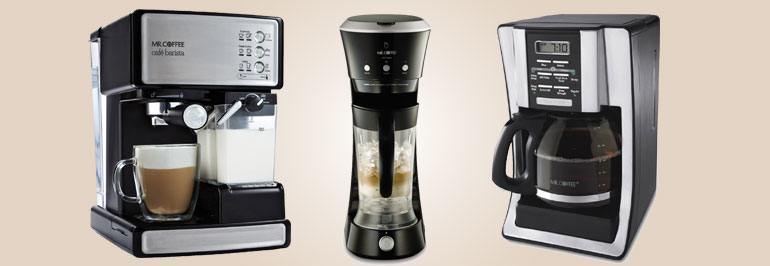
The 12-cup programmables are the volume sellers and where most households land. The current range includes a Digital Easy Measure version, a Rapid Brew system, and several variants with strong-brew mode and auto-pause. Ratings cluster around 4.1 to 4.3, which is fair rather than remarkable. Auto-pause, sometimes called pause-and-serve, is the feature worth having: it stops the drip when you pull the carafe so you can steal a cup mid-brew. Programmability matters only if you genuinely set it the night before, and most people who buy it never use it once.
The thermal carafe machines, sold under the Optimal Brew name, are the best coffee Mr. Coffee makes. A thermal carafe keeps coffee drinkable for hours instead of stewing it on a hot plate, which is the single biggest quality difference in the whole drip category. If you brew a full pot and drink it across a morning, this tier is worth the step up more than any other upgrade the brand offers.
Skip the espresso machines
This is the clearest recommendation on the page. Mr. Coffee’s espresso machines rate substantially worse than their drip machines, with several sitting in the low threes out of five, and the complaints are consistent: underpowered steam wands, inconsistent pressure, and pucks that come out soaked.
Espresso is unforgiving in a way drip is not. A drip machine brewing at slightly the wrong temperature makes slightly weaker coffee. An espresso machine that cannot hold pressure makes something you would not serve. If you want espresso at a budget price, the honest answer is that the entry point is higher than Mr. Coffee sells at, and our budget espresso machine guide covers where that floor actually sits.
The grinders, and why to skip those too
Mr. Coffee sells a basic electric blade grinder. A blade grinder does not grind, it chops, and it produces a mixture of dust and boulders in the same batch. The dust over-extracts and turns bitter while the boulders under-extract and taste sour, and you get both in the same cup.
Grinding fresh genuinely does more for your coffee than upgrading your brewer, but only with a burr grinder, which crushes beans to a consistent size between two burrs. A cheap hand grinder will outperform any blade grinder sold. If you are going to spend money anywhere in this article, spend it on a burr grinder rather than on a better Mr. Coffee.
The specialty products
Mr. Coffee sells a frappe maker, an iced tea maker and, historically, the Cocomotion hot chocolate machine. These are all single-purpose appliances that solve problems a saucepan or a blender already solves. The Cocomotion in particular has a devoted following and is long discontinued, which is a story we tell in our guide to hot chocolate makers.
Unless you make blended drinks or iced tea by the gallon on a regular basis, none of these earns its counter space.
Keeping one alive
Almost every Mr. Coffee that dies early dies of limescale. Hard water leaves mineral deposits inside the heating element and the tubing, and as they build up the machine brews cooler and slower until one morning it does not brew at all. On a machine at this price, descaling is the difference between three years and ten.
Fill the reservoir with equal parts white vinegar and water, run a full cycle without a filter, then run two full cycles of clean water to flush the taste out. Every month or two on hard water, every three or four on soft. If your brew time has been creeping up, or the coffee has started arriving lukewarm, that is scale rather than a failing machine, and it is reversible.
The other common complaint is bitterness that appears gradually. That is almost always coffee oils going rancid in the basket and carafe rather than anything mechanical. Wash both properly with detergent rather than rinsing them, and the problem usually disappears.
What beats them at the same money
Mr. Coffee’s weakness is that its price advantage narrows as you go up the range. At the bottom of the market they are genuinely hard to beat. At the top of their own range, other brands are competing properly.
Around the mid tier, Cuisinart and Black+Decker offer comparable machines with better build quality and, in Cuisinart’s case, more consistent brew temperature. Above that, a Bonavita or a Technivorm is a different class of machine entirely and brews within the certified temperature window, which no Mr. Coffee does. The gap in the cup is real and audible in how people talk about their coffee afterwards.
The honest verdict
Buy the 5-cup Switch if you want cheap, simple and reliable. Buy a thermal-carafe Optimal Brew if you brew a full pot and want it to still taste like coffee an hour later. Buy a 12-cup programmable if you need volume and want the auto-pause. Skip the espresso machines, skip the blade grinder, and skip the specialty appliances.
And if you have found yourself reading about brew temperature and grind consistency, you have probably already outgrown the brand. That is not a criticism of Mr. Coffee. Getting several million households drinking home-brewed coffee reliably for decades is a real achievement. It is just not the same job as making the best cup on your street.
Frequently asked questions
Are Mr. Coffee makers any good?
For the money, yes. They brew slightly below the ideal temperature range and the coffee is correspondingly less bright, but they are reliable and inexpensive. They are not competitive with certified brewers, and they are not trying to be.
Which Mr. Coffee model should I buy?
The 5-cup Mini Brew Switch for simplicity and value, or a thermal-carafe Optimal Brew if you want the best coffee the brand makes. Be careful with older “best of” lists: several frequently recommended model numbers are no longer sold.
Why does my Mr. Coffee taste bitter?
Usually scale or stale grounds rather than the machine. Descale it with equal parts white vinegar and water, run two clean water cycles afterward, and check that your coffee was ground within the last two weeks.
How long should a Mr. Coffee last?
Several years of daily use is normal, and much longer if you descale regularly. The most common failure is the heating element scaling up, which is preventable maintenance rather than bad luck.
Is Mr. Coffee better than Keurig?
Different products. Mr. Coffee brews a pot more cheaply and without pods; Keurig makes one cup fast with far more waste and higher running costs. If you drink more than two cups a day, a drip machine is cheaper within months.
Discussion 1
I am looking for a ecm150 manual, somhow I received this link. I wanted it in a pdf form. It appears to be a dead link.