
Affiliate disclosure: As an Amazon Associate, TalkAboutCoffee earns from qualifying purchases. Our picks are based on editorial judgment, not commission rates.
I tested a KitchenAid thermal carafe coffee maker for a friend who wanted to know whether it justified its price. The honest answer was that it made perfectly good coffee and cost noticeably more than machines that made equally good coffee, and the difference was that it matched her stand mixer. That was the KitchenAid story for years: premium pricing for premium design, with coffee engineering that was fine rather than remarkable.
What has changed is the lineup itself. Search for a KitchenAid coffee maker today and the drip machines that used to anchor the range are hard to find, while espresso machines and grinders sit at the top of the results. The brand has quietly repositioned, and any guide still leading with their 12-cup drip machines is describing a range that has moved on.
Where KitchenAid actually is now
The current coffee lineup centres on three things: semi-automatic espresso machines, a burr grinder, and a manual press. The 12-cup programmable drip machines that most people picture when they think KitchenAid coffee are no longer the front of the range.
That is a meaningful shift in strategy. Drip is a brutally competitive category where Cuisinart, Black+Decker and Mr. Coffee compete on price and Bonavita and Technivorm compete on brewing precision, leaving very little room in the middle for a brand selling design. Espresso is a category where design and build actually command a premium, and KitchenAid has moved to where its strengths pay.
The espresso machines
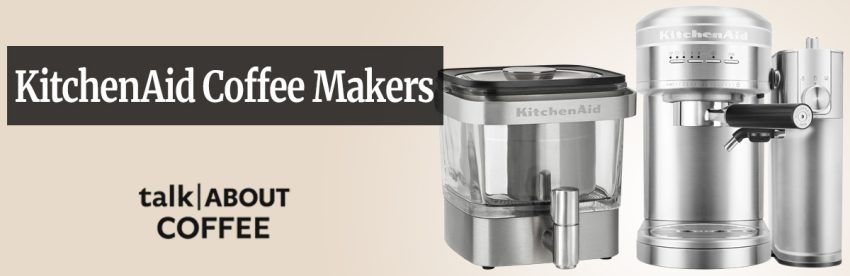
This is the real KitchenAid coffee range now. The semi-automatic machines, sold under KES model numbers, come in a plain version, a version bundled with an automatic milk frother attachment, and a heavier all-metal version in the full stand-mixer colour range. Customer ratings sit at around four out of five, which is respectable without being class-leading.
Semi-automatic means you control the shot: you grind, you dose, you tamp, you pull. That is the right category for someone who wants to learn espresso rather than press a button, and it is a genuinely different proposition from the super-automatics that Philips and DeLonghi dominate. It also means the machine is only as good as your grinder, which is the part most first-time buyers underestimate, and our grinder buying guide is worth reading before you spend on the machine itself.
Where these sit against the competition is roughly where KitchenAid has always sat. Breville remains the reference point in this category, with more precise temperature control and better built-in grinders on the models that include one. The KitchenAid machines are well made and look superb on a counter, and you pay for both. If your kitchen already has the Empire Red stand mixer and you want the espresso machine to match, that is a real preference and not a foolish one. Current KitchenAid espresso machines.
The burr grinder, which is their best coffee product
The KitchenAid burr grinder is the strongest thing in the range on the numbers, rating better than any of their espresso machines. It is a conical burr grinder with a wide range of settings, and it produces genuinely consistent grounds for drip and pour-over.
Its limitation is at the espresso end. Espresso needs fine, precise adjustment in small increments, and grinders that do drip well often lack the resolution at the fine end to dial in a shot properly. If you are buying a KitchenAid espresso machine, think carefully about whether this grinder is the right partner for it or whether a dedicated espresso grinder makes more sense.
For drip and pour-over, though, it is a good machine, and grinding fresh matters more than almost any other upgrade. Against the obvious rival, a Baratza is the better grinder on grind quality and burr longevity, and the KitchenAid is the better looking one. That is a fair summary of the whole brand.
The Precision Press
KitchenAid also sells a French press with a built-in scale, which sounds clever and rates poorly, sitting around three and a half stars. That is unusually low for the brand.
The idea is sound: weighing coffee and water is the single easiest way to make your brewing repeatable, and building the scale into the press removes a step. The execution is where the complaints land. A French press is a fundamentally simple object, and adding electronics to it introduces failure modes that a glass beaker and a plunger do not have. A separate digital scale and any decent press will do the same job, cost less together, and let you replace either half when it breaks.
What a semi-automatic actually asks of you
Worth setting expectations, because this is where people buy an espresso machine and give up on it within a month.
A semi-automatic controls water and pressure. Everything else is yours. You grind the beans, you measure the dose, you level it, you tamp it flat, and you watch the shot. Get the grind slightly too coarse and the water rushes through in fifteen seconds and tastes thin and sour. Slightly too fine and it crawls through in forty and tastes bitter. The target is roughly 25 to 30 seconds for a double, and you reach it by adjusting the grinder, not the machine.
That process is called dialling in, and it takes a few days with a new bag of beans, then needs small adjustments as those beans age. If that sounds like a pleasant ritual, a semi-automatic is the right machine and you will get better coffee than any super-automatic will give you. If it sounds like a chore before breakfast, buy a bean-to-cup machine and be happier.
The practical consequence is budget. A semi-automatic without a decent grinder cannot make good espresso, because a blade grinder or a coarse drip grinder simply cannot hit the window. Plan for the grinder as part of the machine’s cost rather than something to add later, or you will spend the first month blaming the wrong appliance.
On paying for design
It is worth saying plainly that buying for looks is legitimate. A kitchen is somewhere you spend time, and equipment you enjoy looking at is equipment you use. Plenty of people have bought a machine on aesthetics and made more coffee at home as a result, which is a better outcome than a technically superior brewer that lives in a cupboard.
The thing to be clear-eyed about is what the premium buys. With KitchenAid you are paying for industrial design, a colour range that matches other appliances, and build quality that is genuinely good. You are not paying for better extraction than a Bonavita or better espresso than a Breville. If that trade is worth it to you, make it deliberately rather than assuming the price reflects brewing performance.
The honest verdict
If you want espresso and you want it to match your kitchen, the KitchenAid semi-automatics are a reasonable buy, with Breville the better machine and the plainer one. If you want a grinder for drip and pour-over, theirs is good, with Baratza the better performer. Skip the Precision Press and buy a scale separately.
And if you came here looking for their 12-cup drip machine, that part of the range has largely gone. For drip specifically, our grind-and-brew guide and the Bonavita and OXO machines are where that money now goes further.
Frequently asked questions
Does KitchenAid still make coffee makers?
The range has shifted. Espresso machines, a burr grinder and a manual press are the current focus, while the 12-cup programmable drip machines that used to lead the range are hard to find now.
Are KitchenAid coffee products worth the price?
For design and build, yes. For brewing performance per dollar, most categories have a better option: Breville for espresso, Baratza for grinding, Bonavita or OXO for drip.
Is the KitchenAid espresso machine good for beginners?
It is semi-automatic, so you control the grind, dose and tamp. That is the right machine if you want to learn espresso and the wrong one if you want a button that produces a latte. Budget for a grinder alongside it.
Is the KitchenAid burr grinder good enough for espresso?
It is better suited to drip and pour-over. Espresso needs fine adjustment in very small steps, and grinders built primarily for drip often run out of resolution at that end.
Why is KitchenAid coffee equipment more expensive?
Industrial design, the matching colour range across their appliances, and solid build quality. The premium is real and it is mostly not about extraction.
Discussion