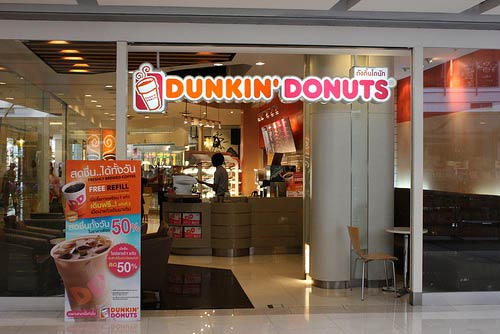
I grew up five miles from Bill Rosenberg’s original Dunkin’ Donuts shop in Quincy, Massachusetts, back when the coffee was very much an afterthought to the donuts. Rosenberg made two promises when he opened that first shop: donuts made fresh every four hours, and coffee that never sat more than twenty minutes. One flavor of coffee, black or light, one lump or two. Fifty-six varieties of donuts, exactly twice as many flavors as Howard Johnson’s had ice cream. That was the whole pitch, and it worked for decades.
Fred the Baker and the donut era
Even in those early years, Dunkin’ had a gift for advertising that stuck in your head longer than it had any right to. Fred the Baker, introduced in the 1980s, became the face of the company for over two decades. His “Time to make the donuts” line earned a permanent spot next to “I can’t believe I ate the whole thing” and “Where’s the beef?” in the small club of ad taglines that escaped their commercials and became part of how people actually talked.
When the coffee took over: the America Runs on Dunkin’ era
When Dunkin’ went looking for Fred’s successor, they found an unlikely fit: They Might Be Giants, the quirky alt-rock duo, wrote an original run of jingles for a new campaign that shifted the company’s whole public identity from donuts to coffee. The “America Runs on Dunkin'” ads ran for years, built around the same trick that made Fred the Baker work: recognizable, slightly off-center characters in everyday situations pushed just far enough to be funny. The harried carpool mom running kids to ballet, soccer, and karate on a loop. The office worker sneaking out at lunch for a secret job interview. The bewildered customer squinting at a menu board full of “Fritalian” coffee names at an unnamed rival. The campaign became genuinely popular enough to spawn imitators in the energy drink category, which is a strange kind of compliment for an ad campaign to receive.
The bigger change: dropping “Donuts” entirely
Here’s the update the original version of this piece never saw coming: in January 2019, the company dropped “Donuts” from its name entirely, rebranding globally as simply Dunkin’. It wasn’t a cosmetic tweak. It reflected exactly the shift this article was already tracking back when the TMBG campaign first launched, coffee and beverages had become the actual core of the business, with donuts as one menu category among many rather than the reason people walked in. The company that started as a donut shop with an afterthought of coffee spent about fifteen years quietly reversing that ratio, then finally made it official in the name.
Why a coffee site is still talking about donut-shop advertising
Coffee marketing rarely gets remembered the way Dunkin’s has. Most coffee ads are forgettable, functional, gone from memory within a week. What Dunkin’ managed, twice, first with Fred the Baker and then with the TMBG jingles, was turning coffee-and-donut advertising into something people actually wanted to watch and quote back to each other. That’s a genuinely rare trick, and it’s worth remembering even now that the ads themselves have moved on to newer campaigns and the company has moved on to just “Dunkin’.”
Frequently asked questions
Did Dunkin’ Donuts actually change its name?
Yes. In January 2019, the company officially rebranded from Dunkin’ Donuts to simply Dunkin’, reflecting the shift toward coffee and beverages as the core of the business.
Who was Fred the Baker?
The company’s advertising mascot through the 1980s and into the 2000s, famous for the “Time to make the donuts” catchphrase, which became one of the most recognized ad taglines of its era.
Did They Might Be Giants really write Dunkin’s ad jingles?
Yes. The alt-rock band wrote original songs for the “America Runs on Dunkin'” campaign across multiple rounds of ads, an unusual and memorable pairing of a mainstream fast-food brand with a genuinely offbeat indie band.
Why this article changed
The original version of this piece was written mid-campaign, treating the TMBG “America Runs on Dunkin'” ads as current news. This rewrite keeps the genuine nostalgia and history intact (it’s exactly the kind of pop-culture coffee history worth preserving) and adds the ending the original never got to see: the company dropping “Donuts” from its name in 2019, which is the real payoff to the coffee-taking-over-from-donuts story this piece was already telling.
Discussion