
Affiliate disclosure: As an Amazon Associate, TalkAboutCoffee earns from qualifying purchases. Our picks are based on editorial judgment, not commission rates.
The Continental Electric coffee maker, model CE23589, is a four-cup drip machine that cost about the price of two coffee-shop lattes. That is the entire pitch, and for a dorm room, a student housing setup with no kitchen, an office cubicle, or a spare room, it was a genuinely sensible purchase. It is also discontinued now, and if you own one there is one thing about it you need to know before you read anything else: it has no automatic shut-off. The hot plate stays on until you turn it off. More on that below, because it matters more than any other feature on this machine.
Availability: The Continental Electric CE23589 is no longer in production and there is no official parts support. Used units turn up cheap online. For current small drip machines, see our coffee makers buying guide or, if this is for a small room, the best dorm room coffee makers roundup.
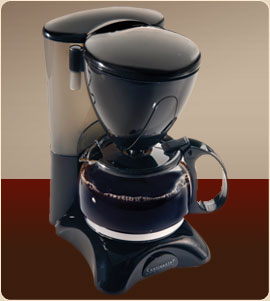
What it is
- 4-cup drip brewer with glass carafe
- Pause and serve, so you can pull the carafe mid-brew
- Permanent metal mesh filter, no paper needed
- Swing-out filter basket
- Translucent water tank that doubles as the level window
- No automatic shut-off, no programming, no clock
That is a complete list, and the simplicity was the point. Lift the lid, pour water, put grounds in the mesh basket, flip it on. There is nothing to learn and nothing to configure, which is exactly what you want from a machine that lives next to a bathroom sink in student housing.
The no-auto-shut-off problem
Take this one seriously. The CE23589 has no automatic shut-off, which means the warming plate stays powered until you physically switch it off. Leave for class or work with it running and it stays on all day, slowly cooking whatever is left in the carafe, or dry-firing an empty one. This is the single biggest practical issue with the machine, and it is the reason I would not leave one plugged into a dorm room I was walking out of.
If you use one, build the habit: switch it off at the wall, not just the button, and do it as part of picking up your mug. If you are the kind of person who has ever driven to work wondering whether you turned something off, put it on an outlet timer and let the timer be the thing that remembers. That is a five-dollar fix for the machine’s one real flaw. It is also worth knowing that plenty of student housing bans appliances with exposed heating elements and no auto shut-off, so check your rules before you set one up.
The honest verdict
What it did well: it was almost free, it took up less counter space than a hair dryer, it used regular ground coffee with a permanent filter so there was nothing to keep buying, and the parts snapped together tighter than the plastic construction had any right to. For a single coffee drinker who just wants a hot cup in the morning without a trip to a coffee shop, it paid for itself in about two days.
What it did not do well: the brew temperature ran cool. Noticeably cooler than a real machine, and well under the 195 to 205 F range where coffee actually extracts properly. That means the coffee comes out a bit thin and a bit sour compared to a good brewer, and if you drink it with cold liquid creamer it lands lukewarm. The carafe also pours messily unless you flip the lid up with your thumb as you go. And the swing-out basket can catch on the carafe when you pull it mid-brew and swivel out, which dumps wet grounds everywhere. Pull the carafe straight down and out, not at an angle, and it will not happen to you the way it happened to the person who wrote the original version of this review.
So: a perfectly functional little unit at an unbelievable price, as long as you know it is a hot-water-through-coffee machine and not a good brewer. Those are different products at different prices, and the CE23589 never pretended otherwise.
Getting a better cup out of one
You cannot fix the temperature, but you can work around it.
- Pre-warm the carafe. Rinse it with the hottest water from the tap right before you brew. On a machine that already runs cool, starting with a cold glass carafe is throwing away heat you cannot spare.
- Grind a little finer and dose a little heavier. Cooler water extracts less, so give it more surface area and more coffee to work with. This is the single biggest improvement available on machines like this.
- Descale it. Run 1:1 white vinegar and water through with no coffee, then two or three plain-water cycles to rinse. Every couple of months, more if your water is hard. On a cheap machine with a narrow heating tube, scale is what drops the temperature further and eventually kills it.
- Skip liquid creamer, or warm it. A splash of fridge-cold creamer in an already-cool cup is what pushes it from “fine” to “why is this lukewarm.”
- Add a paper filter if you want a cleaner cup. The mesh basket lets oils and fines through. A trimmed cone paper filter sitting in the basket gives you a cleaner, brighter cup for a couple of cents.
Common problems
- Brewing slowly or sputtering. Scale, essentially always. Descale as above before you conclude anything is wrong with it.
- Grounds in the coffee. The mesh filter is not fine enough to catch everything, especially with a fine grind. Either accept a little sediment, which is normal here, or drop a paper filter into the basket.
- Mess when pulling the carafe mid-brew. The swing-out basket catching the carafe. Remove the carafe straight down and out.
- It stopped heating. On a machine at this price, that is the end of the line. Nothing inside is serviceable and no parts are sold. Do not spend money on it.
What to buy instead
If yours has died and you want the same thing, a tiny cheap drip machine for one person, the good news is that this category has an easy answer now: buy something with an automatic shut-off. A 4-cup coffee maker with auto shut-off runs about $20 to $35 from Mr. Coffee, Black+Decker, or Hamilton Beach, which is roughly what the CE23589 cost, except it turns itself off and most dorms will actually allow it.
If you would rather put the money in the cup than the machine, an AeroPress or a small pour-over cone plus a kettle costs about $35, has no heating element to leave on, no scale to descale, and makes genuinely better coffee than any cheap drip machine. In a room with no kitchen, that is often the smarter setup. Our best dorm room coffee makers guide walks through the whole category, and the coffee makers buying guide covers drip machines generally.
The CE23581, the near-identical sibling
Continental Electric sold more than one four-cup machine, and the CE23581 turns up almost as often as the CE23589. They are close enough that most of this guide applies to both, but a few things differ and are worth knowing if that is the one on your counter.
The CE23581 has a pause-and-serve valve, which the CE23589 does not. Pull the carafe mid-brew and the drip stops instantly, so you can steal a cup without the puddle on the hot plate. It also uses a swing-out filter basket rather than a lift-out one, which is harder to misplace, and a no-drip carafe spout that pours more cleanly than the CE23589’s.
Like the CE23589 it takes a permanent mesh filter, so no paper filters are needed at all, and it has the same translucent water window for checking the level. The carafe is small enough to fill under a bathroom tap, which is exactly why these ended up in so many offices and dorm rooms.
What it shares with its sibling is the important caveat: no automatic shut-off. The warming plate stays on until you switch it off. Everything in the sections above about the auto shut-off problem, descaling, and getting a hotter cup applies to the CE23581 exactly as it does to the CE23589.
Frequently asked questions
Does the Continental Electric CE23589 have automatic shut-off?
No, and this is the most important thing to know about it. The warming plate stays on until you switch it off manually, so it will run all day if you forget. Turn it off at the wall as a habit, or put it on an outlet timer. Many dorms and student housing rules prohibit appliances like this for exactly that reason.
Is the CE23589 still made?
No. It is discontinued with no official parts support. Working used units are cheap and easy to find, but a current 4-cup machine costs about the same and adds an auto shut-off, which is worth more than anything the CE23589 offers.
Why is my coffee not hot enough?
The machine brews cooler than a proper brewer, and that is inherent to it rather than a fault. Pre-warm the carafe with hot tap water, descale it, grind a bit finer, and use powdered creamer or warm your creamer rather than pouring it in cold. That gets you most of what it has to give.
Do I need paper filters?
No. It comes with a permanent metal mesh filter and takes regular ground coffee, which is a big part of why it was so cheap to run. You can drop a trimmed cone paper filter in the basket if you want a cleaner cup with less sediment, but nothing requires it.
Discussion