
Affiliate disclosure: As an Amazon Associate, TalkAboutCoffee earns from qualifying purchases. Our picks are based on editorial judgment, not commission rates.
The first time I was invited to a coffee ceremony, in a flat belonging to an Ethiopian family I barely knew, I made the mistake of assuming it would take twenty minutes. It took most of an afternoon. Green beans were roasted in a pan in front of me, ground by hand, brewed, and poured three separate times, and at no point was anyone in a hurry. I understood by the end that the coffee was not really the point, or rather that it was the point in the way that a table is the point of dinner.
Most of what English speakers call coffee culture is about buying coffee. Somewhere else, coffee culture means something closer to an invitation.
The Habesha ceremony, in Ethiopia and Eritrea
The ceremony is practised across both Ethiopia and Eritrea, and it is a daily thing rather than a special occasion. Neighbours come, relatives come, and whoever happens to be visiting comes. Declining is possible but awkward, and if you do decline coffee you will almost certainly be given tea instead.
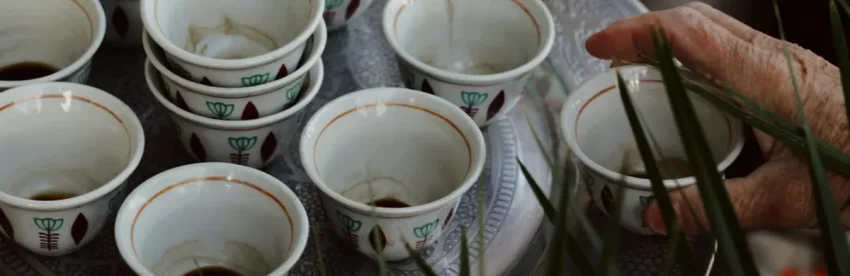
It begins with the floor. Loose grass is spread out where the ceremony will happen, often scattered with small yellow flowers, and around Meskel, the Orthodox holiday, the flowers become part of the occasion. It is performed by the woman of the household, and being the one to conduct it is treated as an honour rather than a chore.
Green beans are roasted over an open flame in a flat pan, and the pan is carried around so that everyone present gets the smoke and the smell. That gesture is deliberate: the aroma is shared with guests as hospitality, not merely produced as a side effect. The roasted beans are then ground with a mukecha, a wooden mortar and pestle, and sieved several times.
The grounds go into a jebena, a round-bottomed clay pot with a neck, a spout, a handle and a straw lid, which sits on the flame until it brews. It is poured from a height into small handleless cups, in a thin stream, which takes practice and looks effortless when someone who has done it for thirty years is doing it. Small snacks appear alongside, sometimes ambasha, a soft bread.
Three rounds are poured, and the visit is not really finished until the third. That structure is the part people miss when they describe it as a long way to make coffee. The length is the function. You cannot conduct a two-hour ceremony and not talk to the people in the room.
Turkish coffee, and what UNESCO made of it
Turkish coffee is a method rather than a bean. The coffee is ground almost to powder, finer than espresso, and brewed unfiltered in a small long-handled pot called a cezve in Turkey and an ibrik in a lot of other places. It is brought just to the boil, never past it, and served with the grounds still in the cup, which settle into a sludge you are not meant to drink.
The grind is so fine that roast level matters more than usual. Medium or medium-dark works; light roasts taste sour and dark roasts turn harsh, because the extraction is so aggressive there is nowhere for a mistake to hide.
The same style appears across the Middle East, the Balkans and the Caucasus under different national names, and each version comes with its own claim of authorship. In 2013 UNESCO inscribed Turkish coffee culture and tradition on the Representative List of the Intangible Cultural Heritage of Humanity, which is a formal acknowledgement that the ritual, not the drink, is the thing worth protecting.
Then there is the reading of the cup. When the coffee is finished, the saucer goes over the cup, the whole thing is inverted, and the patterns the grounds leave as they run down are interpreted. It is called tasseography, it is done half-seriously, and it is one of the few fortune-telling traditions that survives mostly because it is fun.
The modern footnote is worth knowing. There were over 400 Starbucks in Istanbul by 2018, younger Turks have taken enthusiastically to third-wave coffee, and the single most popular coffee brand in Turkey is Nescafé instant. Traditions and habits are different things.
Northern Europe drinks the most of it
The Nordic countries are consistently reported as the heaviest coffee drinkers per head in the world, with Finland usually named first, and the consumption is domestic rather than commercial. It happens at kitchen tables.
The social form is the coffee party: people invited to a house, several kinds of homemade cake and pastry laid out, and coffee poured continuously for hours. Sweden has a word for the habit, fika, which is closer to a scheduled pause in the day than to a drink, and which many workplaces observe formally.
It is a genuinely different model from the café. Nobody is buying anything. The coffee is the excuse for the gathering, exactly as it is in Addis, which is a resemblance you would not expect between a Helsinki kitchen and an Ethiopian living room.
Italy, where the bar is not a café
Italy sits oddly between the two models. It has bars on every corner, but the Italian espresso bar is not a place you settle into. You come in, you stand at the counter, you drink a small strong coffee in about ninety seconds, and you leave. The whole transaction is shorter than the queue in most chains.
Sitting down usually costs more, and visitors regularly take this for a scam aimed at tourists. It is not. Table service is a different service with a different price, published on the wall, and locals pay it too on the days they want to sit. What you are paying for is the chair and the time, not the coffee.
The other rule worth knowing is the milk one. Cappuccino is a morning drink, and ordering one after lunch marks you out immediately, which Italians will forgive and quietly notice.
The café is a Western invention
The café as an industry, a place you go to buy a drink and occupy a chair, is largely a North American and European development, and the modern chain version is more recent still than people assume.
Across much of the Middle East, Africa, South America and Asia, coffee has traditionally been something you drink while doing something else: working, trading, arguing, waiting. It punctuates the day rather than filling it. That distinction is fading as chains expand globally, and Istanbul’s Starbucks count is one measure of how fast.
Britain is the odd case, having been a tea country that turned into a coffee one within a couple of generations, while India, which the British taught to grow and drink tea, has largely stayed with it. Colonial habits outlast the colonists, though not always in the country that exported them.
If you want to try one at home
Turkish coffee is the accessible one. You need a cezve and coffee ground far finer than your grinder probably manages, so buy it ground unless you own a hand grinder that goes properly fine. One heaped teaspoon per small cup, cold water, sugar in at the start if you want it, and take it off the heat the moment it rises. Never let it boil.
The Ethiopian ceremony is harder to replicate honestly, because the equipment is the smallest part of it. You can buy a jebena. You cannot buy an afternoon in which nobody checks their phone, which is the actual ingredient.
For more on how this plays out across the continent, our piece on coffee culture in Asia covers the region where the shift has been fastest.
Frequently asked questions
What is the Ethiopian coffee ceremony?
A daily social ritual practised in Ethiopia and Eritrea in which green beans are roasted, ground with a mukecha, brewed in a clay jebena and poured in three rounds for family and neighbours. Being invited is a mark of regard.
Why is it poured three times?
The three rounds structure the visit. The gathering is not considered complete until the third pouring, which is why the ceremony takes as long as it does.
Is Turkish coffee protected by UNESCO?
Yes. Turkish coffee culture and tradition was inscribed on the Representative List of the Intangible Cultural Heritage of Humanity in 2013.
Which country drinks the most coffee?
The Nordic countries lead per head of population, with Finland usually reported first. The United States is the largest market by total volume, which is a different measure entirely.
What is fika?
A Swedish coffee break treated as a social institution rather than a drink, usually with something sweet, and observed formally in many workplaces.
Discussion 1
The Ethiopian ceremony is perhaps the first true expression of “coffee as a beverage” in any culture. This ritual is a treasure for all mankind.