
I spent an afternoon in 2019 at a small wet mill in the Aquiares region of Costa Rica watching a worker named Maria sort coffee cherries by color. She’d been doing this for nineteen years. She could tell, by the shade of red, which cherries were ripe enough to process and which needed another two days on the tree. The pile of accepted cherries fed into a depulper that stripped the skin and fruit; the rejected cherries went into a separate bin to be re-evaluated. Her speed was extraordinary. Her concentration was extraordinary. The quality of the coffee depended on her hands.
What happens between the picked coffee cherry and the green bean that ships to a roaster is called processing. The processing method shapes the cup’s flavor as much as the bean’s origin or the roast level. If you’ve ever wondered why one Ethiopian coffee tastes like blueberries and another tastes like tea, the difference is usually processing. Here’s how it works and what each method actually tastes like.
Why coffee has to be processed at all
A coffee cherry is a small red fruit. The bean we roast and brew is the pit at the center, surrounded by:
- The skin (exocarp) – the bright red outer layer.
- The pulp (mesocarp) – the soft, sweet fruit underneath the skin.
- The mucilage – a sticky, sugary inner layer adjacent to the bean.
- The parchment (endocarp) – a papery shell surrounding the bean itself.
- The silverskin – a thin membrane between the parchment and the bean.
All of these layers need to come off, and the bean has to be dried from about 60% moisture content down to roughly 11%, before the coffee can be shipped and roasted. The method used to remove each layer, and the order in which it’s done, defines the processing style. Each method leaves different residual sugars, acids, and aromatic compounds in the green bean, which then become flavor in the cup.
Washed (wet) process
The washed process is the cleanest-tasting method and dominates Central American, Colombian, Kenyan, and most Ethiopian washed coffees. The cherries are depulped to remove the skin and fruit, then fermented in tanks of water for 12-48 hours to break down the mucilage. After fermentation, the beans are rinsed, then dried on raised beds or patios.
The result: bright, clean, pronounced acidity with origin-character coming through clearly. A washed Yirgacheffe tastes like jasmine and bergamot. A washed Kenyan AA tastes like blackcurrant and tomato. A washed Colombian tastes like caramel and clean citrus. The bean’s intrinsic flavors are not muddled by fermenting fruit residue.
The cost: enormous water consumption. Washing one pound of coffee can use 4-5 gallons (15-20 liters) of water. In regions with water scarcity, this is a serious environmental problem. Modern wet mills increasingly recapture and recycle their water to mitigate this.
Natural (dry) process
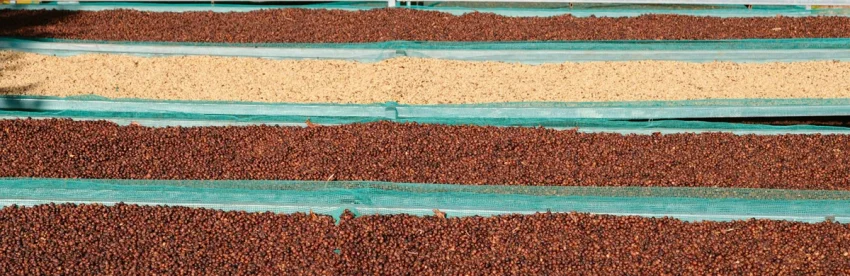
The oldest and simplest method. Whole coffee cherries are spread on patios or raised beds in the sun and dried for 2-4 weeks with the skin and fruit still attached. Workers rake them several times a day to ensure even drying and prevent mold. Once the cherries are dry and shriveled to dark purple-black, the beans are mechanically hulled out of the dried fruit.
The result: fruit-forward, intensely aromatic, often wild-tasting coffee. Natural process Ethiopian Yirgacheffes taste like blueberry compote. Natural Brazilians taste like chocolate-covered cherries. The fruit notes are dramatic. The clean acidity of washed coffee is replaced by a heavier, riper, sometimes fermenting-fruit quality.
The trade-offs: drying takes longer, requires consistent dry weather, and risks mold or off-flavors if not done carefully. Natural process is traditional in Ethiopia (where water is scarce), Brazil (where it’s the default), and increasingly in specialty operations worldwide.
Honey (pulped natural) process
A hybrid method that emerged in Costa Rica and spread to Central America and beyond. The skin and outer fruit are removed (like washed processing), but the mucilage is left on the bean for drying. The amount of mucilage retained determines the sub-category:
- White honey: almost all mucilage removed, dries fast, mild fruit notes.
- Yellow honey: some mucilage retained, balanced.
- Red honey: most mucilage retained, drying takes longer, more pronounced fruit.
- Black honey: all mucilage retained, longest drying, deepest fruit character.
Honey-processed coffees tend to balance washed-coffee clarity with natural-coffee fruit, landing in a sweet, syrupy, balanced flavor profile. They use much less water than washed processing while taking less drying time and less mold risk than full natural processing. Costa Rican coffee culture has embraced honey processing widely; the method has spread to El Salvador, Honduras, and Guatemala.
Anaerobic fermentation
The most recent innovation in specialty coffee processing. Coffee cherries (whole or depulped) are sealed in airtight containers and fermented without oxygen for 24-72 hours before drying. The absence of oxygen changes which microorganisms drive fermentation, producing unusual flavor compounds.
The results are often divisive: intense tropical fruit, dramatic floral notes, sometimes a distinct boozy or wine-like quality. Some specialty roasters love anaerobic process for its dramatic flavor profile; others find it overwhelms the underlying bean character.
Carbonic maceration is a specific anaerobic technique borrowed from wine production, where whole cherries ferment in carbon dioxide. The coffees produced this way are some of the most expensive specialty coffees on the market, often selling at $40-60 per pound retail.
Other emerging methods
- Wet hulling (giling basah): An Indonesian technique where the parchment is removed at higher moisture levels than typical. Produces the distinctive earthy, herbal, full-bodied character of Sumatran and other Indonesian coffees.
- Yeast fermentation: Specialty processors inoculate coffee with specific yeast strains to control fermentation precisely, producing more consistent and customizable flavor profiles.
- Whiskey/wine cask aging: Some specialty roasters age green coffee in used wine, bourbon, or rum casks before roasting. The coffee absorbs subtle flavor compounds from the wood. Limited-run, expensive, polarizing.
How to read processing on a coffee label
Specialty roasters usually list the processing method alongside origin information. Common labels:
- “Washed” or “Fully Washed” – bright, clean.
- “Natural” or “Dry Process” or “Sun-Dried” – fruit-forward, intense.
- “Honey” with optional color (white/yellow/red/black) – balanced.
- “Anaerobic” or “Carbonic Maceration” – experimental, dramatic.
- “Wet-Hulled” or “Giling Basah” – Indonesian style, earthy.
If the label doesn’t mention processing, the coffee is probably from a commodity supply chain where the processing wasn’t tracked. Specialty roasters who can name the farm and the processing method are signaling traceability and quality at every step.
Why this matters for what you brew
If you taste a coffee and think “this is too bright” or “this is too fruity” or “this has weird wine notes,” it’s often the processing as much as the origin. Once you know to ask, you can shop more intentionally:
- Want clean and balanced? Look for washed Central American or Colombian.
- Want fruity and dramatic? Look for natural Ethiopian or Brazilian.
- Want sweet and syrupy? Try honey-process Costa Rican.
- Want earthy and full-bodied? Try wet-hulled Sumatran.
- Want something experimental? Look for anaerobic-process coffees from any origin.
Maria’s two decades of cherry-sorting work in Aquiares was the start of every honey-process coffee that mill produced. By the time the green beans reached a roaster in Brooklyn or Portland or Tokyo, hundreds of small decisions about ripeness, fermentation time, drying duration, and humidity control had already shaped the flavor. The label on the bag tells you a little of that story. The cup tells you the rest.
Discussion