
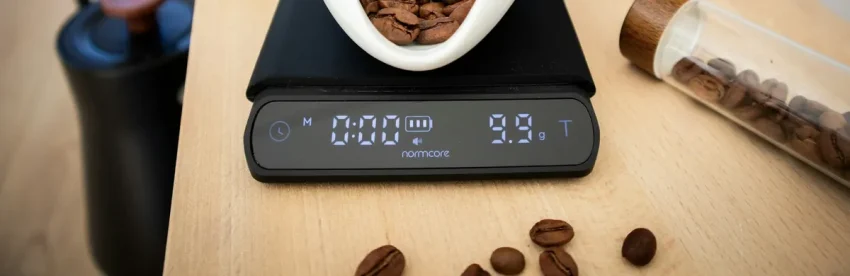
Every brewing method on this site has its own ratio buried somewhere in the instructions, and they are all different numbers on purpose. I get asked constantly why a French press wants more coffee than a drip machine, so this page exists to answer that in one place instead of making you dig through eight articles.
Quick warning before the table: these are starting points backed by the actual standards bodies and the specific numbers I use in my own detailed guides, not folklore. Adjust from here to your own taste. Nobody’s palate reads a spec sheet.
The ratios, method by method
| Method | Ratio (coffee:water) | In practice |
|---|---|---|
| Drip / pour-over | 1:15 to 1:18 | ~15 g (2 tbsp) per 8 oz (240 ml) |
| French press | 1:15 | 30 g per 450 ml (15 oz) |
| AeroPress | 1:16 | 15 g (2 tbsp) per 8 oz (240 ml) |
| Moka pot | 1:7 to 1:10 | fill the basket level, water to the safety valve |
| Percolator | 1:12 to 1:24 | 1 to 2 tbsp per 8 oz (240 ml) cup |
| Cold brew concentrate | 1:5 | 100 g per 500 ml, diluted before drinking |
| Espresso | 1:2 (dose:yield) | 18 g in, 36 g out, 25 to 35 seconds |
Why the numbers are not the same number
The honest answer is contact time and pressure, not tradition. A drip machine touches the grounds with water for three or four minutes at a gentle drip. A French press steeps fully submerged for four minutes. Espresso forces water through in under 30 seconds at 9 bars of pressure. More contact time and more pressure both pull flavor out faster, so a method that extracts quickly needs less water relative to coffee to hit the same strength, and a method that extracts slowly needs more.
Espresso is the odd one out on this list and worth calling out clearly. Every other ratio here describes coffee to the total water in the brew. Espresso describes dose to yield, meaning the dry grounds you start with against the liquid that comes out the spout. There is no separate “add water” step. If you have ever wondered why 18 grams of espresso looks nothing like 18 grams of drip coffee, that is why.
How to scale a ratio up or down
The math behind every row in that table is the same: divide your total water by the ratio number to get your coffee dose. Want 500 ml of pour-over at 1:16? That is 500 divided by 16, so about 31 g of coffee. Doubling a French press recipe just means doubling both numbers, the ratio itself never changes.
This is also the fastest way to catch a bad recipe. If a method claims 1:20 and the result tastes like dishwater, or a moka pot recipe tells you to use 1:20 and it comes out weak, you already know the ratio is off before you taste a drop.
Strength is not the same thing as extraction
This is the part that trips people up most. Adding more coffee grounds makes a stronger cup. It does not make a better-extracted cup. Extraction is about how much of what is inside the grounds actually dissolves into the water, and that is controlled by grind size, water temperature, and contact time, not by how much coffee you dumped in.
A coffee that is under-extracted tastes sour and thin no matter how much you use. A coffee that is over-extracted tastes bitter and hollow no matter how little you use. Ratio sets the strength ceiling. Grind and time decide whether you actually get a good cup within that ceiling. Get the ratio in the right zone first, then fix sourness with a finer grind or more time, and fix bitterness with the opposite.
One number that matters more than people think: water temperature
200 F (93 C), give or take 5 degrees, is the standard for anything other than espresso and cold brew. Water that is too cool under-extracts no matter how perfect your ratio is. Water straight off a rolling boil over-extracts and tastes scorched. If your kettle just clicked off, give it 30 to 45 seconds before pouring.
Want the full method, not just the number
This page is the fast lookup. For the actual technique, grind size, and troubleshooting on each method, these go deeper:
- French press: the full ratio, grind, and timing guide
- Cold brew: ratios, timing, and the coarse-grind rule
- AeroPress: grind, temperature, and both brewing methods
- Moka pot: the brewing technique that actually works
- Percolator: why it gets a bad rap, and how to fix it
- All 13 brewing methods compared
Frequently asked questions
What if I do not own a kitchen scale?
Use 1 rounded tablespoon of coffee as roughly 10 g. It is not lab-precise, but it gets you close enough on any of these ratios to taste the difference between under, over, and about right, which is the whole point of using a ratio in the first place. A cheap scale is a five-minute upgrade if you brew coffee daily.
Can I just use one ratio for everything?
No, and this is the actual reason this page exists. 1:15 is a fine French press but a weak espresso and a flooded moka pot. The method changes how fast water pulls flavor out, so the ratio has to change with it.
Should I use more coffee if I want a stronger cup?
That is the right lever, within reason. Moving from 1:17 to 1:15 will noticeably strengthen a pour-over. But if you are pushing past 1:12 on a drip method and it still tastes weak or sour, the problem has stopped being ratio and started being grind size or water temperature.
Why is cold brew’s ratio so much stronger than everything else?
Because cold water extracts far more slowly than hot water, so cold brew compensates with a long steep, 12 to 24 hours, at a much higher coffee ratio, then gets diluted before drinking. The 1:5 in the table is the concentrate you make, not the strength of the glass you actually drink.
Discussion 1
looking for a list of coffee amounts for my party perk 12-42 cups
thank you in advance