Affiliate disclosure: As an Amazon Associate, TalkAboutCoffee earns from qualifying purchases. Our picks are based on editorial judgment, not commission rates.
I bought a Breville Bambino Plus in 2022 for $499 and have pulled roughly 4,000 shots from it since. The portafilter is a little wobbly, the steam wand could be longer, and the espresso it produces is genuinely good. That is the honest summary of why Breville has earned its spot as the most-recommended brand of home espresso machine: their entry-level units make real espresso at price points where almost every competitor fails.
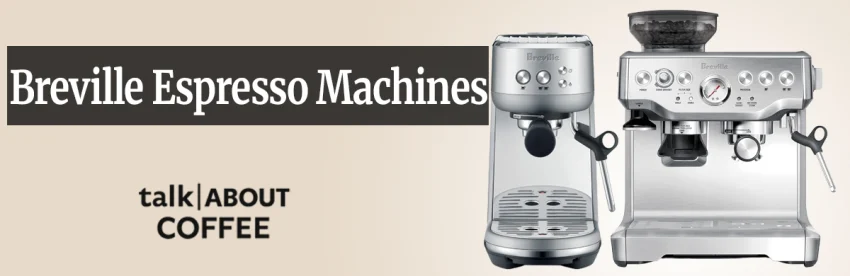
Here’s the current Breville espresso lineup, what each machine is actually good at, and which ones are worth the money.
Breville Bambino ($300) and Bambino Plus ($500)
The Bambino is the cheapest Breville espresso machine that makes real espresso, and it’s the single most-recommended entry-level home espresso machine in the home barista world. 54mm portafilter (slightly smaller than commercial 58mm but workable), thermojet heating that’s ready in 3 seconds, a real steam wand with automatic milk texturing on the Plus.
The base Bambino at $300 is the value pick. The Bambino Plus at $500 adds automatic milk texturing (you stick the wand in cold milk, press a button, walk away). Whether the Plus is worth $200 more depends on how much you care about being involved in the milk texturing process. For new espresso users, automatic milk texturing is the difference between drinkable cappuccinos and frustrating ones. For people who want to learn manual steam wand technique, the base Bambino is fine.
What both Bambinos don’t include: a grinder. You’ll need a separate grinder, ideally a Baratza Encore ($170) or Breville Smart Grinder Pro ($200).
Breville Barista Express ($700-800)
The single most-popular home espresso machine in North America. It has a built-in conical burr grinder, a 58mm portafilter, a steam wand, and a dose-control system that grinds straight into the portafilter at the press of a button. For people who want one device that handles the entire bean-to-shot workflow, this is the standard.
Tradeoffs vs. the Bambino + separate grinder approach: the Barista Express’s built-in grinder is decent but not as good as a dedicated Baratza or Encore. If grind quality matters to you (it does, more than any other variable in espresso), a Bambino + Encore at the same total price gives you better espresso than the Barista Express.
That said: the Barista Express is genuinely good, and the integrated workflow is more pleasant for most users than juggling two appliances. If you’re going to ignore my advice and not buy a separate grinder, the Barista Express is the right machine for you.
Breville Barista Pro ($900) and Touch ($1,200)
The Pro and Touch are upmarket variants of the Barista Express. The Pro adds the thermojet heating system (faster preheat) and a brighter display. The Touch adds a touchscreen interface and saved drink profiles.
Honest assessment: neither produces meaningfully better espresso than the Barista Express. You’re paying for convenience features. For someone with the money and a desire for a polished UX, fine. For someone trying to optimize espresso quality per dollar, the Barista Express + a separate grinder is the better path.
Breville Dual Boiler ($1,600) and Oracle ($2,500-3,000)
This is where Breville enters the prosumer category. The Dual Boiler has separate boilers for espresso brewing and steam, which means you can pull a shot and steam milk simultaneously. The Oracle is a Dual Boiler with an integrated grinder and automatic tamping.
Both machines pull excellent espresso, comparable to commercial-level results (and our guide to pulling the perfect espresso shot covers the technique that turns a Breville into a consistent daily driver) when used well. The Dual Boiler at $1,600 is a serious enthusiast machine. The Oracle’s price is hard to justify against, say, a Rocket Appartamento ($1,800) plus a separate grinder, which would produce equivalent or better espresso.
For an enthusiast who’s outgrown a Bambino and wants more capability without leaving the Breville ecosystem, the Dual Boiler is the move.
Breville drip coffee makers
Breville also makes drip coffee makers, including the Precision Brewer ($350) and the Grind Control ($400, with built-in grinder). The Precision Brewer is SCA-certified, brews with controlled temperature, and produces excellent drip coffee. It’s overkill if you only want a basic morning brewer but worth the money for someone who appreciates the difference between mediocre drip and good drip.
For most home drip needs, a Technivorm Moccamaster ($330) or Bonavita 8-cup ($150) is a better value than the Breville drip lineup. Breville’s strength is espresso, not drip.
My actual recommendation
For someone who wants to start making real espresso at home: Bambino Plus ($500) + Baratza Encore ESP ($230). Total: $730. This will produce real espresso, real milk drinks, and last 5+ years if you descale regularly.
For someone who wants the all-in-one experience: Barista Express ($700-800). Self-contained, no separate grinder needed, decent espresso.
For someone with the budget and the interest to go deeper: Dual Boiler ($1,600) + a serious external grinder. Production-quality espresso for a serious home setup.
For under $200: skip the bottom of the Breville range and get a moka pot ($35) or AeroPress ($35) instead. Cheap espresso machines, including cheap Brevilles, will frustrate you.
For pre-2015 Breville models you might find used: most are still decent but Breville’s modern lineup is meaningfully improved. A used Barista Express from 2014 for $250 is a fine starter machine. A used Cafe Roma (an entry-level model from a decade ago) for $100 is probably going to disappoint you.
The brand has earned its reputation for putting real espresso capability into homes at price points the competition can’t match. Worth the money, with the caveat that you also need to invest in fresh beans, a grinder, and the time to actually learn to dial in your shots.
Discussion 2
my 800ESXL has stopped working. Where can I get it repaired. I live in the Richmond, Charlottesville, Fredericksburg Virginia area. Do you know of a local resturant that uses the Breville machines so that I can contact the to find out where they get their machines repaired.
Interesting article, I was surprised to learn that such a great line of machines is made in CHINA