
Affiliate disclosure: As an Amazon Associate, TalkAboutCoffee earns from qualifying purchases. Our picks are based on editorial judgment, not commission rates.
Bodum is a name manual-coffee people trust, mostly for its French presses, so when it released the Bistro Electric Pour Over, a $250 machine that promised to bring proper pour-over technique to a push-button box, it was worth paying attention to. The honest verdict, years on: it made genuinely good coffee and looked like nothing else on the counter, but it had a couple of real quirks, and Bodum has since discontinued it. This is written for the people who own one, or are eyeing a used unit, and want to know what they are getting into.
What it was, and what made it good
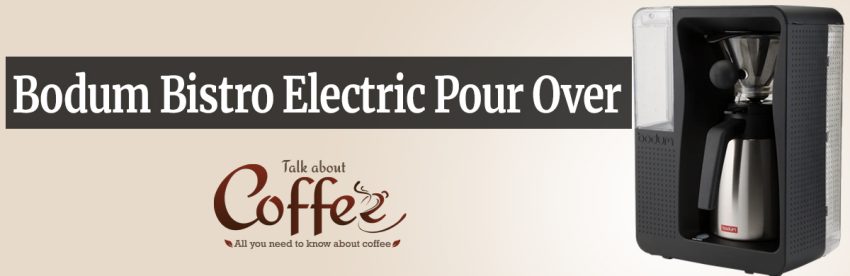
The Bistro Electric Pour Over was exactly what the name says: an electric machine that mimicked hand pour-over. It heated water to the right brewing range, around 195 F (90 C), which is the temperature most cheap drip machines fail to reach, and it distributed that water over the grounds through a circular showerhead rather than a single dribble, for more even extraction. It brewed a 40 oz batch into an insulated carafe in about three and a half minutes, and it came with a gold-plated metal filter instead of paper. The retro, transparent-plastic, brightly colored cube look was polarizing, but plenty of people loved it. On the two things that actually determine coffee quality, temperature and even water distribution, it genuinely delivered, which is why owners tend to speak fondly of the coffee it made.
The metal filter, the oils, and your cholesterol
The gold-toned metal filter is the Bistro’s signature, and it is a real trade-off worth understanding. A metal filter lets more of coffee’s natural oils through than paper does, which gives you a fuller, richer body in the cup. Some people love that; others find it slightly muddy and prefer the cleaner, brighter cup a paper filter produces. That part is just taste.
There is one health wrinkle, though, and a reader raised it directly. Those oils that a metal filter lets through contain cafestol, a compound that can raise LDL cholesterol. Paper filters trap it; metal filters do not. So if you are watching your cholesterol, this is worth knowing. The good news is you are not stuck: you can drop a paper cone filter into the Bistro’s basket and get the cleaner, cafestol-free cup while keeping the machine. We get into the full filter-and-cholesterol picture in our guide to coffee filters.
Common problems and fixes
- The lid blows off and sprays grounds at the end of the brew. This is the most alarming Bistro complaint, a burst of steam near the end of the cycle popping the lid and flinging wet grounds across the machine and counter. It usually comes down to two things: overfilling the water reservoir past its line, which builds too much steam, and the carafe lid or brew basket not being seated fully so pressure has nowhere to vent gently. Fill to the marked line, make sure every piece is clicked firmly into place, and it should stop. If it persists on a specific unit, that one may have a failing seal, and on a discontinued machine that is hard to fix.
- White particles in the water. Another owner noticed tiny white bits when running the machine without coffee. That is almost always mineral scale from hard water, or harmless residue on a new machine. Run a descaling cycle of equal parts white vinegar and water with no grounds, then two cycles of plain water to rinse. If it is a brand-new unit, a couple of plain-water rinse cycles before first use clears any manufacturing residue.
- Weak or uneven coffee. As with any drip machine, this is usually grind or dose. Use a medium grind and enough coffee, and descale regularly, since scale drops the brewing temperature that was this machine’s main advantage in the first place.
Getting the best out of it
If you have a working Bistro, a few habits make the most of it. Grind fresh and grind medium, since the machine’s even showerhead and correct temperature can only shine if the coffee going in is fresh and consistently sized; stale or unevenly ground coffee wastes the machine’s main strengths. Warm the carafe with a splash of hot water before brewing if you like your coffee piping hot, because even an insulated carafe pulls a little heat from the first pour. And descale on a schedule, monthly in hard-water areas, because scale is what quietly kills the 195 F brewing temperature that justified the price in the first place. Do those, and it brews about as well now as it did new.
Bistro versus doing it by hand
It is fair to ask why you would spend $250 on a machine to mimic pour-over when a $30 ceramic dripper and a kettle do the same thing. The answer is consistency and walk-away convenience. A hand pour-over, done well, can beat the Bistro, but it demands your attention and a steady pour every single morning. The Bistro automated the two variables most people get wrong by hand, water temperature and even saturation, and let you press a button and leave. That is the whole pitch of an electric pour-over: not better than a careful hand brew, but more repeatable than a rushed one, with no technique required.
Can it brew a single cup?
No, and this trips people up. The Bistro Electric Pour Over brews a full carafe, not one cup at a time; it is a batch brewer with a nicer temperature and shower system, not a single-serve machine. A reader weighing it against a single-cup Breville had the categories crossed. If what you actually want is one cup on demand with no leftover pot, that is a pod or single-serve machine, and we cover those in the best single-serve coffee makers guide. If you want a good carafe of drip-style coffee, the Bistro was aimed squarely at you.
The verdict, and what to buy now
When it worked as intended, the Bistro made some of the best coffee you could get from an electric brewer, and it did it with real style. But it is discontinued, used units carry the lid-and-seal risk described above, and replacement parts are scarce. So it is not a machine to hunt down new, even though owners who have a good one are right to keep enjoying it.
If you are shopping today for what the Bistro was going for, an electric brewer that actually hits proper temperature and distributes water evenly, that whole category has matured. The current SCA-certified drip machines do the same job with better reliability, and a certified home brewer is the modern equivalent. We round up the ones worth owning, including thermal-carafe picks, in our best coffee makers for home and office.
Frequently asked questions
Can I use a paper filter in the Bodum Bistro?
Yes. You can seat a cone paper filter in the basket instead of, or on top of, the metal filter. That gives you a cleaner cup and removes the cafestol oils that can raise cholesterol, if that is a concern for you. You lose a little body, which is the whole trade-off between metal and paper.
Is it still made?
No. Bodum discontinued the Bistro Electric Pour Over, so new units are hard to find and parts are scarce. Bodum still makes its well-loved French presses and other manual gear, but this electric model is out of production.
Why is my coffee cloudy or oily with sediment?
That is the metal filter doing its job. Unlike paper, it lets fine particles and coffee oils pass into the cup, which gives more body but also a cloudier look and a little sediment at the bottom. It is normal, not a fault. If it bothers you, add a paper filter, which clears both the cloudiness and the oils.
Is it worth buying used?
Cautiously. The coffee is good, but the lid-and-seal issue and the lack of replacement parts are real risks on a secondhand, out-of-production machine. If you find one cheap from someone who can show it brewing cleanly, it can be a nice find. Paying a premium for one is harder to justify when current certified brewers do the same job with a warranty.
Discussion 4
I have only had my machine for a week, but I don;t think it gives you as clear a cup of coffee , like when you use a paper filter. Especially if you are trying to lower cholesterol, I have heard that paper filtered coffee removes most of the oils.. Can you really safely use a paper filter with the Bistro B-over machine? Also I have tiny white particles coming through when I run the machine without coffee grounds. Is that from the silicone inside parts??????
I’ve had my Bodum Bistro B-over for less that 3 months. About two months ago, it developed a problem. During the last few seconds of brewing, a big burst of steam blows the plastic lid off and blows wet coffee grounds out of the gold filter, all over the machine and my kitchen. Has anyone else had this problem?
hello, I have owned (both new and used) the bodum vacuum coffee maker and love the coffee. Do you think they will ever make them again? Is this the closest I can get now to that taste??
The last paragraph leads me to believe this machine can be used for single cup brewing? Was considering a Breville YouBrew, but if this can accomodate a single cup brew I would have a decision on my hands. Thanks!